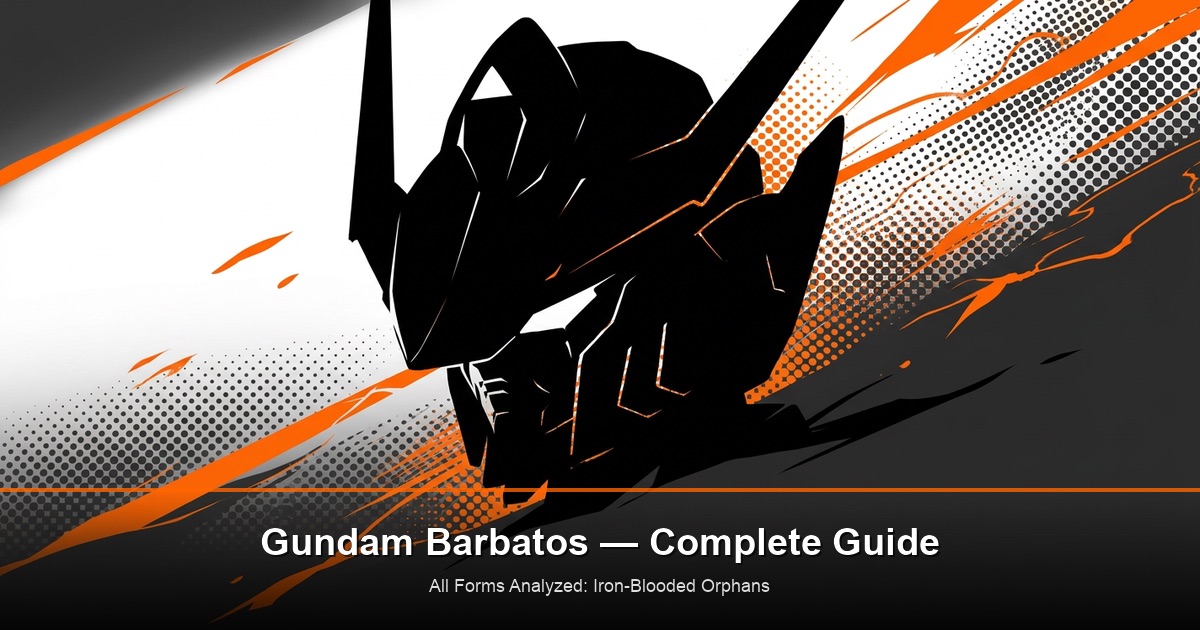
Gundam Barbatos Complete Guide— All Forms Fully Explained [Iron-Blooded Orphans]
Contents
- 01A "Demon" Awakened from 300 Years of Slumber — What Is Gundam Barbatos?
- 02Base Specifications — Gundam Frame ASW-G-08
- 03Full Form Progression — From 1st Form to Lupus Rex
- 04Detailed Breakdown of All Forms
- 1st Form — The "Skeleton" Awakened from the Desert
- 2nd Form — Stripped from the Enemy
- 3rd Form — Graze Armor on Both Shoulders
- 4th Form — The Calamity War Configuration Reborn After 300 Years
- 5th Form — Descending to Earth, Fighting Gravity
- 6th Form — The Final Battle Configuration for Edmonton
- Lupus — The "Wolf" of Season 2
- Lupus Rex — The "King of Wolves," Barbatos's Final Form
- 05Armament Catalog — The Mace Is the Soul of Barbatos
- 06Pilot — Mikazuki Augus
- 07Variations — The Barbatos Lineage
- 08Design Secrets — Naohiro Washio's Vision of "A Gundam That Fights with a Mace"
- 09Cultural Impact — "Keep Moving Forward" and the Shock of Barbatos
- 10Gunpla Guide — Complete Barbatos Kit Catalog
- 11Iconic Scene Digest
- 12Related Articles
- 13Sources
A "Demon" Awakened from 300 Years of Slumber — What Is Gundam Barbatos?
In the entire history of the Gundam franchise, only one story ends with the protagonist defeated and killed — that story is Mobile Suit Gundam: Iron-Blooded Orphans. And the mobile suit that its protagonist, Mikazuki Augus, entrusted his body to until the very end was Gundam Barbatos.
A relic of the Calamity War, buried beneath the Martian desert for 300 years with only its reactor still running. Hidden in the basement of CGS (Chryse Guard Security), a private military company staffed by child soldiers, this machine had been forgotten — reduced to nothing more than a power generator. It was only when Gjallarhorn launched its assault that Mikazuki brought the machine roaring back to life.
Through the Alaya-Vijnana System, which directly linked his brain to Barbatos, Mikazuki instantly "learned" the machine's name.
"Barbatos. That thing from earlier — that's this machine's name! Let's go, Barbatos!"
From that moment on, Barbatos became the banner of Tekkadan, charging across the Earth Sphere, breaking apart time and again, and "evolving" each time by incorporating enemy equipment. From the 1st Form to the 6th Form, then Lupus, and finally Lupus Rex — no other protagonist mobile suit in the entire Gundam franchise has undergone so many transformations.
This article provides a thorough breakdown of all eight forms of Barbatos, complete with specs, armaments, and the story episodes that defined each one.
Base Specifications — Gundam Frame ASW-G-08
Gundam Barbatos (4th Form / Closest to Calamity War Configuration)
| Item | Details |
|---|---|
| Model Number | ASW-G-08 |
| Classification | Mobile Suit with Gundam Frame |
| Affiliation | Tekkadan (formerly CGS) |
| Head Height | 18.0m |
| Base Weight | 28.5t |
| Power Plant | Ahab Reactor x2 (Twin Reactor) |
| Armor Material | Nanolaminate Armor |
| Frame | Gundam Frame |
| Pilot | Mikazuki Augus |
| Designer | Naohiro Washio |
| First Appearance | Mobile Suit Gundam: Iron-Blooded Orphans Episode 1 (2015) |
Reading the Spec Sheet — The Unique Rules of the IBO Universe
In the world of Iron-Blooded Orphans, unlike previous Gundam series, official figures for generator output and thruster thrust are not provided. This reflects the in-universe setting of a world where technology has regressed following the Calamity War.
Instead, the following elements are key to understanding mobile suit performance:
- Ahab Reactor: Gundam Frames are equipped with two reactors. While standard mobile suits operate with a single reactor, running two in parallel provides overwhelming power output. However, synchronizing two reactors is extraordinarily difficult, and even during the Calamity War era, only 72 Gundam Frames were ever manufactured.
- Nanolaminate Armor: A special armor that utilizes Ahab Waves generated by the Ahab Reactor. Because it renders beam weapons ineffective, the IBO universe is dominated by ballistic weapons and melee armaments.
- Alaya-Vijnana System: A piloting interface that surgically implants nanomachine terminals into the pilot's spinal cord, directly linking the nervous system to the mobile suit's computer. Barbatos is equipped with this system, and Mikazuki underwent the implant procedure three times.
Full Form Progression — From 1st Form to Lupus Rex
The defining characteristic of Barbatos is that its equipment and exterior change as the story progresses. Rather than the protagonist switching to a new machine, the same unit grows by absorbing enemy parts — a narrative device unique to Iron-Blooded Orphans.
| Form | Head Height | Base Weight | First Appearance | Key Changes |
|---|---|---|---|---|
| 1st Form | 18.0m | 28.5t | Episode 1 | Freshly excavated frame. Minimal armor |
| 2nd Form | 18.0m | 29.6t | Episode 4 | Graze shoulder armor added |
| 3rd Form | 18.0m | 29.9t | Episode 10 | Graze armor on both shoulders. Improved defense |
| 4th Form | 18.0m | 28.5t | Episode 13 | Restored based on Calamity War data |
| 5th Form | 18.0m | 29.1t | Episode 19 | Ground combat adaptation. Leg thrusters added |
| 5th Form (Ground Type) | 18.0m | 30.5t | Episode 19 | Heavy armament variant with smoothbore cannon |
| 6th Form | 18.0m | 30.8t | Episode 24 | Major chest/shoulder armor reinforcement. Heel-type legs |
| Lupus | 19.0m | 29.1t | Episode 27 (S2 Ep.1) | Full overhaul based on Mikazuki's combat data |
| Lupus Rex | 19.3m | 32.1t | Episode 37 | Final refit after the Hashmal battle. Tail Blade equipped |
Comparing head heights across all forms, the first six forms are uniformly 18.0m, but Lupus grows to 19.0m and Lupus Rex to 19.3m. This indicates that the later upgrades involved not just adding exterior parts but extending the frame itself — a large-scale structural overhaul.
Detailed Breakdown of All Forms
1st Form — The "Skeleton" Awakened from the Desert
This is Barbatos as it appeared when Mikazuki first activated it for combat, after it had spent 300 years operating solely as a power generator in the basement of the CGS base on Chryse, Mars.
Armor coverage is minimal, and much of the Gundam Frame's internal structure is exposed, giving it the appearance of a gaunt skeleton. This "visible skeleton" design served dual purposes: it conveyed the realism of a machine that had received no maintenance for three centuries, and it provided a visual mechanism for showing "growth" as armor was added throughout the story.
Its armaments consisted only of a mace and a shoulder-mounted gauntlet. Yet thanks to the reflexes granted by Mikazuki's Alaya-Vijnana connection and the raw power of the Gundam Frame, it overwhelmed Gjallarhorn's Graze squadron.
2nd Form — Stripped from the Enemy
When the boys of CGS reformed as "Tekkadan," they salvaged armor plates from a Gjallarhorn Graze destroyed in their first battle and mounted them on Barbatos's left shoulder.
The act of capturing parts from enemy machines and grafting them onto their own embodies Tekkadan's identity as "those who have nothing" — child soldiers, not a proper army. The mismatched look of a green Graze plate bolted onto Barbatos's white frame was awkward, and that very awkwardness made it feel real.
3rd Form — Graze Armor on Both Shoulders
Building on the 2nd Form, a second set of Graze armor was added to the opposite shoulder. As space combat became more frequent, this field modification addressed Barbatos's defensive vulnerabilities.
The refit was led by Tekkadan's head mechanic, Yukinojo, who managed to achieve combat-viable defense using only scavenged parts. It was in this configuration that Tekkadan entered negotiations with Teiwaz, the massive Jupiter-sphere conglomerate.
4th Form — The Calamity War Configuration Reborn After 300 Years
With Teiwaz's technological resources, Barbatos underwent a major restoration based on data from the Calamity War era. This is considered the form closest to Barbatos's original appearance, and it can be thought of as the "official" Barbatos of the first half of the story.
The patchwork Graze-derived armor was removed and replaced with purpose-built Gundam Frame exterior plating. The distinctive large shoulder armor on the left side, smoothly curved surfaces, and balanced proportions — even first-time viewers could sense that "this is Barbatos's true form."
The 4th Form added a katana as a primary weapon alongside the mace. This reflected the evolution of Mikazuki's fighting style from pure mace strikes to a combination of bludgeoning and slashing.
5th Form — Descending to Earth, Fighting Gravity
As Tekkadan prepared for its descent to Earth, Barbatos was modified for ground combat. Thruster units were added to the legs to provide stability under gravity, shifting away from the space-oriented mobility of the 4th Form.
A "Ground Type" variant also existed, equipped with a 300mm smoothbore cannon for situations requiring fire support in a heavy armament configuration.
6th Form — The Final Battle Configuration for Edmonton
For the climactic Edmonton battle at the end of Season 1, Tekkadan's maintenance crew and Teiwaz engineers pooled their resources to produce this ultimate equipment loadout.
The visual transformation is dramatic. Chest and shoulder armor were massively reinforced, giving the upper body a distinctly bulkier silhouette. The legs were reshaped into a heel configuration, and boosters were attached to the waist. A new weapon was added: the Wrench Mace — an oversized specialty mace with a built-in chainsaw mechanism at its tip.
The 6th Form represents the "completed" Barbatos of Season 1. The progression from the 1st Form — with its exposed internal structure — to the fully armored 6th Form serves as a visual metaphor for Tekkadan's own journey from a ragtag group of nobodies to a force to be reckoned with.
Lupus — The "Wolf" of Season 2
| Item | Details |
|---|---|
| Official Name | Gundam Barbatos Lupus |
| Head Height | 19.0m |
| Base Weight | 29.1t |
| First Appearance | Season 2 Episode 1 (Episode 27 overall) |
"Lupus" is Latin for "wolf." At the start of Season 2, Teiwaz's engineering division conducted an exhaustive analysis of Mikazuki's combat data and completely overhauled the unit to optimize it for Mikazuki's close-combat fighting style.
The most striking visual change is the longer, sharper limbs and a shift from the previous rounded armor to an angular, aggressive silhouette. Head height increased from 18.0m to 19.0m, and the overall proportions transformed from "warrior" to "beast."
A new primary weapon — the Sword Mace — was equipped. Despite being classified as a mace, it features a blade, enabling both bludgeoning and slashing attacks — a weapon that perfectly embodies Mikazuki's "smash and slash" fighting style. Additionally, a 200mm cannon was built into the left arm, allowing ranged fire between melee engagements.
Lupus's true value lies in the heightened "synchronization rate" with Mikazuki through the Alaya-Vijnana System. The more Mikazuki focused his consciousness, the faster the machine responded, overwhelming enemies with superhuman movements — but the cruel trade-off was that Mikazuki's body gradually lost function when he was not piloting, deepening the story's tragic dimension.
Lupus Rex — The "King of Wolves," Barbatos's Final Form
| Item | Details |
|---|---|
| Official Name | Gundam Barbatos Lupus Rex |
| Head Height | 19.3m |
| Base Weight | 32.1t |
| First Appearance | Season 2 Episode 12 (Episode 37 overall) |
"Rex" is Latin for "king." Lupus Rex — "King of Wolves" — is Barbatos's ultimate and final form.
After Lupus was heavily damaged in the fierce battle against the Mobile Armor Hashmal, Teiwaz rebuilt it. But "rebuilt" hardly does it justice. The armor became heavier across the entire body, the limbs grew even larger, and while traces of the original Barbatos remained, the silhouette had clearly evolved into something that could only be described as a "beast" or a "demon."
The most significant new weapon is the dorsal Tail Blade. As its name suggests, it extends from the machine's back like a tail — a wire-guided blade that Mikazuki controls freely through his Alaya-Vijnana neural link. Both arms also house sub-arms that can deploy to grab and throw enemies in close combat.
The tips of the hands and feet feature claw-like structures called Rex Nails, capable of tearing through enemy armor bare-handed. The primary weapon — the Ultra-Large Mace — exceeds Barbatos's own total height in size, less a blunt instrument than a massive slab of iron.
Lupus Rex is inseparable from Mikazuki's condition in the story's final arc — fighting on even after losing sight in his right eye and all sensation in his right arm. A machine that pushes its performance to the absolute limit while consuming its pilot's body — this was the cruelest proof that Barbatos bears the name of a demon.
Armament Catalog — The Mace Is the Soul of Barbatos
Full Armament Comparison Table
| Weapon | Forms Used | Type | Features |
|---|---|---|---|
| Mace | 1st–6th Forms | Melee (Impact) | The symbol of Barbatos. Effective against Nanolaminate Armor |
| Katana | 4th–6th Forms | Melee (Slash) | Added after Teiwaz refit. Japanese sword style |
| Gauntlet | 1st–3rd Forms | Melee/Defense | Left arm-mounted. Enhances punch power + doubles as shield |
| 300mm Smoothbore Cannon | 5th Form (Ground Type) | Ranged | Waist-mounted. Anti-MS artillery |
| 170mm Machine Gun | 6th Form | Ranged | Chest-mounted. Suppressive fire |
| Wrench Mace | 6th Form | Melee (Impact/Cut) | Oversized mace with built-in chainsaw mechanism |
| Sword Mace | Lupus | Melee (Impact/Slash) | Hybrid weapon combining blunt force and blade |
| 200mm Cannon | Lupus | Ranged | Built into left arm. Used between melee exchanges |
| Ultra-Large Mace | Lupus Rex | Melee (Impact) | Massive bludgeon exceeding the unit's total height |
| Tail Blade | Lupus Rex | Slash/Grapple | Dorsal wire-guided blade. Controlled via Alaya-Vijnana |
| Rex Nails | Lupus Rex | Melee | Claws on hands and feet. Tear through armor bare-handed |
| Sub-Arms | Lupus Rex | Melee/Grapple | Arm-mounted. Deploy to grab enemies |
| Arm-Mounted 200mm Cannon | Lupus Rex | Ranged | Inherited from Lupus. Arm-equipped |
The Mace — The Simplest and Most Savage Weapon in Gundam History
You cannot talk about Barbatos without talking about the mace. Not a beam saber. Not a beam rifle. Just a slab of iron, swung to crush the enemy — this raw simplicity is Barbatos's greatest identity.
In the IBO universe, where Nanolaminate Armor renders beam weapons useless, high-mass physical impact is the most effective form of attack. The Barbatos mace embodies this rule. The sight of Mikazuki bringing his mace down to crush an enemy cockpit delivered a visceral shock to fans — a kind of "grimy violence" never before seen in Gundam.
The mace evolved with each form. From the rudimentary original mace to the chainsaw-equipped Wrench Mace (6th Form), the blade-integrated Sword Mace (Lupus), and finally the Ultra-Large Mace (Lupus Rex) that towers over Barbatos itself. A blunt weapon as the protagonist mobile suit's signature armament — across the entire Gundam franchise, Barbatos stands alone in this regard.
Katana — Teiwaz Craftsmanship
A Japanese-sword-style melee weapon added from the 4th Form onward. Teiwaz restored it based on Calamity War-era data, and Mikazuki would sometimes fight dual-wielding the mace and katana. The contrast between the katana's cutting precision and the mace's crushing weight added both tactical depth and visual beauty to Barbatos's combat repertoire.
Tail Blade — The Tail of the "King of Wolves"
The signature weapon of Lupus Rex. A large wire-guided blade extending from the back, controlled freely by Mikazuki's brainwaves through the Alaya-Vijnana System. It is a weapon that no ordinary pilot could control — only someone like Mikazuki, who underwent the Alaya-Vijnana procedure three times, pushing his body modification to its limit, can wield it. In the series, it proved devastating when engaging multiple enemies simultaneously.
Rex Nails — A Demon That Kills Bare-Handed
Claw-like structures on the hands and feet of Lupus Rex. Even when all weapons are lost, these claws can tear enemies apart — the component that most embodies Barbatos's "demonic nature." In the final battle, as Barbatos lost weapon after weapon, it was the Rex Nails that kept clawing at enemy machines.
Pilot — Mikazuki Augus
Profile
| Item | Details |
|---|---|
| Name | Mikazuki Augus |
| Age | Estimated 15–16 (Season 1) → 17–18 (Season 2) |
| Voice Actor | Kengo Kawanishi |
| Affiliation | CGS 3rd Group → Tekkadan |
| Mobile Suit | Gundam Barbatos (all forms) |
| Alaya-Vijnana Procedures | 3 (among the highest count in the series) |
"What Should I Do Next, Orga?"
Mikazuki Augus is a fundamentally different kind of Gundam protagonist.
Amuro Ray had the conflict of "I don't want to fight." Kira Yamato carried the anguish of "I don't want to pull the trigger." But Mikazuki has almost none of that internal struggle. For him, combat is simply an extension of the daily survival he has known since childhood, and he shows almost no emotional turmoil.
Instead, Mikazuki's entire motivation is distilled into his bond with Orga Itsuka.
"What should I do next, Orga?"
This question is repeated throughout the series, and on the surface it makes Mikazuki appear as if he has chosen to be Orga's "tool." But in reality, for Mikazuki — who could not even read or write — Orga was "the person who gave my life meaning." The words Mikazuki speaks in the final battle prove this:
"Right now, I have the meaning that Orga gave me."
The Alaya-Vijnana System — The Cost of Ceasing to Be Human
The Alaya-Vijnana System is a piloting interface that surgically implants nanomachine terminals into the pilot's spinal cord, directly linking the nervous system to the mobile suit's computer. Its name derives from the Mahayana Buddhist concept of "alaya-vijnana" — the deepest layer of unconscious awareness, a shared storehouse consciousness that transcends the individual.
Through this system, a pilot can operate a mobile suit as a literal extension of their own body. It achieves reaction speeds on an entirely different level from conventional stick-and-pedal controls, and the pilot can even directly perceive the machine's condition as physical sensation.
But the cost is severe. The procedure has a high success rate only when performed on children during their growth period; failure can leave permanent physical disabilities. Furthermore, the deeper the neural connection, the greater the physical burden on the pilot. In Mikazuki's case, the following symptoms manifested in the latter half of the story:
- Loss of sight in his right eye: Overload during the Hashmal battle left him unable to see out of his right eye when not piloting
- Paralysis of his right arm: Similarly, his right arm became immobile outside of Barbatos
- Barbatos dependency: While piloting, his body functioned normally; once he dismounted, he was partially paralyzed. Barbatos had become a literal "part of Mikazuki's body"
Mikazuki accepted this condition and fought to the very end. Each time he boarded Barbatos, he lost more of his ability to function as a human being — and yet he never once hesitated. This "willingness to stop being human" is what elevated Barbatos from a mere robot to a "demon" that devours its pilot's life.
Mikazuki's Relationships with Other Characters
Beyond Orga, several other relationships are essential to understanding Mikazuki.
- Atra Mixta: Tekkadan's cook. For Mikazuki, she represents one of his few connections to "everyday life." Despite his limited emotional expression, Mikazuki occasionally showed a gentle face only around Atra. Their son, Akatsuki, is depicted in the story's epilogue as the one who inherits Tekkadan's legacy.
- Kudelia Aina Bernstein: The young noblewoman who championed Martian independence. Her relationship with Tekkadan evolved from "escort target" to "comrade." Mikazuki could not understand Kudelia's "power of words," but he respected her nonetheless.
- Akihiro Altland: Pilot of the Gushion and Mikazuki's most trusted comrade in battle. Two men of few words, fighting back to back — they formed one of IBO's most iconic duos. In the final episode, both perish, but they protect each other's backs to the very end.
"You can meet the dead after you die, so do what you can for the ones still alive."
This line was originally spoken by Orga to a young Mikazuki, but later in the series Mikazuki returns it to Orga — a moment celebrated as one of the series' most powerful lines, symbolizing the depth of their bond.
Mikazuki's End
The final episode (Episode 50, "Their Place"). Under concentrated Dainsleif (ultra-long-range railgun weapon) fire from the Arianrhod Fleet, Mikazuki launches a solo charge in Lupus Rex.
Dainsleif rods pierce the machine's body, armor shatters, the Tail Blade is severed, sub-arms are destroyed — and still Barbatos presses forward. In the final duel against Julieta Juris's Reginlaze Julia, Mikazuki is already losing consciousness, yet Barbatos continues to move.
The last thing to fall from Mikazuki's hand is the leather bracelet given to him by his Tekkadan comrades. The story closes with the image of that bracelet, still wrapped around his left wrist, stained with blood.
After the battle, Barbatos's wreckage is shown standing in a field of flowers, weathered and still. The machine once feared as a demon, now resting quietly amid blossoms — it is the defining image of Iron-Blooded Orphans.
Variations — The Barbatos Lineage
Barbatos During the Calamity War
The form in which Barbatos was deployed in combat during the Calamity War approximately 300 years ago (around P.D. 323) is believed to be closest to the 4th Form. During the Calamity War, 72 Gundam Frames were fielded as trump cards against Mobile Armors, and Barbatos was one of them.
Manufacturing a Gundam Frame required overcoming the immense technical challenge of synchronizing two Ahab Reactors in parallel operation. Even with the advanced technology of the Calamity War era, only 72 units were ever produced. Each was registered under the name of one of the 72 demons of the Ars Goetia, and Barbatos bears the name of the 8th — "a duke who appears in the guise of a hunter and commands 30 legions."
The pilot during the Calamity War is unknown. After the war ended, Barbatos was transported to Mars, where it gradually became buried underground and was used as CGS's power source. The fact that its Ahab Reactor continued running for 300 years speaks to the extraordinary durability of the Gundam Frame. Because an Ahab Reactor, once activated, operates semi-permanently, Barbatos was in effect "buried alive."
Gundam Frame Siblings
Barbatos is named after the demon "Barbatos," ranked 8th in the Ars Goetia, and the "08" in ASW-G-08 corresponds to this ranking. The following Gundam Frame units appeared in the series:
| Model Number | Name | Demon Origin (Rank) | Pilot |
|---|---|---|---|
| ASW-G-08 | Gundam Barbatos | Barbatos (8th) | Mikazuki Augus |
| ASW-G-11 | Gundam Gusion | Gusion (11th) | Kudal Cadel → Akihiro Altland |
| ASW-G-66 | Gundam Kimaris | Kimaris (66th) | Gaelio Bauduin |
| ASW-G-01 | Gundam Bael | Bael (1st) | McGillis Fareed |
| ASW-G-64 | Gundam Flauros | Flauros (64th) | Shino Harris |
| ASW-G-XX | Gundam Vidar | *Norse mythology origin | Gaelio Bauduin |
Gusion (later remodeled into Gusion Rebake and Gusion Rebake Full City) became the "second pillar of Tekkadan" alongside Barbatos, with Akihiro at the controls. The role division — Barbatos as a front-line melee fighter and Gusion as a heavy-armored fire support unit — mirrored the brother-like relationship between Mikazuki and Akihiro.
Gundam Bael (ASW-G-01) is especially symbolic. Bearing the name of the 1st-ranked demon, Bael was the machine piloted by Agnika Kaieru, founder of Gjallarhorn, and carries the legend that "whoever pilots Bael commands Gjallarhorn." McGillis Fareed's rebellion, launched upon claiming Bael, is a tragedy that runs parallel to the story of Barbatos and Mikazuki.
Barbatos's Final Battle Configuration
In the final episode, Lupus Rex charges the Arianrhod Fleet already battered beyond recognition. Fighting with only the Tail Blade and Rex Nails remaining, it presses forward even after losing all armaments. Among fans, this "Final Battle Configuration" — virtually weaponless, armor stripped away — is beloved as its own distinct "form."
Design Secrets — Naohiro Washio's Vision of "A Gundam That Fights with a Mace"
Mechanical Designer Naohiro Washio
Gundam Barbatos was designed by mechanical designer Naohiro Washio. Known for his work on Eureka Seven, Washio's first time designing the lead mecha for a Gundam series was Iron-Blooded Orphans.
The "Demon" Concept
Director Tatsuyuki Nagai's request was for "a design that appeals to modern audiences while retaining a distinct Gundam identity." Washio responded with the following approach:
- Visible internal frame: By exposing the Gundam Frame's skeletal structure through gaps in the exterior armor, he achieved both mechanical realism and a sense of "ferocity"
- Sloping shoulders: While recent Gundam designs tend toward broad, prominent shoulders, Director Nagai requested a sloped silhouette. This gave Barbatos a distinctly "feral" impression unlike other Gundams
- Vintage car imagery: Washio has described his concept as: "If the Graze is a cutting-edge sports car, then Barbatos is like a 1960s–70s Porsche 917 — old, but powerful"
- Growth expressed through form changes: Starting with minimal armor and an exposed skeleton, the machine gains more armor as the story progresses. This "dress-up" mechanism was designed with both narrative intent and Gunpla product development in mind
Why a Mace?
The reason Barbatos's primary weapon is a mace (a blunt weapon) is directly linked to the Nanolaminate Armor setting. In a world where beams are ineffective, high-mass physical impact is the most effective attack — working backward from this world-building premise, the unprecedented fighting style of "a Gundam that crushes enemies with a mace" was born.
In a 2015 interview, Naohiro Washio discussed the "Gundam that fights with a blunt weapon" concept, noting that he consciously sought to differentiate it from the traditional Gundam image of "elegantly cutting with a beam saber."
Design Philosophy Across Eight Forms
The 1st Form's skeleton-like, exposed-frame appearance was meant to represent the starting point of Mikazuki — and Tekkadan — as "those who have nothing." From there, they steal enemy parts (2nd and 3rd Forms), restore the machine's original form with Teiwaz technology (4th Form), adapt to Earth's gravity (5th Form), prepare for a decisive battle (6th Form), optimize for the pilot's combat instincts (Lupus), and finally awaken as the "King of Wolves" (Lupus Rex).
The evolution of the machine is perfectly synchronized with the progression of the story — this is the defining characteristic of Barbatos's design, and it was a narrative device never before seen in the Gundam franchise.
Color Scheme Evolution
Barbatos's base color scheme is a white-dominant "tricolor" palette accented with blue and red, but the color balance shifts with each form change:
- 1st–3rd Forms: White frame mixed with green and gray from Graze-derived parts, creating a patchwork appearance
- 4th–6th Forms: White, blue, and red achieve a balanced, "proper Gundam" color scheme
- Lupus: Gold accents added to the white base. A more refined impression
- Lupus Rex: A contrast of white and dark blue. Red armor decreases, reinforcing an aggressive impression
This color evolution also mirrors the tonal shift of the story. From Season 1's "boys' adventure" to Season 2's "unavoidable tragedy" — as the machine's palette darkens, so does the narrative.
Cultural Impact — "Keep Moving Forward" and the Shock of Barbatos
The "Keep Moving Forward" Phenomenon
More so than Barbatos itself, the cultural moment that cannot be ignored when discussing Iron-Blooded Orphans is Orga Itsuka's final words: "Don't stop... keep moving forward..." ("Tomaru nja nee zo...").
This line won the Bronze Award (3rd place) at the 2017 Anime Buzzword Awards. Furthermore, in NHK's "All Gundam Poll" (2018), Orga ranked 3rd in the character category — behind only Char Aznable and Amuro Ray — a staggering result.
MAD videos pairing Orga's death scene with unrelated background music, collage images superimposing Orga's final pose onto other characters — the internet meme explosion was relentless, and Iron-Blooded Orphans became, for better or worse, the most "memed" work in Gundam history.
What matters, though, is that beneath this meme culture lies genuine fan attachment. While treating it as a meme, many viewers were deeply moved by the fates of Mikazuki and Orga. The meme phenomenon is, in a sense, proof that this is a work people simply cannot forget.
The Impact of Mace Combat — Redefining Gundam's "Violence"
For decades, the standard formula for Gundam combat scenes was beam saber duels and beam rifle exchanges. Barbatos shattered that convention.
Crushing enemy cockpits with a mace, slashing diagonally with a katana, tearing through armor with Rex Nails — Barbatos's combat was described as "grimy," "savage," and "merciless," establishing a new benchmark for combat portrayal in Gundam.
The scene in Season 2 where Lupus Rex destroys Hashmal (a Mobile Armor) with the Alaya-Vijnana limiter released is particularly iconic — a masterpiece scene where the terror of Mikazuki losing his humanity coexists with Barbatos's overwhelming combat power, and it continues to be celebrated among fans.
The "Death" of a Gundam Protagonist
Mikazuki Augus is the first Gundam protagonist to clearly die at the conclusion of the story (Kamille in Zeta Gundam suffered a mental breakdown, not death).
This ending sparked fierce debate when it aired. "A Gundam protagonist losing and dying?" came the criticism; "That's exactly what makes IBO special," countered the defenders. The very intensity of this debate is evidence of how deeply Barbatos and Mikazuki pierced viewers' hearts.
Tekkadan's "Place"
At the story's end, Barbatos's wreckage stands in a field of flowers. The demon that once served as the banner of child soldiers now sleeps surrounded by blossoms. And Mikazuki and Atra Mixta's son, Akatsuki ("Dawn"), remains as their legacy.
Barbatos is simultaneously a symbol of destruction and death, and a symbol of Tekkadan's boys who never stopped fighting for a "place to belong."
International Reception
Iron-Blooded Orphans earned enormous support from Gundam fans worldwide. Barbatos's "fights with a mace" combat style was particularly beloved in English-speaking communities, where the mace was affectionately dubbed "Mace-chan". On YouTube, compilations of Barbatos's combat scenes have accumulated millions of views.
The Lupus Rex design is especially popular among international mecha fans, with comments calling it "the coolest Gundam ever" appearing frequently on Reddit and MyAnimeList. The HG Barbatos Lupus Rex Gunpla kit has become a perennial bestseller in overseas markets.
Appearances in Video Games
Barbatos has appeared in numerous video game titles, including the Super Robot Wars series, SD Gundam G Generation series, and Gundam Breakers series. In Super Robot Wars in particular, the form changes and Alaya-Vijnana System upgrades are faithfully reproduced as game mechanics, earning the unit high marks for usability.
In 2025, Barbatos (6th Form) and Barbatos Lupus Rex appeared in G Generation Eternal, each implemented as EX units.
Gunpla Guide — Complete Barbatos Kit Catalog
HG (High Grade) 1/144 — HGIBO (Iron-Blooded Orphans)
The HG kits for Iron-Blooded Orphans are released under the "HGIBO" (HG Iron-Blooded Orphans) brand. Barbatos has been made into a kit for each form, making it a highly collectible series.
| Kit Name | Price (Tax Included) | Highlights |
|---|---|---|
| HG Gundam Barbatos | ¥1,100 | Based on 1st Form. Faithfully reproduces the visible-frame design. Ideal entry point |
| HG Gundam Barbatos 6th Form | ¥1,320 | Season 1 final form. Includes Wrench Mace. Bulky proportions |
| HG Gundam Barbatos Lupus | ¥1,100 | Season 2 lead unit. Sharp silhouette. Includes Sword Mace |
| HG Gundam Barbatos Lupus Rex | ¥1,320 | Final form. Includes Ultra-Large Mace and Tail Blade. Overwhelming presence |
The standout feature of the HGIBO series is its shared frame structure. Barbatos and the Graze use the same internal frame parts, and swapping exterior armor produces a different mobile suit — a design approach that directly reflects the in-universe setting. By purchasing multiple kits, builders can enjoy recreating the in-series form changes through parts swapping.
The top recommendation is the HG Gundam Barbatos Lupus Rex. All of Lupus Rex's signature armaments — Tail Blade, sub-arms, Rex Nails — are fully reproduced, and at ¥1,320, the value for money is extraordinary.
1/100 Full Mechanics
| Kit Name | Price (Tax Included) | Highlights |
|---|---|---|
| 1/100 Gundam Barbatos 6th Form | ¥2,750 | 1/100 scale presence. Approx. 18cm tall. Excellent frame detail |
| 1/100 Full Mechanics Gundam Barbatos Lupus | ¥3,300 | Crisp detailing. The Sword Mace's size really stands out |
| 1/100 Full Mechanics Gundam Barbatos Lupus Rex | ¥4,180 | One of the finest Full Mechanics kits. Superb Tail Blade execution |
Full Mechanics is the 1/100 scale line for the IBO series, succeeding the traditional MG role. While it lacks MG's full inner frame, removing the exterior panels reveals the frame structure underneath — a satisfying gimmick at an excellent price point.
MG (Master Grade) 1/100
| Kit Name | Price (Tax Included) | Highlights |
|---|---|---|
| MG Gundam Barbatos | ¥4,950 | Released 2019. Reproduces the 4th Form. Features a completely new inner Gundam Frame. Wide range of joint articulation enables dynamic mace-wielding poses |
The MG Gundam Barbatos drew massive attention as the first MG kit from the Iron-Blooded Orphans series. Its crowning feature is the complete recreation of the Gundam Frame. Remove all exterior armor, and the full internal skeleton appears exactly as depicted in the series. This "visible frame" gimmick is the very essence of Barbatos's design concept — an expression that only the MG grade could achieve.
In 2026, the MG Gundam Barbatos Lupus was also released, expanding the IBO MG lineup. Additionally, the METAL BUILD brand has released a die-cast finished figure of the 4th Form, with new equipment additions announced for 2026.
MGSD (Master Grade SD Gundam)
| Kit Name | Highlights |
|---|---|
| MGSD Gundam Barbatos | MG-level precision in an SD-sized package. Wide range of articulation allows fun mace action poses. The super-deformed proportions give Barbatos's ferocity an adorable twist |
Choosing the Right Kit for You
| Your Type | Recommended Kit |
|---|---|
| Gunpla beginner | HG Gundam Barbatos (¥1,100) |
| Love the Season 1 final form | HG Gundam Barbatos 6th Form |
| Want the impact of the final form | HG Gundam Barbatos Lupus Rex |
| Want 1/100 scale presence | Full Mechanics Gundam Barbatos Lupus Rex |
| Want to build the ultimate single kit | MG Gundam Barbatos |
| Want to collect them all | HGIBO complete form collection |
| SD fan | MGSD Gundam Barbatos |
Iconic Scene Digest
Episode 1 "Iron and Blood" — Awakening
Gjallarhorn assaults the CGS base. Cornered, Mikazuki boards Barbatos in the basement and activates it for the first time in 300 years. Through the Alaya-Vijnana link, he learns the machine's name and cries out, "Let's go, Barbatos!" before smashing a Graze. The series premiere and Barbatos's first battle. The scene of the mace crushing a Graze cockpit in a single blow was a declaration: "This is not the Gundam you are used to."
Episode 25 "Tekkadan" — The Battle of Edmonton
The Season 1 climax. Barbatos in its 6th Form engages in a desperate duel with Gjallarhorn's Ein Dalton (Graze Ein). Facing Ein, who has fused with his machine through the Alaya-Vijnana System, Mikazuki also releases his own Alaya-Vijnana limiter. The scene of the Wrench Mace's chainsaw tearing through Graze Ein's armor is one of IBO's greatest battles.
Episode 37 "Chryse Defense" — Lupus Rex Awakening
The devastating battle against Mobile Armor Hashmal, which destroyed Lupus and led to its rebirth as Lupus Rex. Mikazuki pushed the Alaya-Vijnana System beyond its limits to defeat Hashmal, losing the sight in his right eye and sensation in his right arm. This was the episode that made Barbatos's nature as a "demon that devours its pilot's body" definitive.
Episode 33 "King of Mars" — Hashmal Awakening
Mobile Armor Hashmal awakens from an underground ruin and begins destroying Mars's agricultural plants. Mikazuki sorties in Barbatos Lupus and voluntarily releases the Alaya-Vijnana limiter, moving beyond human limits to challenge Hashmal. The battle cost him the sight in his right eye and sensation in his right arm, but he succeeded in destroying Hashmal. This was the episode where Barbatos's "demonic nature" became most vivid.
Episode 50 "Their Place" — The Final Charge
Lupus Rex presses forward through a rain of Dainsleif fire in the final battle. All weapons lost, frame exposed, and still the Rex Nails claw at enemies. The depiction of Barbatos continuing to move even after Mikazuki has lost consciousness evoked a chilling sense that "perhaps a real demon inhabits this machine."
After the battle, Barbatos's wreckage is laid to rest in a field of flowers. The image of the demon decaying with mace still in hand distills everything that Iron-Blooded Orphans is — a single frame etched into fans' memories to this day.
Related Articles
- Zaku — Complete Mobile Suit Guide: The "mass-production unit" that changed mecha anime history. The polar opposite of Barbatos's philosophy — the beauty of mass production.
- Psycho Gundam — Complete Guide: One of the largest mobile suits in Gundam history. Shares a thematic connection with Barbatos through its system that erodes the pilot's psyche.
- Guncannon — Complete Guide: RX-77. A distinguished artillery support unit — a different class from Barbatos.
- Iron-Blooded Orphans Series Complete Guide: Full guide to the series in which Barbatos appears (coming soon).
Sources
- Mobile Suit Gundam: Iron-Blooded Orphans Season 1 TV Series, Sunrise, 2015–2016
- Mobile Suit Gundam: Iron-Blooded Orphans Season 2 TV Series, Sunrise, 2016–2017
- Mobile Suit Gundam: Iron-Blooded Orphans Official Website (g-tekketsu.com)
- Naohiro Washio Staff Interview, V-STORAGE, Bandai Namco Filmworks
- Naohiro Washio Interview "A Gundam That Fights with a Blunt Weapon: The Birth of Gundam Barbatos," MANTANWEB
- "MS Archives" Gundam Barbatos, GUNDAM.INFO, 2019
- METAL BUILD Gundam Barbatos Information, Tamashii Web (tamashiiweb.com)
- Bandai Spirits Hobby Official Website (bandai-hobby.net)
- Gundam Wiki (gundam.wiki.cre.jp)
- Pixiv Encyclopedia "Gundam Barbatos" and "Barbatos Lupus Rex"
- NHK "All Gundam Poll" Results, 2018
If you spot any errors or have updated information, please let us know. We value accuracy.