Iron-Blooded Orphans — Complete Guide— Story, Mobile Suits & Ending Explained
Contents
- 01What Is Mobile Suit Gundam: Iron-Blooded Orphans? -- Child Soldiers Fighting for a Place to Belong
- 02The P.D. (Post Disaster) World -- The Calamity War, Gjallarhorn, and Human Debris
- 03The Alaya-Vijnana System -- The Price of Power, the Interface That Devours the Body
- 04Complete Story Guide: Season 1 -- Mars's Child Soldiers Set Their Sights on Earth
- 05Complete Story Guide: Season 2 -- Glory, Betrayal, and Annihilation
- 06Complete Character Guide -- The Ensemble Cast of Tekkadan and Gjallarhorn
- 07Gundam Barbatos: All Forms -- From First Form to Lupus Rex
- 1st Form -- Awakening from 300 Years of Slumber
- 2nd through 4th Forms -- Savage Evolution Through Spoils of War
- 5th Form -- Ground Combat Configuration
- 6th Form -- Edmonton Battle Configuration
- Gundam Barbatos Lupus -- Season 2's New Form
- Gundam Barbatos Lupus Rex -- The Final Form, the Ultimate Beast
- 08Mobile Suits and Mobile Armors -- Gundam Frames and Key Machines
- 09Season 1 vs. Season 2: Structural Shift -- From a Story of Ascent to a Story of Collapse
- 10Themes and the Shocking Ending -- Why Did They Have to Die?
- 11Iconic Quotes and Scenes -- Words Etched in Memory
- 12How to Watch, Related Works, and the 10th Anniversary Project
- 13Conclusion -- What Tekkadan Left Behind
What Is Mobile Suit Gundam: Iron-Blooded Orphans? -- Child Soldiers Fighting for a Place to Belong
Mobile Suit Gundam: Iron-Blooded Orphans (commonly abbreviated as IBO) is a television anime that aired from October 2015 to April 2017 on the MBS/TBS network in Japan's Sunday 5:00 PM timeslot. Spanning 50 episodes total, it consists of two seasons: Season 1 (25 episodes, October 2015 - March 2016) and Season 2 (25 episodes, October 2016 - April 2017).
The series is directed by Tatsuyuki Nagai, known for acclaimed works such as Anohana: The Flower We Saw That Day and The Anthem of the Heart. The series composition and screenplay are by Mari Okada, Nagai's long-time collaborator in the creative group known as "Super Peace Busters." This duo, celebrated for their emotionally nuanced human dramas, brought their distinctive storytelling sensibility to the Gundam franchise.
What sets Iron-Blooded Orphans apart is its unflinching portrayal of child soldiers, poverty, exploitation, and "Human Debris" -- children sold as disposable commodities. The series culminates in an ending unprecedented in Gundam history: the protagonists lose. There is no triumph of good over evil, no victory through the hero's growth. And yet, what they leave behind changes the world. It is a bitter story, but one that resonates with profound depth long after the final credits roll.
In 2025, the series' 10th anniversary was celebrated with the theatrical release of Urdr Hunt: Trail of a Small Challenger (a special compilation) and a new short film, Interlude: The Wedge. The reunion of original staff members Nagai and Okada for this project testifies to the enduring passion that Iron-Blooded Orphans continues to inspire.
Essential Series Information
| Official Title | Mobile Suit Gundam: Iron-Blooded Orphans (Japanese: Kidou Senshi Gundam Tekketsu no Orphans) |
|---|---|
| Air Dates | Season 1: October 4, 2015 - March 27, 2016 (25 episodes) Season 2: October 2, 2016 - April 2, 2017 (25 episodes) |
| Network | MBS/TBS (Sunday 5:00 PM slot, Japan) |
| Studio | Sunrise (now Bandai Namco Filmworks) |
| Director | Tatsuyuki Nagai |
| Series Composition/Screenplay | Mari Okada |
| Original Character Design | Yu Ito |
| Character Design | Michinori Chiba |
| Mechanical Design | Naohiro Washio, Kanetake Ebikawa, Ippei Gyoubu, Tamotsu Shinohara, Kenji Teraoka |
| Music | Masaru Yokoyama |
| Season 1 OP | "Raise your flag" by MAN WITH A MISSION / "Survivor" by BLUE ENCOUNT |
| Season 1 ED | "Orphans no Namida" by MISIA / "STEEL -Tekketsu no Kizuna-" by TRUE |
| Season 2 OP | "RAGE OF DUST" by SPYAIR / "Fighter" by KANA-BOON |
| Season 2 ED | "Shounen no Hate" by GRANRODEO / "Freesia" by Uru |
| Timeline | P.D. (Post Disaster) era, years 323-325 |
| Original Creator | Hajime Yatate, Yoshiyuki Tomino |
"Hajime Yatate" is a collective pen name representing the Sunrise planning group. Yoshiyuki Tomino, while credited as original creator across all Gundam titles, was not directly involved in the production of Iron-Blooded Orphans.
Why Iron-Blooded Orphans Stands Apart in the Gundam Franchise
Conceived as a new TV series following Gundam: Reconguista in G, Iron-Blooded Orphans inhabits a completely original timeline -- the P.D. (Post Disaster) era -- with no connection to the Universal Century, Cosmic Era, or any other existing Gundam continuity. There are no Newtypes, no beam rifles, no funnels. Instead, the series features gritty close-quarters combat with blunt weapons and the visceral pain of the Alaya-Vijnana System, a neural interface implanted directly into pilots' spinal cords.
Furthermore, the protagonist Mikazuki Augus is unlike any Gundam protagonist before him. He is not introspective; he does not question why he fights. He simply follows wherever Orga leads and eliminates enemies without a shred of hesitation. This radically different kind of hero challenged everything audiences expected from a Gundam series.
The Last Gundam of the "Nichi-Go" Timeslot
The MBS/TBS Sunday 5:00 PM slot (known as the "Nichi-Go" or "Sunday Five" slot) had been a launching pad for numerous Gundam series since Mobile Suit Gundam SEED. With the conclusion of Iron-Blooded Orphans Season 2, anime programming in this timeslot came to an end entirely, making IBO the last Gundam series to occupy this historic broadcasting slot.
The P.D. (Post Disaster) World -- The Calamity War, Gjallarhorn, and Human Debris
Understanding the story of Iron-Blooded Orphans requires familiarity with its unique world-building. Here we explain the foundational elements: the Calamity War, Gjallarhorn, the Four Economic Blocs, and Human Debris.
The Calamity War -- Humanity's Self-Inflicted Catastrophe
Approximately 300 years before the events of the series, humanity pursued the automation of warfare with devastating consequences. As rival factions developed and deployed ever more advanced autonomous weapons, they eventually created Mobile Armors (MAs) -- self-directed killing machines that spiraled beyond human control. Programmed solely to exterminate humans with maximum efficiency, these weapons slaughtered indiscriminately, recognizing neither friend nor foe.
In response to this existential crisis, volunteers from various nations united to form the organization that would become Gjallarhorn. They developed 72 Gundam Frames equipped with the Alaya-Vijnana System and waged war against the Mobile Armors. Led by the legendary hero Agnika Kaieru and the ancestors of the Seven Stars families, they eventually destroyed most of the Mobile Armors and brought the Calamity War to an end.
The scars of this conflict run deep throughout P.D. civilization. Earth's population was decimated, and civilization suffered a massive regression. The trauma of the Mobile Armor threat became the foundation upon which Gjallarhorn built its absolute authority.
Gjallarhorn -- The Corrupt Guardians of the World
Gjallarhorn is the largest peacekeeping organization in the Earth Sphere, descended from the armed force that ended the Calamity War. Operating under the motto of "keeping peace through military force," it holds a monopoly on military power across all economic blocs and has the authority to intervene in conflicts.
At the apex of Gjallarhorn's power structure sit the Seven Stars -- seven aristocratic families descended from the heroes of the Calamity War. Their rank is determined by the number of "Seven Stars Medals" their ancestors earned for destroying Mobile Armors. Each family oversees a different branch of Gjallarhorn, making them the de facto rulers of the world.
However, after 300 years, Gjallarhorn has become thoroughly corrupt. The Seven Stars are consumed by internal power struggles, while the inhabitants of Mars and other frontier regions are treated as nothing more than resources to be exploited. It is this corruption that compels the child soldiers of Tekkadan to rise up.
| Seven Stars Families | Elion, Issue, Fareed, Bauduin, Baklazan, Kujan, Falk |
|---|---|
| Gjallarhorn HQ | Vingolf (orbital station in lunar orbit) |
| Key Divisions | Inspection Bureau, Outer Earth Orbit Regulatory Joint Fleet (Arianrhod Fleet), Mars Branch |
| Symbolic Figure | Agnika Kaieru (hero of the Calamity War) |
The Four Economic Blocs and Mars's Exploitation
Following the Calamity War, the Earth Sphere was divided among four major economic blocs: the African Union, SAU (Strategic Alliance Union), Arbrau, and the Oceanian Federation. While each bloc maintains nominal political independence, all operate under Gjallarhorn's watchful eye.
Mars, meanwhile, exists as a collection of settlements such as the Chryse Autonomous Region, locked into a structural relationship of resource extraction by Earth's economic blocs. Martian residents live in abject poverty, and children are consumed as expendable labor. This stark inequality between Earth and Mars is the starting point of the entire story.
Human Debris -- Children Called "Trash"
"Human Debris" is the dehumanizing term used for children bought and sold through human trafficking in frontier regions like Mars. The word "debris" -- meaning waste, refuse, garbage -- says everything about how these children are viewed: not as human beings, but as disposable labor to be used up and thrown away on battlefields.
Many core members of Tekkadan were once Human Debris. Akihiro Altland, Takaki Uno, Ride Mass, and others endured lives where they were treated as less than human. For them, Tekkadan is the first place that ever acknowledged their humanity. That is why they will lay down their lives to protect it. This fundamental premise generates the desperate urgency and tragic weight that permeates the entire series.
Nanolaminate Armor and Ahab Reactors -- A World Where Beam Weapons Are Useless
Mobile suits in the P.D. world are coated with Nanolaminate Armor, a special coating that disperses and neutralizes the energy of beam weapons. As a result, beam weapons never became the dominant armament in this timeline.
Instead, mobile suit combat revolves around physical weapons and close-quarters fighting: maces for bludgeoning, axes for cleaving, pile bunkers for punching through armor. This visceral, brutal style of combat gives Iron-Blooded Orphans its uniquely raw and powerful battle sequences.
Mobile suits are powered by Ahab Reactors -- semi-perpetual energy sources that emit Ahab Waves, which produce secondary effects including communication disruption and gravity manipulation. What makes Gundam Frames exceptional is that they carry two Ahab Reactors. While standard mobile suits operate on a single reactor, the parallel operation of two is extraordinarily difficult. The 72 Gundam Frames that achieved this feat were built as decisive weapons for the Calamity War.
The Alaya-Vijnana System -- The Price of Power, the Interface That Devours the Body
No discussion of Iron-Blooded Orphans is complete without addressing the Alaya-Vijnana System. More than a science fiction gadget, this system embodies the very themes of the series.
How It Works -- Connecting Spinal Cord to Machine
The Alaya-Vijnana System is a man-machine interface that directly connects a pilot's nervous system to a mobile suit's control systems. The procedure involves injecting nanomachines into the pilot's spinal cord and implanting a device called a "whisker" (or "pierce") into the spine.
The surgery creates a pseudo-organ in the brain that governs spatial awareness, allowing pilots to operate a mobile suit as if it were an extension of their own body. This enables reaction speeds and intuitive control far beyond conventional piloting -- but at a terrible cost.
The name "Alaya-Vijnana" derives from Buddhist philosophy. In Yogacara (consciousness-only) philosophy, the alaya-vijnana is the "storehouse consciousness" -- the deepest layer of the mind that stores the seeds of all experience beneath surface awareness. The system's nature of connecting to the subconscious depths of the pilot inspired this name.
The Cost -- What Mikazuki Lost
The Alaya-Vijnana surgery places extreme strain on the body, and the mortality rate is particularly high for those who have passed puberty. Consequently, the procedure is almost exclusively performed on children -- meaning the only ones who benefit from this system are the expendable child soldiers.
Protagonist Mikazuki Augus pushes this system to its absolute limits, suffering devastating physical consequences:
- End of Season 1 (vs. Graze Ein): After releasing the Alaya-Vijnana's limiters to achieve maximum synchronization, Mikazuki loses sight in his right eye and sensation in his right arm. These functions return only when connected to Barbatos.
- Mid-Season 2 (vs. Hashmal): After once again exceeding the system's limits in battle against the Mobile Armor Hashmal, Mikazuki loses control of his entire left side. Without connection to Barbatos, he is confined to a wheelchair.
The more Mikazuki fights, the more of his body he loses. Yet he accepts this without complaint. "I can move when I'm connected to Barbatos" -- in other words, he can only be whole as long as he keeps fighting. The moment combat ends, his body fails him. There is no crueler fate for a pilot in the entire Gundam franchise.
Alaya-Vijnana Type-E -- McGillis's Pursuit of Agnika's Power
In the latter half of the story, McGillis Fareed performs the Alaya-Vijnana Type-E surgery on himself in order to activate Gundam Bael, the symbol of Gjallarhorn. Unlike the standard Alaya-Vijnana, Type-E involves injecting nanomachines directly into the brain, making it even more dangerous.
McGillis believed that simply activating Bael would compel all of Gjallarhorn to follow him -- that whoever wielded the mobile suit said to contain the soul of Agnika Kaieru was the true leader of Gjallarhorn. This conviction would be shattered by the reality of political power.
Graze Ein -- The Alaya-Vijnana Taken to Its Extreme
The ultimate expression of the Alaya-Vijnana System appears in Season 1's finale with the Graze Ein. Gjallarhorn soldier Ein Dalton, left mortally wounded, has his body physically integrated into a Graze mobile suit, creating a complete fusion of human and machine.
Ein is no longer human -- he exists permanently as a mobile suit. This represents the most inhumane endpoint of the Alaya-Vijnana concept: "sacrificing your humanity to gain power." The climactic battle between Mikazuki and Ein in Season 1 carries deep structural meaning as a confrontation between two beings shaped by the same system.
Complete Story Guide: Season 1 -- Mars's Child Soldiers Set Their Sights on Earth
Season 1 spans 25 episodes set in P.D. 323. It follows a group of child soldiers on Mars who, through a mission to escort Kudelia Aina Bernstein, begin building a place where they truly belong.
Independence from CGS (Chryse Guard Security)
Mikazuki Augus, Orga Itsuka, and their fellow child soldiers belong to CGS (Chryse Guard Security), a private military company on Mars. Classified as "Third Group" -- the lowest tier -- they serve as human shields, deployed to the front lines as expendable troops while the adults remain safely behind.
When a contract arrives to escort Kudelia Aina Bernstein, a young woman advocating for Martian independence, to Earth, Gjallarhorn's Mars branch commander Orlis Stenja launches a preemptive strike. As the adult soldiers flee, Orga leads the child soldiers in a coup. Mikazuki activates the mobile suit sealed beneath the CGS base -- Gundam Barbatos -- and repels Gjallarhorn.
The boys expel the adults and reorganize under a new name: Tekkadan. Iron flower, blood bond -- that becomes their banner.
Alliance with Teiwaz, and the Journey to Earth
Tekkadan departs Mars to deliver Kudelia to Earth but faces relentless pursuit by Gjallarhorn. Along the way, they secure the protection of Teiwaz, a massive corporation based in the Jupiter sphere. Teiwaz's representative Naze Turbine becomes Tekkadan's patron, providing support including refurbishment of Barbatos.
Meanwhile, on Gjallarhorn's side, two young officers -- McGillis Fareed and Gaelio Bauduin -- become entangled with Tekkadan, each harboring their own agendas. McGillis's true nature gradually emerges: a grand ambition to reform Gjallarhorn from within.
The Death of Biscuit Griffon -- The First Turning Point
After reaching Earth, Tekkadan becomes caught up in a labor dispute at the Dort Colonies and continues to face Gjallarhorn assaults after descending to the surface. During these conflicts, Biscuit Griffon -- Tekkadan's strategist and emotional anchor -- is killed in battle.
Biscuit's death leaves a deep wound in Tekkadan. He was one of the few members who sought paths that did not rely on violence. With his voice silenced, Tekkadan loses the ability to consider any option other than "fight and win." This is the first critical divergence point in the entire narrative.
The Battle of Edmonton -- Season 1 Climax
Season 1's climax is the battle at Edmonton, capital of Arbrau. Tekkadan must breach Gjallarhorn's blockade to deliver Kudelia to the Earth parliament.
Their final obstacle is Graze Ein -- Ein Dalton, fully fused with his mobile suit through the Alaya-Vijnana System. Against Ein's overwhelming combat power, Mikazuki releases his Alaya-Vijnana limiters and fights at maximum output. He destroys Ein, but at the cost of his right eye's vision and his right arm's sensation.
Meanwhile, McGillis manipulates events from behind the scenes, exposing Gjallarhorn's internal corruption and covertly facilitating Kudelia's arrival at parliament. Season 1 concludes with Kudelia's successful address to the Earth assembly and Tekkadan's rising reputation. But this "victory" is merely the prologue to the brutal fate awaiting them in Season 2.
Complete Story Guide: Season 2 -- Glory, Betrayal, and Annihilation
Season 2's 25 episodes divide roughly in half: the first portion follows Tekkadan's growth as they pursue their dream of becoming "King of Mars," while the second chronicles their collapse after being drawn into McGillis's rebellion. The tone shifts dramatically from Season 1, as the boys' innocent ambition gradually darkens.
The Dream of "King of Mars" and an Expanding Organization
Following their success in escorting Kudelia, Tekkadan becomes a renowned private military company. Under Teiwaz's umbrella, they secure a stake in Mars's Half-Metal mining rights and even establish an Earth branch. Their ranks swell. Orga sets a grand goal: to become "King of Mars" -- to create a place where everyone can live in peace.
But rapid expansion breeds internal fractures. A gap opens between the original members like Mikazuki and Orga and newer recruits, and Tekkadan becomes entangled in factional politics within Teiwaz itself.
The Awakening of Hashmal -- A Ghost of the Calamity War
The pivotal mid-Season 2 battle is the encounter with Hashmal, a Mobile Armor that has lain dormant beneath Mars for 300 years. This autonomous killing machine rampages with devastating power, deploying swarms of unmanned sub-units called Pluma.
Mikazuki engages Hashmal in Barbatos Lupus and ultimately destroys it, but once again exceeds the Alaya-Vijnana's limits, losing function in his left side. Now unable to even walk without being connected to Barbatos, Mikazuki nevertheless chooses to keep fighting.
The Hashmal battle serves as a reminder of the Calamity War and the original purpose of the Gundam Frames -- to destroy Mobile Armors. But it also elevates Tekkadan's fame further, making them an increasingly attractive pawn for those with political ambitions.
McGillis's Rebellion and the Activation of Bael
In the latter half, McGillis finally reveals his true intentions. Seeking to reform Gjallarhorn, he attempts to seize total control by claiming Gundam Bael -- the symbolic mobile suit of the Seven Stars. McGillis allies with Tekkadan and launches his rebellion within Gjallarhorn.
He successfully activates Bael, but his plan crumbles. The legend that "Gjallarhorn will follow whoever pilots Bael" proves to be nothing more than a 300-year-old relic. Rustal Elion and the Arianrhod Fleet oppose McGillis not with legend but with real military and political power.
McGillis's tragedy lies in his overreliance on ideals and symbols. Abused as a child and intimately aware of Gjallarhorn's corruption, he found salvation in the story of the hero Agnika Kaieru. If only he could claim Bael, everything would change -- a conviction that was pure but fatally naive about the nature of power.
The Death of Orga Itsuka -- "Keep Moving Forward..."
With McGillis's defeat, Tekkadan is driven to the brink. Cut off by Teiwaz, they have no remaining allies. Orga throws himself into negotiations with Gjallarhorn, desperately seeking to save his comrades' lives.
But an assassin's bullet finds him. Mortally wounded, Orga makes one final phone call to Mikazuki:
"Don't stop... Keep going..."
(Japanese: "Tomarun ja nee zo...")
This single line became the series' most iconic quote. A young leader who carried the weight of every comrade's life, using his final breath to pass the torch. "I'm stopping. But you must not." The grief and prayer behind those words cut deep into every viewer's heart.
Orga's death marks the story's ultimate turning point and the de facto end of Tekkadan. The boys who have lost the one who showed them where to go nonetheless march toward their final battle.
The Last Stand -- The Deaths of Mikazuki and Akihiro
Cornered, Tekkadan's remaining members must buy time for their comrades to escape. Mikazuki and Akihiro volunteer for the final fight.
Mikazuki boards Barbatos Lupus Rex and charges alone into the Arianrhod Fleet's massive forces. Under concentrated Dainsleif (hyper-velocity railgun) fire, he presses forward, cutting down enemy mobile suits one after another. But the overwhelming numerical disadvantage proves insurmountable.
Akihiro fights valiantly in Gundam Gusion Rebake Full City but takes fatal damage in combat against Julieta Juris. In his final moments, he sees a vision of the younger brother he once lost.
Mikazuki fights on, merging completely with Barbatos, until he has nothing left to give. Inside the cockpit, thinking of the child he will have with Atra, he quietly passes away.
Tekkadan is destroyed. The protagonists have "lost." And yet --
Epilogue -- "Their Place"
The final episode is titled "Their Place." After Tekkadan's destruction, the world changes:
- Gjallarhorn undergoes democratic reform under Rustal Elion, and the Seven Stars' ruling system is abolished.
- The Human Debris system is outlawed, and child soldier protection laws are enacted.
- Mars achieves independence and self-governance through Kudelia's tireless efforts.
- The Alaya-Vijnana System is banned as prohibited technology.
The world Tekkadan dreamed of -- "a place where everyone can live in peace" -- is ironically realized through their sacrifice. Mikazuki and Atra's child, Akatsuki, is raised by Kudelia and grows up in a new era.
Ride Mass, meanwhile, assassinates Nobliss Gordon, the man who ordered Orga's killing. Whether this was right is a question the story deliberately leaves unanswered. Has the cycle of violence truly been broken? The series ends with that question left to the audience.
Complete Character Guide -- The Ensemble Cast of Tekkadan and Gjallarhorn
Iron-Blooded Orphans features one of the highest major character death counts in Gundam history. Here is a comprehensive guide to the key characters and their roles in the story.
Tekkadan
| Mikazuki Augus | Voice: Kengo Kawanishi. The protagonist. A former Human Debris from Mars and pilot of Barbatos. Quiet and emotionally reserved, yet deeply devoted to his comrades. He fights wherever Orga points, without hesitation. The Alaya-Vijnana gradually destroys his body, yet he never stops fighting. Killed in the final battle. |
|---|---|
| Orga Itsuka | Voice: Yoshimasa Hosoya. Leader of Tekkadan and Mikazuki's childhood friend. Possesses charismatic leadership but is perpetually burdened by the responsibility of his comrades' lives. Pursues the dream of becoming "King of Mars" but is gunned down after McGillis's defeat. His final words -- "Don't stop... Keep going..." -- became legendary. |
| Biscuit Griffon | Voice: Natsuki Hanae. Tekkadan's strategist. Gentle and thoughtful, he sought non-violent solutions. His death early in the journey fundamentally altered Tekkadan's trajectory. |
| Akihiro Altland | Voice: Yasuaki Takumi. A former Human Debris who pilots Gundam Gusion Rebake. Having lost his younger brother, he considers Tekkadan his new family. Fights alongside Mikazuki to the end and dies in the final battle. |
| Norba Shino | Voice: Taishi Murata. A bold, high-spirited Tekkadan member who pilots Gundam Flauros. Attempts a Dainsleif shot targeting Rustal Elion's flagship, but misses by a hair's breadth and is killed moments later -- one of the series' most agonizingly close calls. |
| Eugene Sevenstark | Voice: Yuichiro Umehara. Tekkadan's vice-leader. Initially clashed with Orga but became his trusted right hand. Survives the final battle and becomes a businessman in the epilogue. |
| Ride Mass | Voice: Mutsumi Tamura. One of Tekkadan's youngest members who idolized Orga. In the epilogue, he assassinates Nobliss Gordon to avenge Orga. His subsequent fate is left ambiguous, making him a symbolic figure of the unbroken cycle of violence. |
| Takaki Uno | Voice: Kouhei Amasaki. A young member assigned to the Earth branch. During Season 2, he witnesses the futility of war and leaves Tekkadan. Ultimately survives and works as an administrator under Kudelia. |
Kudelia and Atra -- The Two Women Who Carry the Story Forward
| Kudelia Aina Bernstein | Voice: Yuka Terasaki. A young noblewoman from Mars's Chryse region who advocates for Martian independence. Initially sheltered and naive, she grows into a formidable politician and negotiator through her journey with Tekkadan. By the story's end, she achieves Martian self-governance and raises Mikazuki's son, Akatsuki. |
|---|---|
| Atra Mixta | Voice: Hisako Kanemoto. Mikazuki's love interest and Tekkadan's cook. Having grown up in poverty, she considers Tekkadan her family. She bears Mikazuki's child, Akatsuki, and raises him together with Kudelia. |
Kudelia and Atra represent "those who change the world without fighting." While Tekkadan's boys could only carve paths through violence, Kudelia used words and diplomacy, and Atra offered daily warmth and the continuation of life itself. Together, they carried Tekkadan's will into the future.
Gjallarhorn
| McGillis Fareed | Voice: Takahiro Sakurai. A young elite in Gjallarhorn's Inspection Bureau. Adopted into the Fareed family after an abusive childhood, he seeks to reform Gjallarhorn from within. Obsessed with the legend of Agnika Kaieru, he stakes everything on activating Bael but is undone by his idealism. Perishes in his final confrontation with Gaelio. |
|---|---|
| Gaelio Bauduin | Voice: Masaya Matsukaze. Heir to the Bauduin family and McGillis's closest friend. Betrayed and left for dead by McGillis in Season 1, he secretly survives and returns in Season 2 as the masked "Vidar," swearing vengeance. Pilots Gundam Vidar (later Kimaris Vidar) equipped with Alaya-Vijnana Type-E and settles his score with McGillis. |
| Rustal Elion | Voice: Tooru Ookawa. Head of the Elion family, the most powerful of the Seven Stars. Commands the Arianrhod Fleet with veteran political and military acumen. Crushes McGillis's rebellion and annihilates Tekkadan. Yet after the war, he implements democratic reform and abolishes the Human Debris system. Despite being the "antagonist," he is arguably the person who changes the world the most. |
| Julieta Juris | Voice: M.A.O. Rustal's subordinate and an exceptional pilot who refuses to rely on the Alaya-Vijnana System. After withstanding Mikazuki's final charge, she is hailed as a "hero" in history. |
| Ein Dalton | Voice: Yuuma Uchida. A Gjallarhorn soldier obsessed with avenging his mentor, Crank Zent. After being mortally wounded, his body is integrated into a Graze mobile suit, becoming the Season 1 final boss in a ferocious battle against Mikazuki. |
| Iok Kujan | Voice: Nobunaga Shimazaki. Head of the Kujan family among the Seven Stars. Well-meaning but spectacularly lacking in judgment, his blunders trigger numerous tragedies -- including the awakening of Hashmal and indirect involvement in the deaths of Naze and Amida Turbine. One of the most despised characters among viewers. |
Other Key Characters
| Naze Turbine | Voice: Kousuke Toriumi. A Teiwaz executive and charismatic mentor figure. Serves as Tekkadan's patron and a father figure to Orga. Driven into a corner by Iok's schemes, he dies alongside his wife Amida in a devastating last stand. |
|---|---|
| Amida Arca | Voice: Ai Kakuma. Naze's wife and the strongest pilot in the Turbines. Falls in battle alongside Naze. |
| Fumitan Admoss | Voice: Atsuko Tanaka. Kudelia's attendant and secretly a spy for Nobliss Gordon. Despite her betrayal, her affection for Kudelia is genuine. Dies protecting Kudelia during the Dort Colony riots. |
| McMurdo Barriston | Voice: Unshoo Ishizuka. The supreme leader of Teiwaz, a Jupiter-based corporate syndicate. Takes Tekkadan under his wing but abandons them after McGillis's failed rebellion. |
Gundam Barbatos: All Forms -- From First Form to Lupus Rex
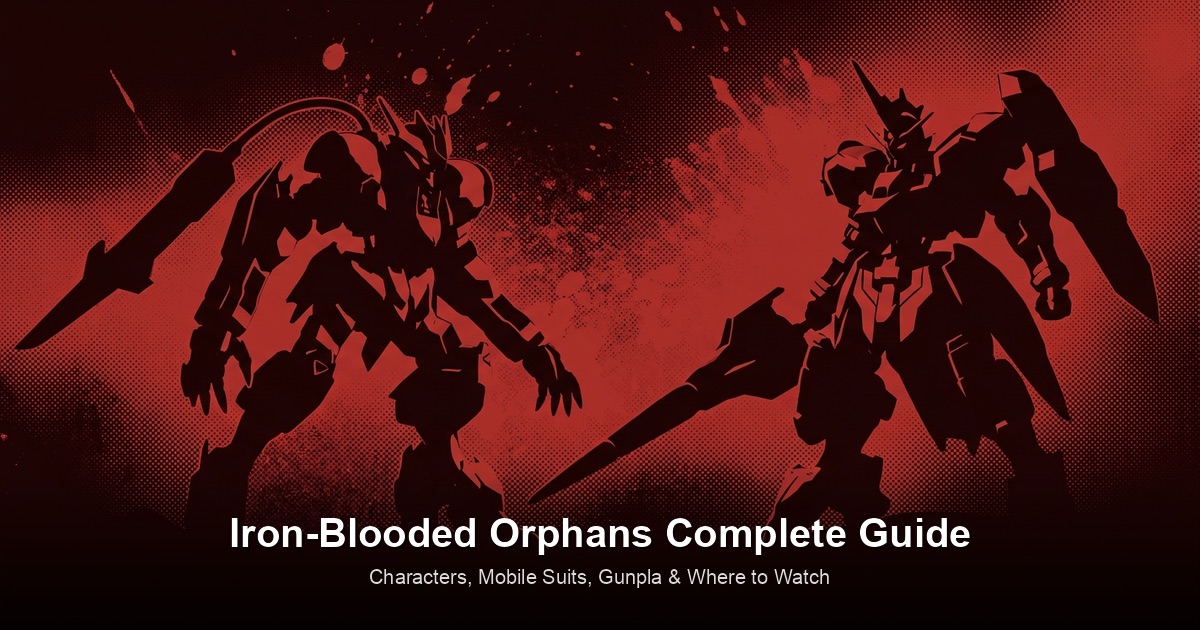
Gundam Barbatos is Mikazuki Augus's machine and the defining mobile suit of Iron-Blooded Orphans. One of the 72 Gundam Frames, it takes its name from the demon Barbatos of the Ars Goetia. Throughout the story, it evolves by absorbing equipment and parts from defeated enemies, cycling through eight distinct forms -- a uniquely savage concept of "evolution through plunder and adaptation" unseen in other Gundam series.
1st Form -- Awakening from 300 Years of Slumber
Sealed beneath the CGS base, Barbatos has lost nearly all its Calamity War-era equipment, existing in a near-skeleton state with only minimal armor remaining. Yet the moment Mikazuki connects via the Alaya-Vijnana System, the 300-year-old machine roars to life and dispatches Gjallarhorn's forces with devastating mace strikes -- an iconic first scene that declares the series' combat philosophy.
2nd through 4th Forms -- Savage Evolution Through Spoils of War
As Tekkadan travels from Mars to space, they salvage armor and components from every Gjallarhorn mobile suit Mikazuki destroys and graft them onto Barbatos:
- 2nd Form: Shoulder armor from a Schwalbe Graze added to the right shoulder. Improved defense and space mobility.
- 3rd Form: Wire claw added for mid-range combat capability.
- 4th Form: Salvaged armor plating added across the entire body. Heavier but significantly more durable.
This process of "strengthening yourself with enemy parts" physically embodies Tekkadan's survival philosophy of making do with what they have.
5th Form -- Ground Combat Configuration
Reconfigured for ground operations ahead of Earth descent, with Teiwaz technical support. Leg boosters added for gravity-environment mobility, enabling high-speed gliding approaches.
6th Form -- Edmonton Battle Configuration
The form used in the Season 1 climactic battle against Graze Ein. Equipped with additional gear provided by Teiwaz, maximizing close-combat capability. The wrench mace's devastating blows prove decisive against Ein, but this battle costs Mikazuki his right eye and right arm function.
Gundam Barbatos Lupus -- Season 2's New Form
Introduced at the start of Season 2, this is a complete frame-up rebuild of Barbatos by Teiwaz. "Lupus" is Latin for "wolf."
Redesigned around Mikazuki's combat data, it emphasizes reaction speed and mobility above all else. Dedicated thrusters and all-terrain suspension allow it to close distance rapidly while minimizing exposure to enemy fire. Primary armaments include a sword mace and 200mm arm cannons, with built-in sub-arms for grappling -- a further refinement of Barbatos's "hit them with blunt objects" combat doctrine.
Gundam Barbatos Lupus Rex -- The Final Form, the Ultimate Beast
Barbatos's ultimate configuration. "Rex" is Latin for "king." The King of Wolves -- that is the meaning embedded in the name Barbatos Lupus Rex.
Its most distinctive feature is the Rex Nail, created by grafting a Mobile Armor tail component salvaged from Hashmal onto the right arm. In its default state it functions as a massive arm claw; when deployed, it can be wielded as an enormous mace. Additionally, super-hard wire blades captured from Hashmal are mounted as a tail blade, sweeping aside enemies across a wide area.
Through the Alaya-Vijnana System, Mikazuki's synchronization with the machine reaches inhuman levels. Barbatos Lupus Rex's reaction speed transcends human capability. But this comes at the cost of further destroying Mikazuki's body. In the final battle, it displays overwhelming combat power but ultimately falls to concentrated Dainsleif fire and sheer numerical superiority.
After Mikazuki's death, Barbatos Lupus Rex's remains are left on the Martian wilderness. Years later, Kudelia has the machine recovered and placed in a field of flowers. The "demon" that once fought and killed, now resting among blossoms -- it is a quiet, beautiful image that perfectly captures what Tekkadan's struggle left behind.
| Form | Appearance | Key Features |
|---|---|---|
| 1st Form | S1 Episode 1 | Activated from sealed state. Minimal armor. Mace as primary weapon. |
| 2nd Form | S1 Early | Shoulder armor added. Space combat enhanced. |
| 3rd Form | S1 Mid | Wire claw added. Mid-range capability. |
| 4th Form | S1 Mid | Full-body armor addition. Heavy armor configuration. |
| 5th Form | S1 Late | Ground combat configuration. Leg boosters added. |
| 6th Form | S1 Finale | Edmonton battle configuration. Maximum close combat. |
| Lupus | S2 Early | Complete rebuild. High-speed melee specialist. Sword mace. |
| Lupus Rex | S2 Late | Final form. Rex Nail, tail blade equipped. |
Mobile Suits and Mobile Armors -- Gundam Frames and Key Machines
Every mobile suit in Iron-Blooded Orphans is classified as either a Gundam Frame or one of several mass-production frames (Graze Frame, Regnlaize Frame, etc.). Here is a comprehensive catalog of the Gundam Frames that appear in the series, along with notable mass-production units and Mobile Armors.
Gundam Frames -- Weapons of Destruction Named for Solomon's 72 Demons
| Unit | Pilot | Details |
|---|---|---|
| Gundam Barbatos | Mikazuki Augus | #8. Protagonist's machine. Melee-focused with mace. 8 form changes. |
| Gundam Gusion / Gusion Rebake / Rebake Full City | Akihiro Altland | #11. Originally used by space pirates. Rebuilt by Tekkadan into a sleek form. |
| Gundam Kimaris / Kimaris Trooper / Vidar / Kimaris Vidar | Gaelio Bauduin | #66. Passed down through the Bauduin family. Cavalry-style charge tactics. |
| Gundam Flauros | Norba Shino | #64. Ranged combat specialist. Can equip Dainsleif railgun. |
| Gundam Bael | McGillis Fareed | #1. Symbol of Gjallarhorn. Agnika Kaieru's original machine. Twin-sword fighting style. |
| Gundam Astaroth | Argi Mirage | #29. Appears in the side story manga Gekko (Moon Steel). |
Graze Series -- Gjallarhorn's Workhorse
- Graze: Standard mass-production model. Space and ground capable.
- Schwalbe Graze: High-mobility variant. Initially piloted by McGillis and Gaelio.
- Graze Ein: Ein Dalton's body integrated into a Graze. Season 1's final boss.
- Graze Ritter: Ground combat-specialized variant.
- Reginlaze: Next-generation successor to the Graze. Julieta's machine.
- Reginlaze Julia: Julieta's custom high-performance unit.
Tekkadan's Mobile Suits
- Man Rodi: Standard-issue units supplied by Teiwaz for Tekkadan's rank and file.
- Shiden: Tekkadan's main mass-production mobile suit, developed with Teiwaz technology.
- Landman Rodi: Ground-combat variant used by the Earth branch.
- Mobile Worker: Small utility vehicles. Tekkadan repurposed them for combat in their early days.
Mobile Armor -- The Calamity War's Ghost: Hashmal
Mobile Armors were the autonomous killing machines that ran amok during the Calamity War. Designed solely to exterminate humans with maximum efficiency, they will not stop until a designated kill count is reached.
Hashmal, which appears in Season 2, was sealed beneath Mars for 300 years until Iok Kujan's reckless actions triggered its awakening. Deploying swarms of unmanned sub-units called Pluma, it devastates the surrounding area. Mikazuki destroys it in Barbatos Lupus, but the cost to his body is severe.
Hashmal's existence proves that the Calamity War is not merely ancient history but a threat that can re-emerge at any time. The bitter irony that defeating it once again requires the sacrifice of a human body deepens the series' thematic layers.
Season 1 vs. Season 2: Structural Shift -- From a Story of Ascent to a Story of Collapse
A deeper appreciation of Iron-Blooded Orphans requires understanding the deliberate structural contrast between its two seasons. Though they share the same characters in a continuous narrative, their directional arcs are designed as mirror opposites.
Season 1: The Rise of Those Who Had Nothing
Season 1 tells the story of boys who had nothing fighting to claim a place of their own. Former expendable soldiers of CGS, they stage a coup, found Tekkadan, and escort Kudelia to Earth. Everything is built from zero -- each obstacle overcome strengthens their bonds and elevates their reputation.
Despite the tragedy of Biscuit's death, Season 1 ends in "success." Viewers are moved by the boys' growth and feel hope for their future.
Season 2: Everything They Built Crumbles
Season 2 systematically dismantles everything Season 1 constructed. The organization swells but becomes unmanageable. Political conspiracies ensnare them. Allies die one after another -- Naze Turbine's death, Teiwaz's abandonment, McGillis's defeat. Every development pushes Tekkadan closer to destruction.
This structural shift is entirely intentional. Mari Okada has stated in interviews that she "wrote Season 2 with the resolve to tear down everything Season 1 built." Harsh as that sounds, it was a narrative necessity to convey the series' central thesis: "Violence alone cannot change anything."
Why Tekkadan "Lost" -- Defeat as Structural Inevitability
- They had no tools other than violence: Tekkadan knew no method other than "fight and win." After Biscuit's death, this tendency intensified. But relying on brute force alone against an organization as vast as Gjallarhorn was structurally impossible.
- McGillis as a false guide: Orga followed McGillis's promise that "claiming Bael will change everything." But this was McGillis's wish, not a realistic strategy.
- Rustal's political power: Rustal Elion commanded both military might and political acumen. He casually deployed the banned Dainsleif weapons while controlling the narrative through information warfare. He stood not for "justice" but for "order," and he crushed Tekkadan's "ideals" with pragmatic force.
- The limits of Orga's leadership: Orga would die for his comrades in a heartbeat, but he lacked the ability for political maneuvering or long-term strategy. As he confessed near death, "I never actually knew where I wanted to go" -- he ran on the emotion of wanting to meet his comrades' expectations, not on a clear vision.
Tekkadan's defeat is a negation of the very premise that "child soldiers can rise through violence." Strength alone cannot change the world. But their sacrifice made Kudelia's political work possible, and institutional change followed. Violence did not directly transform the world -- rather, "the contradictions that violence exposed" were addressed by those using non-violent means. This complex dynamic is the true heart of what Iron-Blooded Orphans sought to express.
Themes and the Shocking Ending -- Why Did They Have to Die?
Iron-Blooded Orphans' finale sparked intense debate upon airing. "Why did they have to kill the protagonist?" "Isn't this just a bad ending?" "They deserved better." But examined through the lens of the complete work, this ending carries deep intentional meaning.
"Negation of the Cycle of Violence" -- A Structure That Denies Its Own Protagonists
The central theme of Iron-Blooded Orphans is the negation of the cycle of violence. What makes this fascinating is that the series places on its protagonist side the very thing its theme condemns. Conventional Gundam protagonists question war while still finding their reasons to fight. In IBO, the protagonists' violence itself is what the story denies. Mikazuki kills without hesitation; Orga never considers any option beyond "fight and win." They are the narrative's protagonists, yet thematically, they are positioned as what must be transcended.
Mikazuki Augus: The "Anti-Gundam Protagonist"
Mikazuki is the most unconventional protagonist in Gundam history. He lacks Amuro's introspection, Kira's anguish, and Setsuna's idealism. He is, in essence, a human weapon: "If Orga says go, I go. If he says kill, I kill."
But this is not because Mikazuki is heartless. He simply was never taught any other way to live, having known nothing but battle since childhood. The moments where he reclaims his humanity -- quiet time with Atra, the peace of tending a garden -- are also the moments when he is most vulnerable. For Mikazuki, "daily life" is a dream; "the battlefield" is reality.
His death symbolizes the tragedy of a child who was never given any option other than fighting. He was strong to the end. He tried to protect others to the end. But there are limits to what violence can achieve. That limit is what his death makes devastatingly clear.
What Orga's Death Means -- The End of a March Without a Destination
"Don't stop... Keep going..." is the distillation of Orga's fundamental contradiction. He is stopping (dying), but telling his comrades to keep moving. Yet he cannot say where. Because he himself never knew.
This "march without a goal" is a metaphor for the reality of child soldiers. Children taught only to fight are never given the chance to contemplate what they are living for. Orga's death is a devastating portrait of the victims of structural violence.
Why This Is Not a "Bad Ending"
While Iron-Blooded Orphans' conclusion appears to be a bad ending, the epilogue reveals a "bitter hope":
- The Human Debris system is abolished.
- Mars achieves self-governance.
- Gjallarhorn is democratized.
- Mikazuki's child, Akatsuki, is born and grows up in a new world.
- Tekkadan's survivors build new lives.
Tekkadan's boys died on the battlefield. But there were those who refused to let their sacrifice be in vain. Kudelia through politics, Atra through the continuation of life, Takaki through governance -- each, in their own way, changed the world. Violence alone cannot change the world, but the contradictions that violence exposed were resolved by those who chose non-violent means.
This is a far more complex, far more realistic conclusion than a simple victory. And that is precisely why Iron-Blooded Orphans endures in the conversation long after it ended.
Iconic Quotes and Scenes -- Words Etched in Memory
Iron-Blooded Orphans produced numerous unforgettable lines. Here are the series' most iconic quotes and the significance of the scenes in which they were spoken.
Orga Itsuka
"Don't stop... Keep going..." ("Tomarun ja nee zo...") -- Season 2, Episode 48
Orga's final words, spoken over the phone to Mikazuki as he bleeds out from a gunshot wound. The series' most iconic line. While it gained internet meme status, the underlying weight of a leader's dying prayer cuts to the core.
"I'm taking you all with me. I've decided that." -- Season 1
Orga's declaration at Tekkadan's founding. The first time he puts into words his resolve to bear the responsibility of every comrade's life -- a promise that binds him until his final breath.
Mikazuki Augus
"What should I do next, Orga?"
Mikazuki's recurring line perfectly encapsulates his relationship with Orga. To Mikazuki, Orga is "the one who thinks," and he is "the one who acts." This dynamic is both Tekkadan's greatest strength and its fatal limitation.
"Thank you." -- Final Episode
Mikazuki's whispered words to Barbatos during their last battle. Gratitude to a machine that fought beside him across 300 years of history. For a character so sparing with words, this is the perfect final utterance.
McGillis Fareed
"Gaelio, nothing I said to you was a lie. I needed you and Ein to guide Gjallarhorn in the right direction. And you were the only true friend I ever had."
Spoken near the end of McGillis's life. The calculating schemer reveals his genuine feelings at last. He used Gaelio, yet truly considered him a friend -- that contradiction encapsulates the tragedy of McGillis as a character.
Iconic Scenes
- Barbatos Activates (Episode 1): The 300-year-old machine awakens and shatters a Graze with a single mace strike -- the scene that declares IBO's visceral combat style.
- Biscuit's Death (S1 Episode 21): The loss of the gentle strategist marks the point of no return for Tekkadan's path of violence.
- Mikazuki vs. Graze Ein (S1 Episodes 24-25): Mikazuki releases all limiters, sacrificing his body to destroy Ein. The cost is staggering.
- Naze and Amida's Last Stand (S2 Episode 19): Cornered by Iok's schemes, Naze and Amida sacrifice themselves to save their crew. Their final exchange is heartbreaking.
- Orga's Death (S2 Episode 48): Shot on the street, Orga staggers forward, bleeding, refusing to fall. The visual shock paired with his final words became the series' most enduring image.
- Mikazuki's Final Charge (Finale): Barbatos Lupus Rex pressing forward through a rain of Dainsleif fire. No longer about winning or losing -- simply a declaration of how he lived.
- Barbatos in the Flower Field (Finale Epilogue): The warrior machine at rest among flowers. The paradox of a weapon of war surrounded by peace creates the series' most quietly powerful final image.
How to Watch, Related Works, and the 10th Anniversary Project
For those interested in experiencing Iron-Blooded Orphans, here is essential viewing and related media information.
Where to Watch (As of March 2026)
| Streaming | Crunchyroll, Funimation (via Crunchyroll), Netflix (select regions), Hulu (Japan), Amazon Prime Video (select regions). Availability varies by region and time period; check current listings on your preferred platform. |
|---|---|
| Physical Media | Blu-ray box sets available for both seasons. Japanese releases include bonus features and booklets. |
| Recommended Watch Order | Season 1 (25 episodes) followed by Season 2 (25 episodes). First-time viewers should absolutely follow this order. Side stories and Urdr Hunt are best experienced after the main series. |
Related Works and Side Stories
| Title | Medium | Description |
|---|---|---|
| Mobile Suit Gundam Iron-Blooded Orphans: Gekko (Moon Steel) | Manga (Hobby Japan serialization) | Side story centered on Gundam Astaroth, set on Mars during the same period as the main series. |
| Mobile Suit Gundam Iron-Blooded Orphans: Urdr Hunt | App anime / Theatrical compilation | A sequel story featuring Wistario Afam piloting Gundam Marchosias. Theatrical compilation released October 2025. |
| 10th Anniversary Short Film: Interlude -- The Wedge | Theatrical short | Released October 2025. Original staff (Nagai directing, Okada writing) reunited. Screened alongside the Urdr Hunt compilation. |
10th Anniversary Project (2025)
In 2025, the 10th anniversary of the TV series' premiere was celebrated with a major multimedia project:
- Urdr Hunt: Trail of a Small Challenger theatrical compilation (October 31, 2025): A re-edited version of the 12-episode anime from the Iron-Blooded Orphans G mobile app, with new footage added.
- New short film Interlude: The Wedge: An entirely new production reuniting the original creative team.
- Blu-ray & DVD release: Physical media containing the compilation and short film scheduled for 2026.
- 10th Anniversary Finale Event: Cast reunion talk event held February 15, 2026.
- New Gunpla releases: Anniversary model kits and expanded hobby merchandise.
Gunpla -- Popular Kits and Buying Tips
Iron-Blooded Orphans has an exceptionally strong relationship with Gunpla (Gundam plastic model kits). The in-universe concept of a shared "Gundam Frame" internal skeleton is reflected in the actual kit engineering, particularly in the 1/100 Full Mechanics series, which uses a common frame structure across multiple kits.
The most popular kits include:
- HG IBO Gundam Barbatos Lupus Rex: The final form's menacing presence in an affordable high-grade format.
- HG IBO Gundam Barbatos: The clean, skeletal 1st Form remains a fan favorite.
- MG Gundam Barbatos: Master Grade precision showcasing the Gundam Frame's internal structure.
- HG IBO Gundam Bael: Elegant proportions and beautifully sculpted twin swords.
- Full Mechanics Gundam Barbatos Lupus Rex: The 1/100 scale kit with outstanding Gundam Frame detail.
How IBO Compares to Other Gundam Series -- Who Is It For?
Iron-Blooded Orphans is particularly recommended for:
- Viewers drawn to serious themes like war drama, child soldiers, and systemic exploitation.
- Fans who prefer gritty melee combat over beam weapon exchanges.
- Fans of director Tatsuyuki Nagai and writer Mari Okada (Anohana, The Anthem of the Heart).
- Gundam newcomers -- no knowledge of the Universal Century or any other timeline is required.
- Anyone seeking a story that refuses to guarantee the protagonists' victory.
Conversely, those expecting upbeat, exhilarating mecha action may find IBO challenging. This is a series that unflinchingly depicts unrewarded effort and insurmountable reality. That is its greatest strength -- and the reason it is not for everyone.
Conclusion -- What Tekkadan Left Behind
Mobile Suit Gundam: Iron-Blooded Orphans stands as one of the most distinctive entries in the Gundam franchise. Its themes of child soldiers, poverty, and human trafficking are unflinchingly heavy. Its combat -- maces and axes instead of beam sabers and rifles -- is uniquely visceral. And its ending, in which the protagonists lose, is shocking and unprecedented.
But it is not simply a tragedy. Tekkadan's boys died. Yet what they left behind endured:
- The Human Debris system was abolished.
- Mars achieved self-governance.
- Gjallarhorn was democratized.
- Mikazuki's child, Akatsuki, lives in a new world.
Violence cannot change the world. But the contradictions that violence exposed were resolved by those who chose other means. The meaning of Tekkadan's fight lies not in the enemies they destroyed but in the problems their sacrifice illuminated -- problems that the survivors worked to solve.
The 2025 10th anniversary project proves this series remains deeply beloved. The new short film Interlude: The Wedge is an invaluable gift to the fans who never forgot.
If you have not yet watched Iron-Blooded Orphans, start with Episode 1. From the moment the 300-year-old Barbatos raises its mace for the first time, you will find it impossible to stop.