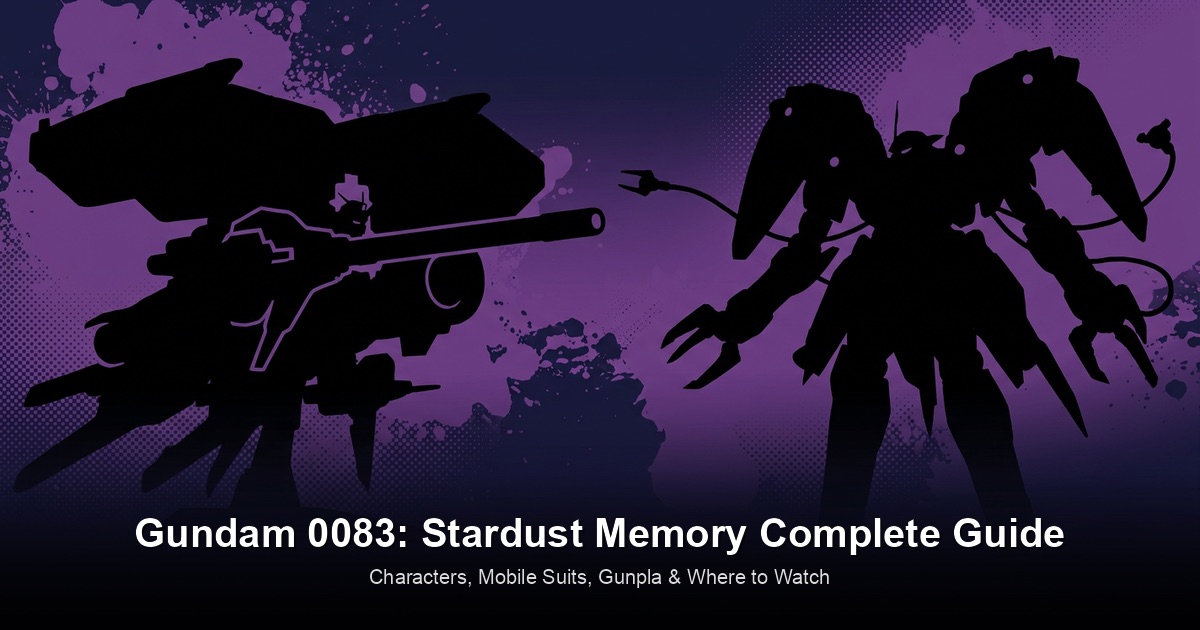
Gundam 0083: Stardust Memory — Complete Guide— Story, Mobile Suits & Iconic Scenes
Contents
- 01What Is 0083? The "Lost Four Years" Between 0079 and 0087
- 02The Full Story — Operation Stardust in Three Acts
- 03Episode Guide — Complete Summaries for All 13 Episodes
- Episode 1: "Gundamjack"
- Episode 2: "Endless Pursuit"
- Episode 3: "Into Battle Zone"
- Episode 4: "Attack and Retreat in the Burning Sand"
- Episode 5: "Gundam, to the Sea of Stars"
- Episode 6: "The Warrior of Von Braun"
- Episode 7: "With Shining Blue Fire"
- Episode 8: "Conspiracy Sector"
- Episode 9: "The Nightmare of Solomon"
- Episode 10: "Clash in the Battle Zone"
- Episode 11: "La Vie en Rose"
- Episode 12: "Assault: The Point of No Return"
- Episode 13 (Finale): "A Storm Raging Through"
- 04Characters — Earth Federation
- 05Characters — Zeon Remnants / Delaz Fleet
- 06Mobile Suits — The Gundam Development Project (GP Series)
- 07Mobile Suits — Federation and Zeon Remnant Mainline Units
- 08Operation Stardust — The Full Scope of the Delaz Conflict
- 09The Formation of the Titans and the Road to Zeta Gundam
- 10Top 10 Quotes and Scenes
- #1: "Solomon! I have returned!" — Anavel Gato (Episode 9)
- #2: "I stand on righteousness." — Anavel Gato
- #3: "We have waited for three years!" — Aiguille Delaz (Episode 9)
- #4: The GP02 Nuclear Strike (Episode 9)
- #5: Dendrobium's First Sortie (Episode 12)
- #6: Kou vs. Gato — First Encounter (Episode 1)
- #7: Kelly's Final Flight (Episode 6)
- #8: "Magnificent. It is as though Zeon's spirit has taken physical form." — Anavel Gato
- #9: Captain Synapse's Final Order
- #10: Gato's Final Charge (Episode 13)
- 11Behind the Scenes — Why 0083 Became "The OVA Masterpiece"
- 12Streaming Guide [2026 Edition]
- 13Gunpla Guide
- 14FAQ
- Q: Can I enjoy 0083 without watching the original Gundam first?
- Q: Should I watch 0083 before or after Zeta Gundam?
- Q: Nina Purpleton's actions don't make sense to me...
- Q: OVA or theatrical film first?
- Q: Why don't 0083's mobile suits appear in Zeta Gundam's era?
- Q: Is Gato a hero?
- Q: Does the GP04 Gerbera appear in the show?
- 15Conclusion
What Is 0083? The "Lost Four Years" Between 0079 and 0087
Mobile Suit Gundam 0083 STARDUST MEMORY is the most densely packed "gap story" in the entire Universal Century saga.
Between the end of the One Year War (UC 0079) and the outbreak of the Gryps Conflict (UC 0087), roughly eight years passed. What happened in that interval? A devastating story lay buried between the original Mobile Suit Gundam and Zeta Gundam. 0083 unearthed it.
The Principality of Zeon was defeated. But not every Zeon soldier laid down their arms. Anavel Gato, the ace feared as "The Nightmare of Solomon," resurfaces after three years in hiding. His mission: to steal a nuclear-armed prototype Gundam and deliver one final, devastating blow to the Earth Federation. Standing against him is a young test pilot with zero combat experience, Kou Uraki.
After watching this story, you will understand the opening of Zeta Gundam with entirely new weight: why the Titans were born, and why they wielded such unchecked power.
Production Data (OVA, 13 Episodes, 1991-1992)
| Official Title | Mobile Suit Gundam 0083 STARDUST MEMORY |
|---|---|
| Format | OVA (Original Video Animation) |
| Episodes | 13 |
| Release Period | May 23, 1991 - September 24, 1992 |
| Director | Mitsuko Kase (Eps. 1-7), Takashi Imanishi (Eps. 8-13) |
| Character Design | Toshihiro Kawamoto |
| Mobile Suit Original Design | Kunio Okawara |
| Mechanical Styling | Shoji Kawamori |
| Mechanical Design | Hajime Katoki |
| Music | Mitsuo Hagita |
| OP Theme | "THE WINNER" by Miki Matsubara (Eps. 1-7) / "MEN OF DESTINY" by MIQ (Eps. 8-13) |
| ED Theme | "MAGIC" by Jacob Wheeler (Eps. 1-7) / "Evergreen" by Hiroko Kasahara (Eps. 8-13) |
| Production | Sunrise |
| Timeline | Universal Century 0083 |
| Theatrical Film | Mobile Suit Gundam 0083: The Afterglow of Zeon (August 29, 1992) |
Its Place in the Universal Century
Within the Universal Century timeline, 0083 occupies a critically important turning point.
Three years after the end of the One Year War (UC 0079), the Republic of Zeon had signed a peace treaty with the Federation. But Zeon remnant forces were scattered across the Earth Sphere, still resisting. The Federation was drawing down its military while outsourcing next-generation mobile suit development to the private corporation Anaheim Electronics. The result was the "Gundam Development Project" — the GP Series.
This was also an era when "hardliners" and "moderates" within the Federation military were locked in a tug-of-war over policy toward former Zeon territories. The Delaz Conflict depicted in 0083 is the event that tipped the balance decisively toward the hardliners — the future Titans.
In other words, 0083 simultaneously depicts the "aftermath" of the original Gundam and the "prelude" to Zeta Gundam. It is the keystone of the Universal Century.
OVA vs. Theatrical Film The Afterglow of Zeon — Which Should You Watch?
There are two ways to experience 0083: the full 13-episode OVA and the theatrical film The Afterglow of Zeon.
The answer is clear: watch the full 13-episode OVA.
The Afterglow of Zeon is a re-edited compilation primarily covering the second half (Episodes 8-13), with some new footage added. At roughly 120 minutes, it offers a condensed version of the climax. However, it sacrifices the careful character development and the gradually deepening rivalry between Kou and Gato from the first half.
Episodes 1 through 7 — the Gundam theft, the ground combat, the journey to space — are reduced to a digest in the film. To truly appreciate Kou's growth, his bond with Captain Burning, and the weight of Gato's conviction, you need the full OVA's pacing.
If you're pressed for time, the film will do. But if you want to understand the true value of 0083, watch all 13 episodes.
The Full Story — Operation Stardust in Three Acts
The story of 0083 unfolds in an elegant three-act structure. At its center is "Operation Stardust" — the Zeon remnants' final, most devastating strike against the Earth Federation.
Act I: "Gundam Theft" (Episodes 1-4)
October, UC 0083. Two prototype Gundams developed by Anaheim Electronics arrive at Torrington Base in Australia: the GP01 Zephyranthes and the GP02A Physalis. Test pilot Kou Uraki and Anaheim engineer Nina Purpleton are there to receive them.
That night, Anavel Gato steals the GP02 — nuclear warhead and all.
The base erupts in chaos. Kou scrambles into the GP01 to pursue, but he is hopelessly outmatched by a veteran ace. This stark skill gap defines the tension of the entire story.
Kou and his comrades board the assault carrier Albion, chasing Gato and the GP02 into Africa. Through brutal desert combat, Kou receives his baptism of fire and begins to awaken as a pilot. Captain South Burning, the "ideal officer," becomes the pillar supporting Kou's growth.
Act II: "Into Space" (Episodes 5-9)
Gato escapes to space with the GP02. Kou and the Albion follow, but space holds entirely different threats.
Enter Cima Garahau — a former Zeon Marine Corps commander forced to carry out a poison gas attack during the war, then abandoned by her own side afterward. Cunning, ruthless, yet haunted by a tragic past, she adds profound depth to the story.
On the lunar city of Von Braun, Kou encounters Kelly Layzner, a former Zeon pilot who lost an arm in the war and is obsessively restoring a mobile armor called the Val Walo for one last flight. Their brief bond across enemy lines is one of 0083's finest human dramas.
Then comes Episode 9, "The Nightmare of Solomon" — the story's greatest turning point.
At the Federation's naval review held at the former Solomon fortress (now renamed Konpei Island), Gato fires the GP02's Atomic Bazooka into the heart of the assembled fleet. Just before the nuclear fire, he cries out:
"Solomon! I have returned!"
Over two-thirds of the Federation fleet is crippled. Phase one of Operation Stardust is complete.
Act III: "Stardust" (Episodes 10-13)
The nuclear attack was only the opening move. The true objective of Operation Stardust is a colony drop.
Cima's fleet seizes a space colony and alters its trajectory. The massive cylinder begins falling toward Earth, aimed at the agricultural heartland of North America — the Federation's food supply.
Kou boards the GP03 Dendrobium, a 140-meter behemoth, to stop the colony drop. His clash with Gato's Neue Ziel in the final battle is one of the most spectacular combat sequences in OVA history.
But the colony cannot be stopped. The Federation's Solar System II fires but is thrown off target by Cima's interference. Delaz is assassinated. The operation implodes from within, yet the colony still falls. It crashes into North America, causing catastrophic damage.
Gato makes his final charge into the Federation fleet with his wrecked Neue Ziel. Neither victor nor vanquished — simply a man who lived and died by his convictions.
The Aftermath — Birth of the Titans
The story's true ending is not the battle's conclusion. It is what comes after.
In the wake of the Delaz Conflict, voices within the Federation government demanding that "Spacenoids are dangerous" surge to a roar. The colony drop — a horrifying echo of the One Year War — hands the hardliners their perfect justification.
Jamitov Hymen and Bask Om establish the Titans: a special forces unit tasked with monitoring and suppressing Spacenoids. This is the very organization that becomes the primary antagonist of Zeta Gundam.
The Gundam Development Project is "erased from history." All records are destroyed, witnesses are silenced, and the GP Series vanishes from official documentation. Kou Uraki is imprisoned — though later pardoned.
The final scene of 0083 connects directly to Episode 1 of Zeta Gundam. The Titans' tyranny, Kamille's rage, the formation of the AEUG — every seed was planted here.
Episode Guide — Complete Summaries for All 13 Episodes
Episode 1: "Gundamjack"
October 13, UC 0083. Two prototype Gundams arrive at Torrington Base in Australia. Test pilot Kou Uraki is captivated by the GP01 but is merely a spectator alongside his friend Chuck Keith.
That night, Zeon infiltrators spring into action. Anavel Gato steals the GP02A Physalis, nuclear warhead included. Kou mounts the GP01 in pursuit, but Gato's overwhelming skill makes the outcome a foregone conclusion. Gato escapes with ease.
Highlight: The opening salvo of the story. The tension as Gato infiltrates the base and activates the GP02 is breathtaking. The brutal skill gap between Kou and Gato is established with merciless clarity, and "how will this gap be closed?" becomes the driving question of the entire series.
Episode 2: "Endless Pursuit"
The pursuit of the GP02 continues, but Gato skillfully evades capture with resupply support. Kou faces his first real combat in the GP01 and his inexperience shows. Captain Burning and his "Immortal 4th Platoon" lead the chase, and Kou learns battlefield reality from watching his seniors.
Highlight: Captain Burning's calm leadership and warmth shine through. This episode establishes him as Kou's mentor and moral compass.
Episode 3: "Into Battle Zone"
The Albion formally deploys on the mission to recover the GP02. Under Captain Eiphar Synapse's command, the crew begins organized pursuit. Nina Purpleton joins aboard to maintain the GP01, and her relationship with Kou begins to deepen.
Highlight: The Albion becomes the story's mobile stage, and the interpersonal dynamics aboard are established with care. Captain Synapse's integrity as a career officer is immediately apparent.
Episode 4: "Attack and Retreat in the Burning Sand"
In the African desert, Gato and Kou clash again. The harsh environment exposes the GP01's limitations as a ground-type unit. Through this combat, Kou takes another step forward as a pilot. And then Captain Burning—
Highlight: The desert combat animation is stunning. And narratively, an irreversible loss occurs. From this point on, the naivety disappears from Kou's eyes.
Episode 5: "Gundam, to the Sea of Stars"
Gato escapes to space. The Albion follows, entering a new phase of the pursuit. The GP01 is a ground-type and cannot perform in space, so Nina and her team refit it into the GP01Fb Full Burnern, a space-optimized variant. Kou launches into orbital combat with his evolved machine.
Highlight: The conversion scene from GP01 to GP01Fb is a must-see for mecha fans. The concept of "a machine evolving to match its environment" epitomizes 0083's approach to realistic mecha design.
Episode 6: "The Warrior of Von Braun"
On the lunar city of Von Braun, Kou meets Kelly Layzner, a former Zeon pilot who lost an arm in the One Year War. Kelly is consumed by his desire to restore the mobile armor Val Walo and fly one last time. Beyond enemy lines and loyalties, two pilots connect through their shared language.
Highlight: A poignant portrayal of a veteran living in war's aftermath. Kelly and Kou's brief friendship is one of 0083's most emotionally complete episodes. Kelly's final display of pride is unforgettable.
Episode 7: "With Shining Blue Fire"
The Delaz Fleet's stronghold, "The Garden of Thorns," is discovered, and the Federation launches a major offensive. Kou engages in fierce space combat with the GP01Fb against Cima Garahau's forces. The full scale of Cima as a threat becomes clear for the first time.
Highlight: The culmination of the first half. The GP01Fb's space combat capabilities are fully displayed in a large-scale battle worthy of a first-half finale.
Episode 8: "Conspiracy Sector"
The story enters a new phase. The true scope of the Delaz Fleet's plan — Operation Stardust — begins to emerge. Within the Federation military, political maneuvering over the crisis intensifies. The shadows of what will become the Titans are already visible.
Highlight: Director Takashi Imanishi's influence becomes evident. The series shifts from pure action to political thriller, and the narrative gains a new dimension of depth.
Episode 9: "The Nightmare of Solomon"
The single greatest climax of the series. At the Federation's naval review held at Solomon (Konpei Island), Gato fires the GP02's Atomic Bazooka into the assembled fleet.
"For the success of Operation Stardust! For the rebirth of the ideals of Zeon! To prove that the deaths of those brave soldiers were not in vain! Solomon! I have returned!"
Nuclear fire engulfs Solomon. Over two-thirds of the Federation fleet is rendered inoperable. Yet this is only "Phase One" of Operation Stardust.
Highlight: One of the most iconic scenes in all of Gundam. Gato's anguished cry merging with the nuclear flash is a moment that sends chills no matter how many times you watch it. The final duel between GP02 and GP01Fb also concludes in this episode.
Episode 10: "Clash in the Battle Zone"
Amid the chaos of the nuclear strike, the Delaz Fleet's real plan goes into motion: colony seizure and colony drop. Kou loses the GP01Fb and needs a new machine. The Federation finally grasps the full scope of Operation Stardust, but its response is too slow.
Highlight: The post-nuclear confusion is depicted with raw intensity. The Federation military's organizational fragility is laid bare, setting up the political justification for the Titans' creation.
Episode 11: "La Vie en Rose"
At Anaheim Electronics' massive dock ship La Vie en Rose, the GP03 Dendrobium is entrusted to Kou. A 140-meter weapon system — a fusion of mobile suit and mobile armor. This is the Gundam Development Project's final and most extreme answer.
Kou resolves to fight on the front line against the colony drop with this new power.
Highlight: The Dendrobium's reveal is a moment of pure mecha romance. Its sheer scale leaves viewers speechless.
Episode 12: "Assault: The Point of No Return"
The colony is falling toward Earth. The point of no return approaches — beyond this line, nothing can stop it. Kou in the Dendrobium faces Gato in the Neue Ziel for the final battle.
Simultaneously, Cima's betrayal unfolds. She has been negotiating with the Federation. Delaz is assassinated. The operation collapses from within even as the colony's descent accelerates.
Highlight: The Dendrobium vs. Neue Ziel clash is among the largest-scale battle sequences in all of Gundam. Two massive weapons systems colliding in space — the spectacle rivals any theatrical anime production.
Episode 13 (Finale): "A Storm Raging Through"
The Federation activates Solar System II to destroy the falling colony, but Cima's interference throws off the targeting. The colony is not fully destroyed. Its remains crash into the agricultural heartland of North America, causing devastating damage.
Gato, in his shattered Neue Ziel, charges into the Federation fleet one last time. To the very end, a soldier of Zeon.
The story closes not with the end of battle, but with politics. The Gundam Development Project is erased. Captain Synapse is court-martialed and executed. Kou is imprisoned. And Jamitov announces the formation of the Titans.
Highlight: The lack of a triumphant ending is this show's integrity. Justice does not prevail. Heroes are not rewarded. Only politics wins. That bitter conclusion is the strongest possible bridge to Zeta Gundam.
Characters — Earth Federation
Kou Uraki
| Affiliation | Earth Federation Forces |
|---|---|
| Rank | Ensign |
| Mobile Suits | GP01 Zephyranthes → GP01Fb Full Burnern → GP03 Dendrobium (Stamen) |
| Voice Actor | Ryo Horikawa |
The protagonist of 0083. A test pilot at Torrington Base with strong technical skills but zero combat experience. A typical "postwar generation" youth.
Kou's journey is a struggle with one question: "Why do I fight?" Gato has a clear "cause." Kou does not — at least not at first. He wants to pilot a Gundam, wants to beat Gato, wants to protect Nina. His motivations are personal and vague.
That is precisely what makes his growth feel authentic. He did not choose war; war chose him. Through the deaths of comrades and encounters with the enemy's convictions, he finds his own answer — something more grounded than Gato's lofty "righteousness": simply protecting the people in front of him.
Ryo Horikawa's performance perfectly captures this arc from immaturity to resolve. The uncertain voice of the early episodes transforms into one carrying quiet conviction by the finale.
South Burning
| Affiliation | Earth Federation Forces, Albion crew |
|---|---|
| Rank | Captain (Lieutenant) |
| Mobile Suit | GM Custom |
| Voice Actor | Masashi Sugawara |
Commander of the "Immortal 4th Platoon" and a battle-hardened veteran. He is Kou's ideal commanding officer and emotional anchor.
Burning is the most "proper soldier" in 0083. Calm judgment, trust in his subordinates, and courage under fire. He is not a flashy hero, but his presence keeps the Albion's unit functioning.
That is why Burning's departure has such a devastating impact on the story. Once the "reliable adult" is gone, Kou must stand on his own. The contrast between Burning's presence and absence is what accelerates Kou's growth.
Eiphar Synapse
| Affiliation | Earth Federation Forces |
|---|---|
| Rank | Captain (Colonel equivalent) |
| Ship | Assault Carrier Albion |
| Voice Actor | Shigeru Otsuka |
Captain of the Albion. A quiet, principled officer who tries to do the right thing despite being manipulated by his superiors' political agendas.
Synapse's tragedy is the clearest symbol of 0083's central theme. He acts on his own authority to stop the colony drop, violating the chain of command. After the war, he is court-martialed and executed. The man who did the right thing is punished for it — an injustice that speaks volumes about the corruption that allowed the Titans to rise.
Nina Purpleton
| Affiliation | Anaheim Electronics |
|---|---|
| Role | Systems Engineer (GP Series development) |
| Voice Actor | Rei Sakuma |
A Gundam Development Project engineer and Kou's love interest. She is a talented technician responsible for the GP01 and GP03 systems.
Nina is the most divisive character in 0083. Her past relationship with Gato, revealed in the second half, and her actions in the final episodes have sparked debate among fans for decades.
However, that very divisiveness is proof of her raw humanity. Making irrational choices in the midst of war — that is, arguably, realistic. Nina embodies the fact that 0083 is as much a human drama as it is a war story.
Characters — Zeon Remnants / Delaz Fleet
Anavel Gato
| Affiliation | Delaz Fleet |
|---|---|
| Rank | Major |
| Epithet | "The Nightmare of Solomon" |
| Mobile Suits | GP02A Physalis → Neue Ziel |
| Voice Actor | Akio Otsuka |
0083 is Anavel Gato's story.
The protagonist may be Kou Uraki, but the character who burns deepest into every viewer's memory is unquestionably Gato. Akio Otsuka's deep, resonant voice gives Gato's words of conviction an overwhelming charisma that captivates viewers even though he is, technically, the antagonist.
An ace pilot who fought through the Battle of Solomon during the One Year War and earned the epithet "The Nightmare of Solomon." After the war, he joined the Delaz Fleet and spent three years in hiding, living solely for "the ideals of Zeon."
What makes Gato extraordinary is his unwavering resolve. He does not hesitate. Nuclear strikes, colony drops — all in service of his "cause." "Those who fight driven only by hatred cannot defeat me. I stand on righteousness." That single line encapsulates everything Gato is.
An antagonist who makes the audience call him "cool" with this level of conviction is exceedingly rare across the entire Gundam franchise. It is a miracle born from Akio Otsuka's vocal performance and a narrative that treats Gato's beliefs with genuine seriousness.
Aiguille Delaz
| Affiliation | Delaz Fleet (Leader) |
|---|---|
| Rank | Vice Admiral |
| Voice Actor | Kiyoshi Kobayashi |
Founder and leader of the Delaz Fleet. After the One Year War, he refused to accept the armistice and assembled Zeon remnant forces into an independent fleet.
Delaz is defined by his oratory. His declaration of war broadcast across the entire Earth Sphere at the launch of Operation Stardust is unforgettable: "We have waited for three years!" That single sentence compresses three years of humiliation and endurance into one explosive cry.
His tragedy is that he champions "ideals" while his means of realizing them — a colony drop — amounts to mass murder. Zeon's ideals may be noble, but the method demands civilian casualties. This contradiction is one of the heaviest questions 0083 poses.
Cima Garahau
| Affiliation | Delaz Fleet (former Zeon Marine Corps) |
|---|---|
| Mobile Suit | Gelgoog Marine (Commander Type) / Gerbera Tetra |
| Voice Actor | Mari Mashiba |
The most "complicated" character in 0083.
During the One Year War, Cima was ordered to carry out a poison gas attack on a colony. The stain of that act left her ostracized even among Zeon remnants. She joins the Delaz Fleet but is fundamentally at odds with Gato's "noble ideals." Her motivation is survival, pure and simple. She will betray anyone to achieve it.
Cima is the antithesis of "idealism." If Gato is "the man who dies for his cause," Cima is "the woman betrayed by every cause." That contrast gives the antagonist side of 0083 a rich, three-dimensional texture. Her end is violent but tinged with sadness. If she had just a little more luck—
Kelly Layzner
| Affiliation | Principality of Zeon (former pilot) |
|---|---|
| Mobile Armor | Val Walo |
| Voice Actor | Tessho Genda |
A former Zeon soldier living on the lunar city of Von Braun. He lost an arm in the One Year War and was cut off from his life as a pilot. Yet he pours his soul into restoring the mobile armor Val Walo, dreaming of one last flight.
His bond with Kou is the most heartwarming episode in 0083. Two pilots from opposing sides connecting through their shared love of flight. But war tears even that bond apart. Kelly's episode proves that 0083 is far more than just combat.
Mobile Suits — The Gundam Development Project (GP Series)
The star machines of 0083 are the Gundams born from the "Gundam Development Project": the GP Series. Developed by Anaheim Electronics as the Federation's next-generation mobile suits after the One Year War, each unit embodies a radically different concept, pushing the limits of what a Gundam can be.
The mechanical designs were crafted by Shoji Kawamori (mechanical styling) and Hajime Katoki (mechanical design) — two talents who would later stand at the pinnacle of Japanese mecha design. Their work on 0083 transformed these machines from "mere robots" into objects radiating the realism of actual military hardware.
GP01 Zephyranthes / GP01Fb Full Burnern
| Model Number | RX-78GP01 (Zephyranthes) / RX-78GP01-Fb (Full Burnern) |
|---|---|
| Head Height | 18.0m |
| Base Weight | 39.7t (Zephyranthes) / 41.2t (Full Burnern) |
| Generator Output | 1,790kW |
| Armor Material | Luna Titanium Alloy |
| Armament | Beam Rifle, Beam Saber x2, 60mm Vulcan Guns x2, Shield |
| Pilot | Kou Uraki |
| Codename | Zephyranthes (a flower in the Amaryllis family) |
Unit 1 of the Gundam Development Project. Developed as the direct successor to the original RX-78 Gundam, it is a concept model for a next-generation general-purpose mobile suit.
The Zephyranthes is the ground-combat configuration. It inherits the original Gundam's silhouette while significantly upgrading generator output and armor. Kou faces Gato in this unit during their first encounter.
The GP01's true potential, however, is realized in its conversion to the Full Burnern. Optimized for space combat, the Full Burnern features a completely redesigned thruster layout, dramatically improving AMBAC (Active Mass Balance Auto-Control) maneuverability. It represents the pinnacle of high-mobility space combat.
"A machine that evolves to match its environment" — this concept is supremely convincing as real-robot anime. The GP01/01Fb layers "pragmatic military engineering" onto the Gundam's traditional "all-purpose hero machine" identity.
GP02A Physalis (Nuclear-Armed)
| Model Number | RX-78GP02A |
|---|---|
| Head Height | 18.5m |
| Base Weight | 54.5t |
| Full Weight | 83.0t |
| Generator Output | 1,860kW |
| Armor Material | Luna Titanium Alloy |
| Armament | Atomic Bazooka, Beam Saber x2, 60mm Vulcan Guns x2, Radiator Shield |
| Pilot | Anavel Gato |
| Codename | Physalis (ground cherry flower) |
A Gundam that fires nuclear weapons. That shocking concept is the GP02 Physalis.
Designed solely to deliver tactical nuclear warheads, it is a heretical Gundam. It carries a dedicated Atomic Bazooka and a massive Radiator Shield to protect the unit from the blast of its own weapon. Its heavy, imposing silhouette resembles no other Gundam.
The GP02's design perfectly embodies the unprecedented concept of "a villainous Gundam." The large shoulder binders, the intimidating frame, the Atomic Bazooka strapped to its back — when this machine falls into Gato's hands and fires nuclear death at Solomon, it creates 0083's single greatest visual and narrative impact.
The GP02 is destroyed in Episode 9 after its final duel with the GP01Fb at Solomon. It fulfilled its one mission — a single shot of nuclear fire. That finality suits Gato perfectly.
GP03 Dendrobium (Total Length: 140m)
| Model Number | RX-78GP03 (Stamen + Orchis) |
|---|---|
| Stamen Head Height | 18.0m |
| Dendrobium Total Length | Approx. 140.0m |
| Armament (Stamen) | Beam Rifle, Beam Saber x2, Folding Bazooka x2 |
| Armament (Orchis) | Mega Beam Cannon, Large Beam Saber x2, I-Field Generator, Large Cluster Missiles, Micro Missiles |
| Pilot | Kou Uraki |
| Codename | Dendrobium (orchid) = Stamen (the reproductive organ of a flower) + Orchis (wild orchid) |
140 meters long. A weapon system that shatters every convention of what a mobile suit can be. The Gundam Development Project's final answer.
The GP03 Dendrobium consists of two units: the core mobile suit "Stamen" and the massive armed base "Orchis" that envelops it. The Stamen alone is a frontline-capable Gundam, but combined with the Orchis, it becomes a mobile fortress capable of area denial.
Its Mega Beam Cannon can destroy warships in a single shot. The I-Field Generator provides beam-weapon barriers. Combined with a huge arsenal of missiles and large beam sabers, it is the ultimate "everything included" superweapon.
The Dendrobium represents the peak of 0083 as a mecha anime. The awe of "a Gundam this big can exist" combined with the spectacle of it rampaging through the final battle is unforgettable. The HGUC Gunpla kit spans roughly one meter in length, making it a legendary entry in Gunpla history.
Why the GP Series Was "Erased from History"
After the Delaz Conflict, the Federation military destroyed all records related to the Gundam Development Project. Blueprints, combat logs, development histories — all were buried.
Why?
First, the GP02's nuclear capability was an embarrassment. The Antarctic Treaty forbade nuclear weapons, yet the Federation had secretly developed a nuclear-armed mobile suit. If this became public, the Federation's credibility would be destroyed.
Second, the Titans' political agenda. The Titans exploited the Delaz Conflict as proof that "Spacenoids are a threat." They could not afford for the details — the Federation's own failures and internal betrayals — to come to light. They needed to rewrite history into a narrative of "Zeon remnant villainy met with Federation resolve."
Third, Anaheim Electronics' interests. Anaheim developed the GP Series for the Federation while simultaneously being suspected of supplying technology to the Delaz Fleet. Exposure as a "merchant of death" would have been fatal for the company.
And so GP01, GP02, and GP03 were erased from the Universal Century's official record. This is also a brilliantly clever meta-narrative device: it explains why such advanced Gundams between the original and Zeta are never mentioned in other series — they were deliberately deleted from history.
Mobile Suits — Federation and Zeon Remnant Mainline Units
The GP Series are not 0083's only mecha. The supporting cast of mass-production units and enemy machines uphold the show's exceptional mechanical presentation.
Earth Federation
GM Custom (RGM-79N): A high-performance mass-production unit deployed after the One Year War. Piloted by Captain Burning and other Albion pilots. Despite bearing the "GM" name, its performance vastly exceeds the wartime models.
GM Cannon II (RGC-83): An artillery-focused mass-production unit. Designed for long-range support and team-based operations, it conveys the reality of "military-scale mobile suit deployment."
Powered GM (RGM-79 Powered): A high-mobility GM developed as a testbed for the GP01. Its role as an experimental platform adds depth to the Gundam Development Project's lore.
Delaz Fleet / Zeon Remnants
Gelgoog Marine (MS-14F): The Marine Corps variant of the Gelgoog, operated by Cima's forces. Modernized from the late-war Gelgoog, it remains combat-viable three years later in UC 0083. Cima's unit is further customized as a commander variant.
Gerbera Tetra (AGX-04): Cima Garahau's later mobile suit. Officially an Anaheim-built unit, its true identity is derived from the GP04 Gerbera data of the Gundam Development Project. Despite its Zeon-like silhouette, it carries Gundam DNA — one of 0083's hidden secrets.
Dra-C (MS-21C): An improvised mobile suit combining Zaku parts with Gattle bomber boosters. It symbolizes the Delaz Fleet's resource scarcity — a design that conveys the desperation of a remnant army.
Neue Ziel (AMA-X2): The large mobile armor piloted by Gato in Operation Stardust's final phase. Bristling with weapons, it serves as the Dendrobium's opponent in the climactic battle. Its I-Field generator renders beam weapons ineffective.
Val Walo (MA-06): The mobile armor restored by Kelly Layzner, used for his "final flight" in the Von Braun episode. Its Plasma Leaders enable all-range attacks.
Operation Stardust — The Full Scope of the Delaz Conflict
Operation Stardust was a three-year campaign of preparation culminating in the Delaz Fleet's all-or-nothing counterattack against the Earth Federation. Its scale and planning elevate it from mere terrorism to something deserving of the word "war."
Nuclear Strike on the Naval Review
November 10, UC 0083. At the former Solomon Fortress — now renamed Konpei Island by the Federation — a grand naval review is held.
Gato infiltrates the ceremony in the stolen GP02 Physalis and fires the Atomic Bazooka at the assembled fleet.
Nuclear fire engulfs the area. Over two-thirds of the Federation fleet is rendered inoperable — one of the most catastrophic military disasters in the Universal Century.
The significance goes beyond physical destruction. Solomon was a fortress where Zeon soldiers fought and died during the One Year War. The Federation renamed it "Konpei Island" and paraded it as a symbol of victory. To Gato, this was an insult to his fallen comrades. That is why he shouted: "Solomon! I have returned!" — asserting that its name was never "Konpei Island." It was Solomon.
The Colony Drop and Its Aftermath
The nuclear strike was merely a diversion. While the Federation's space forces were neutralized, Cima's fleet attacked two space colonies in transit, ramming them together and using the collision to redirect one onto a trajectory toward Earth.
The Federation attempted to stop the drop. Solar System II was fired to alter the colony's course, but Cima's interference threw off the targeting, preventing complete destruction.
The colony ultimately crashed into the agricultural heartland of North America, dealing catastrophic damage to the Federation's food production infrastructure. Echoing the One Year War's Operation British, this disaster seared deep fear and anger into the Federation's citizenry.
Was the Operation a "Success"?
Militarily, Operation Stardust was a success. The nuclear strike crippled the Federation fleet. The colony drop devastated North America. For a small remnant force to inflict this level of damage against a superpower is extraordinary.
Politically, however, the result was the exact opposite of Delaz's ideals.
Operation Stardust explosively amplified fear and hostility toward Spacenoids. "Zeon's ghost inflicted this catastrophe" — that fear was exactly what Jamitov Hymen and Bask Om needed to establish the Titans.
The Titans became an instrument of Spacenoid oppression — the diametric opposite of Zeon's ideals of Spacenoid self-governance and independence. In a supreme irony, Operation Stardust produced the outcome most hostile to everything Zeon stood for.
This is 0083's most bitter question. Fighting for "righteousness" produces the negation of "righteousness." Was Gato's conviction real, or did it merely spin history's gears in reverse? The answer is left to each viewer.
The Formation of the Titans and the Road to Zeta Gundam
The most important "legacy" of 0083 is the birth of the Titans.
Immediately after the Delaz Conflict, a special forces unit called the "Titans" is established within the Federation military. Commanded by Jamitov Hymen with Bask Om leading field operations, its stated mission is "the elimination of Zeon remnants."
In reality, it was a surveillance and suppression organization targeting all Spacenoids. Not just Zeon remnants, but ordinary colonists were subjected to oppression, eventually escalating to the use of poison gas against a colony (the 30 Bunch Incident).
In Zeta Gundam Episode 1, when Kamille Bidan lashes out against the Titans' arrogance — the "cause" of that anger is the Delaz Conflict depicted in 0083.
What makes 0083's depiction so compelling is that it portrays the Titans' formation as inevitable. The colony drop actually happened. Federation citizens genuinely experienced terror. Politicians exploited that fear, certainly — but the fear itself was not fabricated. The Titans were born not only from malice but also from legitimate terror.
This reframes Zeta Gundam in new light. The Titans are not simply an "evil organization" but a product of "distorted justice" born from the trauma of the Delaz Conflict. After watching 0083, the world of Zeta Gundam looks immeasurably deeper.
And one more thing. Remember that the AEUG (Anti-Earth Union Group) in Zeta is funded by Anaheim Electronics. The corporate behavior Anaheim exhibits in 0083 — supplying weapons to both sides — remains fully intact during the Gryps Conflict. The merchant of death profits from war in every era. 0083 depicts this dynamic even more nakedly than Zeta Gundam itself.
Top 10 Quotes and Scenes
#1: "Solomon! I have returned!" — Anavel Gato (Episode 9)
One of the most iconic lines in all of Gundam. Just before firing the nuclear weapon at the naval review, Gato cries out:
"To prove that the deaths of those brave soldiers were not in vain! To raise the ideals of Zeon once more! For the success of Operation Stardust! Solomon! I have returned!"
Breaking three years of silence to baptize Solomon with nuclear fire — in that moment, Gato's voice carries rage, grief, and pride in equal measure. The pinnacle of Akio Otsuka's performance.
#2: "I stand on righteousness." — Anavel Gato
"Those who fight driven only by hatred cannot defeat me. I stand on righteousness."
A single line that defines Gato's conviction. The archaic word "righteousness" gains tremendous weight when delivered in Akio Otsuka's voice. With these words, Gato is established not as "just an enemy" but as a man of absolute principle.
#3: "We have waited for three years!" — Aiguille Delaz (Episode 9)
Delaz's declaration of war, broadcast across the entire Earth Sphere at the start of Operation Stardust. "We have waited for three years!" compresses three years of humiliation and endurance into one explosive sentence. It forces the viewer to see the conflict from Zeon's perspective.
#4: The GP02 Nuclear Strike (Episode 9)
Not just a line but a visual masterpiece. The Atomic Bazooka detonates among the assembled Federation fleet. The screen fills with white light, then cuts to the devastated fleet — a contrast that generates both horror and terrible beauty simultaneously.
#5: Dendrobium's First Sortie (Episode 12)
The 140-meter behemoth tears through space. Its Mega Beam Cannon sweeps away enemy ships, its I-Field deflects incoming fire, and it unleashes a torrent of missiles. The sheer display of overwhelming power is a landmark scene in mecha anime history.
#6: Kou vs. Gato — First Encounter (Episode 1)
Kou in the GP01 takes on Gato in the stolen GP02. The skill gap is merciless. Gato does not even consider Kou a threat. This crushing disparity becomes the engine that drives the entire story forward.
#7: Kelly's Final Flight (Episode 6)
The one-armed former Zeon pilot Kelly Layzner flies his restored Val Walo one last time. A battle fought for the pride of being a pilot. In his clash with Kou, Kelly seems satisfied simply to have flown again. A scene where the "souls of pilots" transcend the lines of war.
#8: "Magnificent. It is as though Zeon's spirit has taken physical form." — Anavel Gato
Gato's reaction upon first seeing the Neue Ziel. Awe at the new machine and reverence for what it represents — the crystallization of Zeon's technology and will.
#9: Captain Synapse's Final Order
Synapse defies his superiors to stop the colony drop. Torn between "military duty" and "human decency," he ultimately chooses to save lives. After the war, he pays for that choice with his life.
#10: Gato's Final Charge (Episode 13)
The conclusion of Operation Stardust. In his shattered Neue Ziel, Gato launches one last charge into the Federation fleet. A soldier of Zeon to the very end. Beyond victory or defeat, this is the aesthetics of a life lived with absolute conviction.
Behind the Scenes — Why 0083 Became "The OVA Masterpiece"
Mobile Suit Gundam 0083 STARDUST MEMORY, released between 1991 and 1992, achieved animation quality and narrative density that stood head and shoulders above its contemporaries. Why did this series earn the title "OVA masterpiece"?
Quality Impossible on Television
The OVA format fundamentally differs from TV production. Longer production schedules per episode and larger budgets meant that 0083's battle animation far exceeded what television anime could deliver at the time.
The mobile suit combat scenes are particularly remarkable. Inertial movement in space, thruster exhaust, the heft of weapons — everything is rendered with a pursuit of "realism as military hardware." This animation revolution raised the visual bar for all subsequent Gundam productions.
The Influence of Top Gun — Merging Military Entertainment
The 1986 Hollywood film Top Gun cast a long shadow over 0083's production. A young pilot's coming-of-age story, exhilarating aerial (space) combat, and a romantic subplot — these elements gave 0083 an entertainment accessibility that previous Gundam entries lacked.
However, 0083 avoided becoming a mere imitation of Top Gun by never abandoning Gundam's signature element: the politics of war. Behind every thrilling dogfight lurks political intrigue and historical consequence. The coexistence of entertainment spectacle and serious drama is what makes 0083 unique.
Kawamori x Katoki — A Revolution in Mecha Design
0083's mechanical designs profoundly influenced the Japanese anime mecha design field.
Shoji Kawamori, famous for the Valkyrie from Super Dimension Fortress Macross, handled the GP Series' styling. His background in aeronautical design brought unprecedented realism to Gundam's "military hardware" aesthetic.
Hajime Katoki established himself as a top-tier mechanical designer through 0083. The origins of his later "Ver.Ka" brand can be traced directly to this project. The GP01Fb's clean lines and the Dendrobium's overwhelming information density are quintessential Katoki.
This collaboration made 0083's mecha designs supremely "Gunpla-ready." The GP01Fb, GP02, and GP03 have remained popular Gunpla kits for decades. It is a prime example of how great mecha design extends a show's life span.
The Director Change — Kase to Imanishi
One cannot discuss 0083's production without addressing the mid-series director change. Mitsuko Kase directed the first half (Episodes 1-7), and Takashi Imanishi directed the second half (Episodes 8-13).
Kase's first half emphasizes character drama with careful pacing: Kou's growth, Kelly's story, and the gradual deepening of relationships. Imanishi's second half accelerates the scale of combat and foregrounds the political dimensions.
For years, the director change was criticized for creating tonal inconsistency. More recently, however, a reappraisal has emerged: "It is precisely because the first half builds characters so carefully that the second half's climax hits so hard." The two halves' contrasting styles may actually be what gives 0083 its distinctive dual identity — entertainment spectacle married to political suspense.
Streaming Guide [2026 Edition]
Streaming Services
| Service | OVA (13 Eps.) | Film: The Afterglow of Zeon |
|---|---|---|
| Crunchyroll | Subscription | Subscription |
| Amazon Prime Video | Rental | Rental |
| Bandai Channel (Japan) | Subscription | Subscription |
| U-NEXT (Japan) | Subscription | Subscription |
| d Anime Store (Japan) | Subscription | Subscription |
*Availability as of March 2026. Check each service's official site for the latest information.
Recommended Watch Order
First-time viewers: Watch the 13-episode OVA from Episode 1 in order. At 2-3 episodes per day, it is a roughly five-day journey.
Universal Century marathon: Mobile Suit Gundam (original) → 0080: War in the Pocket → 0083: STARDUST MEMORY → Zeta Gundam. 0083 delivers maximum impact as a direct prequel to Zeta.
Short on time: The theatrical film The Afterglow of Zeon (~120 min.) covers the climax, but you sacrifice the first half's character work. Use it as a digest only.
Blu-ray / DVD
The complete 13-episode OVA is available in a Blu-ray Box Set. The battle animation revived in high definition has a visceral quality that streaming cannot fully replicate. Highly recommended for collectors.
Gunpla Guide
0083 is an exceptional match for Gunpla. The GP Series' refined designs are a treasure trove of elements that translate beautifully to plastic model kits.
For Beginners — Your First Kit
HGUC 1/144 Gundam GP01Fb Full Burnern: The main mecha of 0083 and the quintessence of Katoki's design philosophy. As an HGUC kit, it is affordable, easy to build, and delivers a stylish finished product. The ideal entry point for 0083 Gunpla.
Essential Kits
HGUC 1/144 Gundam GP02A Physalis: The Atomic Bazooka and Radiator Shield look imposing even at 1/144 scale. A must-have for Gato fans.
MG 1/100 Gundam GP01Fb Full Burnern: The MG grade's inner frame and articulation bring the GP01Fb's "space fighter" silhouette to life. A satisfying build with outstanding posability.
MG 1/100 Gundam GP02A Physalis: The GP02's heavy frame reproduced at 1/100 scale. The Atomic Bazooka's presence is commanding. Display it and feel "The Nightmare of Solomon" looming over your shelf.
For Advanced Builders — Legendary Kits
HGUC 1/550 Dendrobium: Approximately one meter in length. This kit shatters the boundaries of HGUC and is a legendary entry in Gunpla history. The completed model's presence is unmatched by any other kit — but finding shelf space is the real final boss.
MG 1/100 Gundam GP03S Stamen: The "inner mobile suit" of the Dendrobium at MG grade. Even without the Orchis, the Stamen is a handsome Gundam that stands on its own merits.
For Zeon Fans
HGUC 1/144 Neue Ziel: Gato's final machine brought to life. Bristling with beam weapons and missiles, it radiates "full-spectrum assault" energy. Display it alongside the Dendrobium to recreate the final battle.
RE/100 1/100 Gerbera Tetra: Cima's machine at RE/100 grade. A Zeon-looking unit with Gundam heritage hidden within. A perfect kit for appreciating the layered mecha lore of 0083.
FAQ
Q: Can I enjoy 0083 without watching the original Gundam first?
To a degree, yes. But watching the original Mobile Suit Gundam first is strongly recommended. The outcome of the One Year War, the Federation-Zeon dynamic, and the significance of the Battle of Solomon all multiply 0083's emotional weight. Gato's cry of "Solomon! I have returned!" simply does not hit the same without knowledge of the One Year War.
Q: Should I watch 0083 before or after Zeta Gundam?
Either order works, but the most effective approach is to watch 0083 before Zeta Gundam. Knowing the origins of the Titans before watching Zeta deepens your understanding immensely. Conversely, if you have already seen Zeta, watching 0083 afterward offers the thrill of discovering "so this is where the Titans came from."
Q: Nina Purpleton's actions don't make sense to me...
This may be the most common question about 0083. Nina's behavior in the final episodes — particularly regarding Gato — strikes many viewers as inconsistent. This is partly attributed to the mid-series director change. However, some interpret it as "the human weakness of making irrational choices during wartime." Either way, it has been a topic of fan debate for decades and remains one of 0083's acknowledged imperfections.
Q: OVA or theatrical film first?
The OVA. The theatrical film is a re-edit of the second half and omits the first half's character development. Watching all 13 OVA episodes is essential for understanding the full story. The film works well as a revisit.
Q: Why don't 0083's mobile suits appear in Zeta Gundam's era?
In-universe, the Gundam Development Project was "erased from history" after the Delaz Conflict. All GP Series records were purged. Meta-narratively, since 0083 was produced after Zeta, the absence of any GP Series references needed a story-level explanation. "They were erased" elegantly solves the retroactive continuity issue.
Q: Is Gato a hero?
One of 0083's deepest questions. Gato has unwavering conviction and dies for his beliefs. But his methods are nuclear attacks and colony drops — acts of mass murder. He possesses extraordinary charisma while bearing responsibility for countless civilian deaths. "A hero who died for his cause" or "a terrorist who committed atrocities under a noble banner" — the judgment is left entirely to the viewer.
Q: Does the GP04 Gerbera appear in the show?
Not as "Gundam Unit 4." The GP04 Gerbera was dropped from the Gundam Development Project at the design stage. Its data was later used by Anaheim to independently develop the Gerbera Tetra, which does appear in the series as Cima Garahau's mobile suit. The connection between the Gerbera Tetra and GP04 was established in supplementary materials added after the OVA's release.
Conclusion
Mobile Suit Gundam 0083 STARDUST MEMORY is far more than a series that fills a gap in the Universal Century.
Anavel Gato, an antagonist radiating overwhelming charisma. The mechanical romance of the Gundam Development Project, evolving from GP01 to GP03. The staggering scale of Operation Stardust with its nuclear strike and colony drop. And at the end of it all, the birth of the Titans.
This series depicts both the glory and the ugliness of war without flinching. Gato's conviction is magnificent, but its consequences are horrific. Kou's growth is classic heroism, but his reward is a prison cell. The man who did the right thing, Captain Synapse, is executed. Only the politicians win.
That bitterness is the true value of 0083.
Beneath the exhilarating mecha action lies the fundamental absurdity of war. That a 1991 OVA depicted this with such overwhelming animation quality is precisely why, more than three decades later, 0083 continues to be called "the OVA masterpiece."
If you are a fan of the Universal Century, 0083 is not something you "should" watch — it is something you must watch. When you experience this dense story lying between the original Gundam and Zeta Gundam, your understanding of the Universal Century will become immeasurably richer.