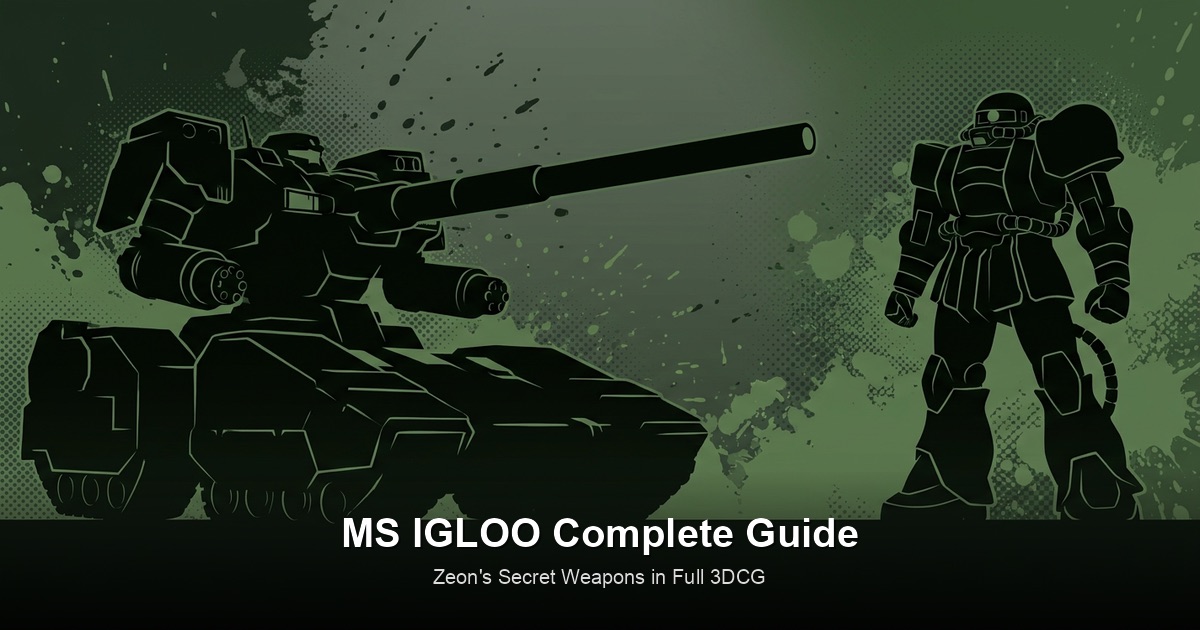
Gundam MS IGLOO — Complete Guide— Zeon's Experimental Weapons in Full CG
Contents
- 01What Is MS IGLOO? — A Story of Weapons That Could Not Win
- 02Understanding the Three-Series Structure at a Glance
- 03Series 1: The Hidden One Year War (2004)
- 04Series 2: Apocalypse 0079 (2006)
- 05Series 3: MS IGLOO 2: The Gravity Front (2008)
- 06Main Characters
- 07Experimental Weapons Compendium — The "What If" Weapons That Vanished
- 08Innovation as a Full CG Anime
- 09The "Truth of War" That MS IGLOO Tells
- 10How to Watch / Streaming Information
- 11Going Deeper with MS IGLOO
- 12Conclusion: What MS IGLOO Wants to Say
What Is MS IGLOO? — A Story of Weapons That Could Not Win
Mobile Suit Gundam MS IGLOO is the first fully 3D CG anime in the Gundam franchise.
This is not a Gundam about heroes. A machine called "Gundam" barely appears at all. The stage is a small Zeon test unit. Their mission: field-test experimental weapons of uncertain adoption and record the results.
Director Yutaka Izubuchi described the work as "a losing Project X." Most of the pilots who risked their lives in these tests were killed in action, and the weapons they rode vanished without a trace in the records. Yet — that is precisely where the true weight of war lies.
A story about the people who stood in the shadows during the grand historical stage of the One Year War. That is MS IGLOO.
Series Data (3 Series / 9 Episodes Total)
| Official Title | Mobile Suit Gundam MS IGLOO |
|---|---|
| Format | Full 3D CG anime (OVA / theater screening) |
| Total Episodes | 9 (3 per series) |
| Production Period | 2004–2009 |
| Director | Takashi Imaishi |
| Character / Mechanical Design | Yutaka Izubuchi, Hajime Katoki, Kimitoshi Yamane, Shinji Aramaki, and others |
| Music | Megumi Ohashi |
| Production | Sunrise, Bandai Visual |
| Time Setting | Universal Century 0079 (One Year War era) |
| Setting | Primarily space and Earth (Zeon 603rd Technical Evaluation Unit) |
Placement in the Universal Century
MS IGLOO depicts Universal Century 0079 — exactly the same era as the original Mobile Suit Gundam.
The perspective, however, is completely different. Where the original Gundam followed Federation boy Amuro Ray, MS IGLOO places Zeon technical officers at the center. Moreover, every weapon they handle is an experimental prototype that never achieved official adoption.
No place in the regular forces' records. No mention in the history books. But there were people who truly fought and gave their lives — MS IGLOO digs up that "invisible war."
For a full Universal Century timeline, see: Universal Century Timeline
Understanding the Three-Series Structure at a Glance
MS IGLOO is divided into three series, each depicting a different perspective and a different battlefield.
| Series Title | Release Year | Episodes | Main Perspective |
|---|---|---|---|
| The Hidden One Year War | 2004 | 3 | Zeon forces (space / Earth) |
| Apocalypse 0079 | 2006 | 3 | Zeon forces (final stage of the war) |
| MS IGLOO 2: The Gravity Front | 2008 | 3 | Earth Federation forces (ground combat) |
Series 1 and 2 follow the Zeon side; Series 3 switches to the Federation side. Both sides have their dramas, and both sides had their "nameless heroes."
Series 1: The Hidden One Year War (2004)
Series Overview
Created in 2004 for screenings at the Bandai Museum theater in Matsudo, Chiba. As the landmark first fully 3D CG anime in the Gundam franchise, it was produced by bringing together the best CG technology of its time.
The setting is the test support ship Jotunheim. Originally a civilian cargo vessel, it was requisitioned and converted by the Zeon military. The 603rd Technical Evaluation Unit boards her with a mission: field-test weapons still under development in live combat conditions.
The name "Jotunheim" comes from Norse mythology's "Land of the Giants," and many of the weapons and characters in this series take their names from Norse myth.
Episode 1: "The Iron Giant Sleeps in the Sea of Stars" (lit. "The Great Serpent Vanished at Loum")
Universal Century January 0079. In the chaos immediately following Zeon's declaration of independence for Spacenoids, a single experimental weapon is loaded onto the Jotunheim.
Its name: the Fleet Battle Cannon Jormungand — a massive prototype cannon developed with the goal of destroying a Magellan-class battleship in a single shot.
Towing this cannon, the Jotunheim heads for the Loum region, to participate in what will later be called the Battle of Loum — the largest space fleet engagement of the entire One Year War.
Young technical officer Lieutenant Oliver May is fresh out of university. He takes up his post nervous but believing in the weapon's potential. Meanwhile, Special Lieutenant Monique Cadillac, an elite female officer dispatched from Supreme Headquarters, attends the test as a calm and capable observer.
Jormungand faces its live combat test — but amid a massive fleet battle where history is being made, the gun's fate was quiet and unremarkable.
Episode 2: "Howl at the Setting Sun" (lit. "The Howl Was Dyed in the Setting Sun")
This time the experimental weapon is for ground combat.
Prototype Mobile Tank Hildolfr — a phantom weapon that had once failed its trials and been rejected, now dragged back out to coincide with the Earth drop operation.
Its pilot is Major Demeziere Sonnen, a seasoned tanker. A craftsman-soldier of long experience and pride. Hildolfr is a hybrid of tank and mobile suit, a heavily armored ground-crawler bearing multiple large-caliber weapons.
Loaded into the Jotunheim's Komusai (descent shuttle), Hildolfr drops to Earth — but suffers a Federation attack during transport. Real combat begins before the test can even start.
Landing in the Arizona wasteland, Hildolfr tears across the battlefield with overwhelming firepower, however outdated it may be called. Major Sonnen's fight is simply cool. But the day this weapon is rewarded never comes — its end embodies the senselessness of war.
Episode 3: "Spirits of the Fallen Advance on Odessa" (lit. "A Phantom Races in Orbit")
The conclusion of The Hidden One Year War features the most famous weapon in the entire series.
EMS-10 Zudah — a phantom mass-production mobile suit said to surpass the Zaku II in performance. Piloted by Major Jean-Luc Duvall, it is assigned to the Jotunheim.
Zudah carries a tragic history. An earlier machine, the EMS-04 Zudah, had a design flaw in the "Saturn Engine" that generated its high performance; a test unit disintegrated and exploded mid-flight. The footage was used by the Federation as propaganda, cementing the image that "the Zudah is defective."
But the EMS-10 Zudah, born after four years of redesign, is a genuinely high-performance machine that has overcome those flaws. Universal Century October 0079. Over the skies of Odessa, the Zudah fights fiercely against Federation mobile suits. Its agility is breathtaking, and pilot Major Duvall shows superb skill.
Even so, the Zudah was never mass-produced — politics and bureaucracy warped the proper evaluation of technology. "The Zudah was defeated by politics. And by demagogues." — This line stands as the most memorable quote from The Hidden One Year War.
Series 2: Apocalypse 0079 (2006)
Series Overview
Released as an OVA in 2006. Set aboard the same Jotunheim of the 603rd Technical Evaluation Unit as Series 1, but the story's timeline shifts to the final phase of the One Year War — the period when Zeon's forces are being driven back.
The Jotunheim and its crew, previously a "test unit," now face a situation where they are "committed to real combat as an active fighting force." There is no longer time for testing. Survival becomes the top priority.
Oliver May, who has been recording experimental weapons, undergoes a major change here. His role shifts from mere "recorder" to "warrior."
Episode 4: "The Desert Ogre Vanishes into the Moon"
Still fighting on Earth, the 603rd Technical Evaluation Unit receives a new test request: a prototype mobile suit called the Ghem Kamov.
Designed for desert combat, the Ghem Kamov is a close-combat mobile suit with a unique appearance unlike existing production machines. They set out to test it in the desert — but of course, the test unfolds under brutal conditions.
The Zeon lines had already begun to retreat. There is no longer any environment with the luxury to conduct tests at leisure. Even so, the technical evaluation unit keeps recording — because that is their pride.
Episode 5: "The Demon God Weeps in the Shaman's Desert" (lit. "A Demon God Weeps in Shamal of the Wilderness")
As the military situation deteriorates, the 603rd Technical Evaluation Unit receives orders to test the next experimental weapon.
What commands attention in this episode is the presence of Monique Cadillac's younger brother, Corporal Erwin Cadillac. Still a young soldier, he is assigned to a unit equipped with hastily built prototype mobile pods called Oggo, intended for A Baoa Qu's final defense.
The Oggo is a small combat pod emergency-developed to compensate for Zeon's shortage of fighting strength. Using salvaged parts from existing weapons and designed for rapid mass production in a short time — in other words, a near "disposable" weapon anyone can pilot, not just veterans.
Sister Monique knows of her brother's dangerous mission but can do nothing. This sibling drama gives Episode 5 a deep emotional weight.
Episode 6: "Flash of Valor at A Baoa Qu"
The final episode of Apocalypse 0079, and the conclusion of all six episodes across The Hidden One Year War and Apocalypse 0079.
Universal Century December 31, 0079 — the Battle of A Baoa Qu. The final decisive battle to determine the fate of the One Year War has begun.
Defense Command issues an order to the 603rd Technical Evaluation Unit: use the prototype mobile armor MA-05Ad Big Rang to defend the E-Field.
Big Rang is a massive mobile armor using the MA-05 Bigro as its control unit, designed as a "mobile forward bridgehead" — a forward supply base to resupply friendly units at the front. Its development concept was logistical support rather than combat, but such luxuries don't survive contact with the battlefield.
Placed under the command of Colonel Herbert von Kaspen and designated Kaspen Combat Battalion, the Jotunheim and its crew plunge into the final battle. Young Oggo pilots are thrown in one after another, the Zudah counterattacks, and Oliver May himself boards the Big Rang.
The tactical situation spirals downward. Even as ceasefire orders are issued, some Federation units refuse to stop attacking. Still May continues to fight — believing that "if soldiers have entrusted their lives to battle in any weapon, my duty is to faithfully pass on the truth of those weapons to future generations."
May's machine is destroyed. But Monique, piloting a Zudah, rescues him. The Jotunheim escapes A Baoa Qu and survives the One Year War.
Series 3: MS IGLOO 2: The Gravity Front (2008)
Series Overview
The third series, released for theater screenings and on OVA in 2008. It differs from the first two series in two major ways.
First, the perspective switches to the Federation. This is the story of Earth Federation soldiers, not the Zeon forces.
Second, the setting is limited to the ground (Earth). Not space combat, but fighting between infantry, tanks, and mobile suits on the surface. It sheds light on the "ground war" side of the One Year War — an aspect rarely depicted.
The format is anthology — each episode focuses on a different unit and different characters. But what every episode shares is the theme of "the struggle and death of nameless soldiers."
Episode 7: "Shoot That Death God!"
Universal Century March 0079 — immediately after Zeon launches its Earth Drop Operation.
The Federation had no countermeasure yet against the Zeon mobile suits (Zakus) that had descended to Earth. So they formed the Anti-Mobile Suit Specialist Platoon, an infantry unit equipped with specialized anti-MS guided missiles called "Regina," commanded by Lieutenant Barbary.
This episode's theme is "asymmetric disparity of force." How do living human beings fight mechanical giants? The Regina missiles have a certain effectiveness, but the one-sided situation doesn't change. Even so, the soldiers never abandon their posts — they keep fighting.
Episode 8: "Seize the Runway!"
Set on the Northern European front, the story follows a 61st Tank Platoon.
The tank platoon led by Lieutenant Yandel and Sergeant Slur faces a Zeon "White Zak" — not a standard mass-production type, but a distinctively colored machine piloted by a skilled and formidable enemy.
The Type 61 Tank was the main weapon before mobile suits appeared. In the age of MS supremacy it is becoming outdated, but they can only fight with the weapons they are given. The pride and inner conflict of the tank crews, and the bonds between comrades — this is the most human drama-filled episode of the Gravity Front series.
Episode 9: "Iron Knights of the Sky, Charge!"
The final episode of The Gravity Front features a Guntank platoon as its protagonist.
A large-scale Federation counter-offensive toward the Odessa front against Zeon. The Guntank platoon thrown into this battle is ordered to destroy the Zeon flagship Dabude.
The Guntank is a unique mobile suit (or rather, combat vehicle) with a mobile suit cockpit in the upper body and treads (caterpillar tracks) for a lower body. Unable to engage in pure close-quarters combat, its main role is long-range artillery bombardment.
The Guntank, which had almost no standout action in the original Gundam, is given its moment to shine as the protagonist here. This is essential viewing for Guntank fans. It is also known for generating many viewer comments along the lines of "You surprised me, Guntank."
Main Characters
Technical Lieutenant Oliver May (Protagonist, Series 1 & 2)
A young technical officer fresh out of university. Assigned to the 603rd Technical Evaluation Unit, he is responsible for evaluating and recording experimental weapons.
He believes purely in the technical potential of weapons, and is sometimes called a "tech nerd" by those around him. But as the war progresses, he transforms from a test record-keeper into a warrior fighting to survive.
In the final battle he boards the Big Rang himself and fights, but is rescued by Monique and survives the One Year War. "To faithfully convey to future generations the weapons that soldiers wagered their lives to fight in" becomes the guiding principle of his actions.
Special Lieutenant Monique Cadillac
An elite female officer dispatched from Supreme Headquarters (the core of the Zeon state). Calm, composed, and capable, she also carries the hidden role of intelligence gathering and surveillance.
As the series progresses, a relationship of trust deepens between her and May, making her far more than a mere monitor. Her younger brother Erwin is assigned to the Oggo unit, becoming the emotional core of the finale. In the final episode, she pilots a Zudah to rescue May — a scene that crowns the series' climax.
Captain Prohnov
The captain of the Jotunheim. A soldier of calm judgment, he also shows genuinely human consideration for his crew. He fulfilled the unconventional mission of a test support ship and protected the vessel through to the end of the war.
Colonel Herbert von Kaspen (Apocalypse 0079, latter half)
A regular Zeon unit commander who pilots a Gelgoog. He joins the Jotunheim in the latter half of Apocalypse 0079 and forms the Kaspen Combat Battalion. He leads the young Oggo soldiers into the defense of A Baoa Qu.
Experimental Weapons Compendium — The "What If" Weapons That Vanished
The greatest appeal of MS IGLOO is its experimental weapons, erased to the shadows of history. Each has a backstory, and each carries the tragedy of "not being adopted" for its own reason.
Fleet Battle Cannon Jormungand
A massive prototype cannon developed with the goal of destroying a Magellan-class battleship in a single shot. Named after the World Serpent of Norse mythology.
It participated in the mass fleet engagement of the Battle of Loum, but its end was quiet. In large-scale fleet combat, the mobile suit's wave tactics proved more effective than a single cannon's contribution — an experience that, it could be said, firmly cemented Zeon's MS-first doctrine.
Prototype Mobile Tank Hildolfr
A heavily armored, heavy-firepower prototype weapon for ground warfare. Designed as a hybrid of tank and mobile suit, mounting multiple large-caliber guns. A "rejected weapon" that had once failed its adoption review, dragged back to the testing stage amid the chaos of the Earth Drop Operation.
Its pilot, Major Demeziere Sonnen, is a former tanker. His "craftsman's pride" breathes life into the Hildolfr. The combination of a weapon left behind by the times and a soldier who takes pride in that weapon is the core of Episode 2.
EMS-10 Zudah
The most popular weapon in the series. A prototype mobile suit expected to surpass the Zaku II in mobility.
Its predecessor, the EMS-04 Zudah, suffered a mid-air disintegration accident due to a design flaw in the "Saturn Engine," was exploited by Federation propaganda, and was branded a "defective machine." But the EMS-10 Zudah is an improved variant that overcame those problems, and its actual performance was very high.
Even so, the reputation of "Zudah = defective" was never reversed. Defeated not by technical inferiority but by politics and information warfare — that message struck viewers' hearts. The HGUC kit has also been released, and the Zudah remains popular as a Gunpla to this day.
Prototype Mobile Pod Oggo
A small mobile pod emergency-developed by the Zeon military in the final phase of the One Year War, when they faced a critical shortage of fighting strength. Using salvaged parts from the MS-06J Zaku (Ground Type) and designed for rapid mass production. Its armaments are also recycled from existing Zaku equipment.
Deployed to the final defense of A Baoa Qu were not veteran pilots, but young soldiers. Monique's brother Erwin is one of them. The mission assigned to them and their fate form the emotional core of Apocalypse 0079.
Prototype Mobile Armor MA-05Ad Big Rang
A massive mobile armor using the MA-05 Bigro as its control unit. Designed as a "mobile forward bridgehead" — a forward supply base to resupply and support allies at the front.
Its concept was logistical support rather than combat, but it is thrown directly into battle in the final battle. The weapon that serves as the stage for the story's climax, when Oliver May himself boards it and takes up the defense of the E-Field.
Innovation as a Full CG Anime
When MS IGLOO was released in 2004, full 3D CG anime had no precedent in the Gundam franchise.
What sets it apart is that everything, including the characters, is rendered in CG. Conventional anime typically composites hand-drawn characters over CG backgrounds and mechanical elements, but MS IGLOO expressed everything in CG — from characters' facial expressions to the movement of machines.
This approach had its challenges. With 2004-era CG technology, human expressions and movement sometimes felt "somehow stiff" — what is called the "uncanny valley" effect. But the detail and texture of the machines (mobile suits, warships, weapons) carried overwhelming realism that impressed machine enthusiasts.
Director Takashi Imaishi also worked on 0083: Stardust Memory (Episodes 8–13). The mechanical design roster includes Yutaka Izubuchi, Hajime Katoki, Kimitoshi Yamane, and Shinji Aramaki — powerhouses of the Gundam world — and the designs of the experimental weapons have a high degree of finish.
By the third series, "The Gravity Front" (2008), the technology had further advanced, achieving more natural visual expression than the first two series.
The "Truth of War" That MS IGLOO Tells
The Gundam franchise carries a consistent theme of "depicting the tragedy of war." But MS IGLOO's approach is a notch different from prior works.
In typical Gundam, the center of the story is held by protagonists with the ability to change the course of the war, or villains who carve their names into history. "Newtypes," "the white thing from the Federation," "the Red Comet" — figures everyone knows.
The people in MS IGLOO are not like that. A small unit that does nothing but test experimental weapons. A technical officer whose name will never appear in any history book. Pilots of weapons that were never even adopted. They simply try to fulfill their own roles within the enormous gears of war.
That is precisely why the deaths in MS IGLOO hurt. The story of people who were treated as "expendable" interchangeable parts, yet fought with dignity. The tagline "a losing Project X" is not mere advertising copy — it expresses the very essence of the work itself.
For those who haven't yet learned the story of the original Gundam: Original Gundam Complete Guide
How to Watch / Streaming Information
MS IGLOO is available on multiple platforms.
| Platform | Series Available | Format |
|---|---|---|
| Bandai Channel | All 3 series | Subscription streaming |
| d Anime Store | Series 1 & 2 | Subscription streaming |
| Amazon (physical purchase) | All 3 series (Blu-ray) | Purchase |
| Crunchyroll Store | All 3 series (Blu-ray) | Purchase |
Bandai Channel is the most comprehensive platform for the Gundam franchise and carries all episodes of MS IGLOO. Series 1 and 2 are also available on d Anime Store.
The recommended viewing order is The Hidden One Year War → Apocalypse 0079 → The Gravity Front. Rather than following chronological order, watching along the emotional flow of "Zeon perspective → Federation perspective" makes the final Gravity Front resonate more deeply.
Watching the original Gundam first creates a double pleasure of seeing the same era's events told from a different point of view. That said, MS IGLOO is structured so it can be enjoyed on its own without having seen the original.
Going Deeper with MS IGLOO
Gunpla Information
Some of the experimental weapons from MS IGLOO have been released as Gunpla.
EMS-10 Zudah has been kitted in the HGUC (High Grade Universal Century) series and is still obtainable today. The distinctive Saturn Engine nozzle and the unique silhouette distinct from the Zaku are faithfully reproduced.
Hildolfr has also been kitted, and is especially popular with Gunpla fans who like tank-type machines. Its uniquely heavy, substantial design looks impressive as a plastic model as well.
Manga / Novel Adaptations
A manga version of MS IGLOO (MS IGLOO 603) also exists, published by Kadokawa. It delves deeper into the anime's story and portrays the psychology of its characters with careful attention.
Conclusion: What MS IGLOO Wants to Say
MS IGLOO is not "the first work to watch if you don't know Gundam." But for those who already know the One Year War, or who watch it after seeing the original Gundam, its depth of flavor is extraordinary.
The discovery of: so, during the same One Year War timeline, these people were fighting, with these weapons, in this way.
There are no flashy victories. No famous heroes appear. Even so, they were truly there. People who recorded experimental weapons, witnessed the final moments of pilots, and survived the other side of the war.
A Gundam work in which a machine called "Gundam" barely appears. That is MS IGLOO. And that is precisely why this work occupies a truly unique place within the Gundam franchise.
Please, witness this other face of the One Year War for yourself.
Related Articles: - Original Gundam Complete Guide - Universal Century Timeline