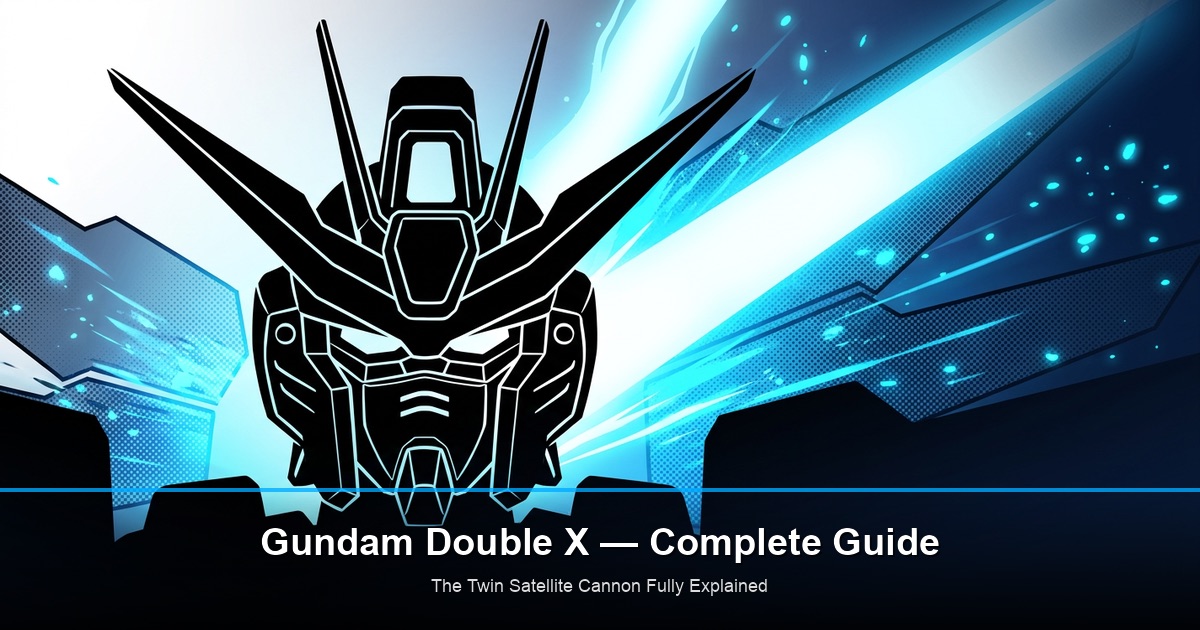
Gundam Double X Complete Guide— The Twin Satellite Cannon Fully Explained [After War Gundam X]
Contents
- 01What Is Gundam Double X — Successor to the "Last Trump Card"
- 02Core Specifications — Top-Tier Combat Performance in the Post-War Era
- 03Development History — The "Crystallization of Ambition" of the New Earth Federation
- 04Armament Breakdown — From the Twin Satellite Cannon to Close Combat
- 05Pilot — Garrod Ran
- 06Story Highlights — Garrod's Path to DX
- 07Variants — The Lineage from Gundam X to DX
- 08Design Notes — Kunio Okawara's "Aesthetics of Power"
- 09Cultural Impact — The Unique Legacy of Gundam X
- 10Iconic Scene Selections — Moments When Gundam Double X Shone
- 11Gundam Double X Q&A — Answering Common Questions
- 12Gunpla Guide — All Grades Compared in Detail
- 13Related Articles
- 14Sources & References
What Is Gundam Double X — Successor to the "Last Trump Card"
Energy channeled down from the moon, converged to a single point, capable of erasing an entire island. That is the reality of the Twin Satellite Cannon wielded by Gundam Double X (model number: GX-9901-DX).
Debuting in the second half of After War Gundam X, which aired in 1996, Gundam Double X was built to surpass Gundam X (GX) — the most feared strategic weapon of the 7th Space War. Its destructive power far exceeds that of the single Satellite Cannon, and in the final battle it triggered an explosion that shook the surface of the moon itself.
Yet when discussing this mobile suit, the pilot who wielded it — Garrod Ran — matters just as much as the weapon itself. Not a Newtype. Not a soldier. An orphan who lost his parents to war, who took hold of this superweapon for one reason alone: to protect the person he loved. That human drama is the true protagonist of Gundam Double X.
This article covers everything about Gundam Double X — technical specs, development history, the story of Garrod and Tiffa Adill, variant units, and Gunpla — with nothing left out.
Core Specifications — Top-Tier Combat Performance in the Post-War Era
GX-9901-DX Basic Specifications
| Item | Details |
|---|---|
| Model Number | GX-9901-DX |
| Classification | General-Purpose Mobile Suit for Newtypes |
| Head Height | 17.1 m |
| Empty Weight | 7.7 t |
| Armor Material | Luna Titanium Alloy |
| Power Source | Satellite System (lunar microwave receiver) |
| Main Armaments | Twin Satellite Cannon ×2, DX Buster Rifle, Hyper Beam Sword ×2, Breast Launcher ×2 |
| Special Equipment | Flash System, GX-Bit command capability |
| Developer | New Earth Federation Army (led by Aimzat Kartral) |
| Manufacturing Site | Pacific artificial island "Zonder Epta" |
| Pilot | Garrod Ran (after capture), New Earth Federation soldiers (original) |
Unit Concept
Gundam Double X was designed as a "strategic decisive-battle weapon that surpasses GX." Where GX carried a single Satellite Cannon, DX lives up to its name by mounting double (two) cannons. Its output substantially exceeds its predecessor, and it demonstrated the destructive power to eliminate an artificial island in a single shot.
The armor uses Luna Titanium Alloy, ensuring a high standard of protection. The integrated Flash System enables remote control of GX-Bits (unmanned mobile suits), giving DX a level of total combat capability considered among the strongest of any mobile suit developed in the post-war period.
Development History — The "Crystallization of Ambition" of the New Earth Federation
What the 7th Space War Left Behind
To understand how Gundam Double X came to exist, we must first go back to the "7th Space War" (commonly called the Great War) — the conflict that preceded it.
During the Great War, the old Earth Federation used Gundam X and the Satellite System to counter the colony drops. Newtype pilot Jamil Neate, piloting a single GX alongside 12 GX-Bits, unleashed a simultaneous barrage that destroyed numerous colonies. Ultimately, however, Jamil's GX was heavily damaged in combat against the Space Revolutionary Army's Newtype-dedicated unit "Febral," and it fell to Earth. The war left both sides devastated, and civilization collapsed.
The post-war world was in ruins. Former cities lay buried under rubble, and people survived day to day. From those ruins, a faction emerged seeking to build "a new order" — the New Earth Federation Government (Government Reconstruction Committee).
Aimzat Kartral's Ambition
Within the New Federation, the one person most aggressively pushing for the development of Gundam Double X was Intelligence Chief Aimzat Kartral. Operating under the logic that "to deter war, you need a superweapon no one can defy," he drove the development of a GX successor — advancing the plan in secret, separate from the Government Reconstruction Committee's official agenda.
The development came with significant obstacles.
- Absence of Newtypes: After the Great War, no Newtype capable of operating the Flash System could be secured.
- Technical limitations: A fully original design was not feasible, requiring the GX's blueprints to be reused as a base.
- GX recovery: As a solution, Jamil's GX — which had fallen to Earth — was recovered. Its systems were transplanted wholesale into the new unit.
Manufacturing at Zonder Epta Island
The artificial island of Zonder Epta, constructed in the Pacific Ocean, was chosen as the site for secret development. The Flash System transplanted from GX, combined with newly designed twin Satellite Cannons, produced a unit that was GX on the outside and something entirely different within. The completed GX-9901-DX was placed under tight security as the symbol of the New Federation's power.
Because no Newtype had been secured by the time development was completed, conventional pilot operation was also considered early on — but drawing out the Flash System's true potential still required a Newtype.
This contradiction — "the most powerful unit, but no Newtype to pilot it" — was eventually resolved by an exceptional individual named Garrod Ran.
Armament Breakdown — From the Twin Satellite Cannon to Close Combat
Gundam Double X's weapon system covers a wide range, from ultra-long-range strategic strikes to close-quarters combat.
Twin Satellite Cannon — The Ultimate Ace in the Hole
The defining armament of Gundam Double X and its most powerful weapon. Large-scale energy transmitted via microwave from a lunar power generation facility is received and focused by the reflector unit on DX's back, then fired as an ultra-high-output beam. This is a strategic-class weapon.
Differences from the GX's Satellite Cannon
Where GX's Satellite Cannon was a single barrel, DX — as its name implies — carries two. The output is not merely doubled; firing both barrels simultaneously creates a synergistic effect, delivering destructive power that far exceeds its predecessor.
In the series, a single shot demonstrated the ability to annihilate Zonder Epta Island (the artificial island). When the two Satellite Cannons clashed in the final battle, the collision triggered a massive explosion affecting nearly a third of the moon's surface — a literally astronomical impact.
Operational Constraints
The Twin Satellite Cannon carries significant limitations.
- Usable only when the moon is visible: Energy must be received via microwave from the moon, so the cannon can only fire when the moon is above the horizon.
- Charging time required: A certain amount of time is needed from energy reception to focusing and firing. The unit is vulnerable during this period.
- Original Newtype dependency: The weapon achieves its full potential in conjunction with the Flash System, originally requiring a Newtype pilot. Garrod, though not a Newtype, wielded it through extraordinary instinct and adaptability.
DX Buster Rifle
A large beam rifle designed specifically for Double X. It shares design lineage with the Gundam X Buster Rifle but is uprated for higher output, serving as the primary weapon in situations where the Satellite Cannon cannot be used.
In standard combat, this Buster Rifle takes center stage while the Twin Satellite Cannon is held in reserve as a trump card. Its rapid-fire capability also proved effective in engagements against multiple enemies.
Hyper Beam Sword ×2
Close-combat beam weapons, with two mounted at the waist. An enhanced version of Gundam X's beam sword, offering improved blade stability and output.
Garrod made active use of these in a dual-wield configuration, displaying overwhelming strength even in close-range combat. In particular, the scene immediately after capturing Double X — in which he annihilated enemy forces using only the built-in weapons — stands as a celebrated moment that proved both Garrod's melee instincts and the unit's close-combat capability.
Breast Launcher ×2
Twin fixed-mount weapons embedded in the chest. A mid-range armament capable of firing beams or missile-type projectiles, and when combined with the Buster Rifle, it enables simultaneous attacks from multiple directions.
Because these are fixed weapons requiring no repositioning, they appear frequently in scenes of quick counterfire and suppression — a good match for Garrod's versatile fighting style.
Flash System + GX-Bit Command Capability
Not a weapon in the conventional sense, but the Flash System transplanted from GX grants DX the ability to remotely control GX-Bits (bit mobile suits).
This system amplifies and transmits a Newtype's brainwave signals to control multiple unmanned units. While originally intended for Newtypes, Garrod was able to achieve a degree of operation despite not being one. The ability to simultaneously command multiple unmanned units in a suppression role represents a level of combat capability that no contemporary mobile suit could match.
Pilot — Garrod Ran
Character Profile
Garrod Ran is the protagonist of After War Gundam X and the pilot of Gundam Double X. Age 16. Voiced by Wataru Takagi.
A war orphan who lost his parents in the 7th Space War, Garrod made his living in the devastated post-war world through MS Hunting (mobile suit salvage and resale) and scavenging. He received no formal military training, but having climbed into and played around with abandoned mobile suits since childhood, he developed superior piloting skills entirely on his own.
Personality and Character
Garrod's personality combines "hot-blooded directness" with "extraordinary adaptability."
He expresses emotion without a filter, often clashing with those around him because he says what he means too bluntly. But at his core he is honest and pure — he acts on simple, powerful motivations: "I hate bullying" and "I want to protect the person I love."
Extraordinary Marksmanship
The main reason Garrod — not a Newtype — could operate GX with its Flash System is his exceptional spatial awareness and shooting ability. He demonstrated an almost Newtype-like sense of perception, such as accurately targeting GX-Bits in the middle of a blinding blizzard, suggesting intuition that borders on Newtype-level instinct.
A Non-Newtype Protagonist
Many Gundam protagonists are Newtypes (or enhanced humans), but Garrod is not.
"Does a person have to be a Newtype to deserve a Gundam?" — Rather than answer that question with talent or bloodline, Garrod continually answers it with will and effort. He begins by stealing GX — a Flash System-equipped unit — and ultimately masters Newtype-class weaponry aboard DX. This arc of growth is deeply intertwined with the series' overarching theme: "What is a Newtype?"
Relationship with Tiffa Adill
Garrod's direct motivation for stealing Gundam X was to save Tiffa Adill.
Tiffa is "the only Earth-born Newtype confirmed to exist after the war," and she had been held captive by an organization called Alternative seeking to exploit her abilities. Garrod became involved in escorting Tiffa through a job and immediately fell for her. To steal Tiffa away from the organization, he grabbed GX — which happened to be nearby — and ran.
Tiffa had possessed prophetic painting ability and empathic powers since before the war, but years of being treated as a research subject had left her nearly silent and unable to show her feelings. As she meets Garrod and gradually experiences his rough-edged kindness, she begins opening her heart.
Their relationship goes beyond a simple romance. The shift from "the one who protects and the one who is protected" to "two people walking toward the future together" is the narrative core of Gundam X, and the two of them in the final episode remain one of the most emotionally resonant moments the series has to offer.
Mentor Relationship with Jamil Neate
From the middle of the story onward, the figure who becomes essential to Garrod is Freeden's captain, Jamil Neate.
Jamil was the pilot of GX Unit 1 — a former Newtype who survived the Great War. Emotionally scarred by guilt over the war, he has continued his journey as a captain since losing GX. Jamil initially refused to acknowledge Garrod's right to pilot GX, but gradually comes to recognize his talent and watch over him as a successor — a relationship carefully depicted as a secondary storyline throughout the series.
Story Highlights — Garrod's Path to DX
First Encounter with GX (Episode 1 onward)
Garrod's first encounter with a mobile suit comes when he steals Gundam X — stored in an abandoned factory — to rescue Tiffa. A boy with no training whatsoever, operating one of the world's most powerful mobile suits by sheer instinct: this forceful setup was emblematic of the Gundam X series from its very opening.
Picked up by Freeden (a mobile fortress and transport ship), Garrod and Tiffa join Captain Jamil's Newtype search team. They travel through a world still scarred by the remnants of the Great War, clashing with faction after faction along the way.
First Encounter with Double X (Episode 22)
Episode 22 marks the story's turning point.
Gundam Double X — developed as a secret weapon of the New Earth Federation Army — finally appears before the Freeden team. The revelation that a unit beyond what they had believed to be the strongest GX existed shook Garrod and his companions deeply. The tense scene in which the Twin Satellite Cannon is aimed directly at Freeden raised the story's sense of crisis to its peak.
Capturing Double X (Episode 24)
Garrod takes possession of DX in episode 24.
During an infiltration operation on Zonder Epta Island, Garrod successfully captures Gundam Double X — though at that point it is restricted to built-in weapons only (the Hyper Beam Swords).
Even so, Garrod wipes out enemy forces in that limited state. He then confirms the evacuation of all personnel before destroying Zonder Epta Island with the Twin Satellite Cannon — forcing the New Federation's Far East Army reinforcements into retreat as well.
Why Garrod Could Use DX
The background to Garrod — not a Newtype — being able to operate DX with its Newtype-exclusive Flash System lies in his accumulated real-combat experience with GX and his own near-Newtype spatial awareness. He did not have full control of the Flash System, but at the level of practical battlefield operation, he was able to draw out sufficient performance.
Docking with the G-Falcon
From the middle of the series through the finale, Gundam Double X increasingly appears in the combined "G-Falcon + Gundam Double X" configuration with support unit G-Falcon.
G-Falcon is a large transformable support unit developed during the 7th Space War era with Gundam-type docking in mind, but its design was also compatible with the newer DX. When docked, mobility and thrust increase substantially, dramatically extending DX's operational range in space.
The Final Battle — Lunar D.O.M.E.
The story reaches its climax on the surface of the moon.
D.O.M.E. — a mysterious system on the moon — houses the memories and consciousness of past Newtypes and holds the answer to the question "What is a Newtype?"
In the final battle, the Space Revolutionary Army's trump card "Gundam Virsago Chest Break" (piloted by Olba Frost) clashes with Gundam Double X. When the Satellite Cannons of both units collide, the impact triggers a massive explosion affecting nearly a third of the moon's surface.
The explosion leaves Gundam Double X heavily damaged and abandoned. But that battle brings closure to the conflict surrounding the concept of Newtypes — and leads to the conclusion in which Garrod and Tiffa survive as "a hope for the future."
Variants — The Lineage from Gundam X to DX
GX-9900 Gundam X — Where It All Began
| Item | Details |
|---|---|
| Model Number | GX-9900 |
| Head Height | 17.1 m |
| Empty Weight | 8.2 t |
| Armor Material | Luna Titanium Alloy |
| Main Armaments | Satellite Cannon ×1, Buster Rifle, Beam Sword ×2 |
| Pilot | Jamil Neate (during the Great War), Garrod Ran (post-war) |
The predecessor to Gundam Double X. A decisive-battle weapon manufactured by the old Earth Federation during the 7th Space War, this was the first unit ever equipped with lunar microwave reception capability (the Satellite Cannon).
During the Great War, Jamil Neate piloted it alongside 12 GX-Bits in the colony defense campaign. After the war it was abandoned, only to be retrieved and reactivated by Garrod Ran. GX is the foundation on which DX was built; the Flash System and basic structural framework were carried over directly from GX to DX.
GX-9900-DV Gundam X Divider — A Field-Modification Masterpiece
| Item | Details |
|---|---|
| Model Number | GX-9900-DV |
| Head Height | 17.1 m |
| Empty Weight | 7.7 t |
| Armor Material | Luna Titanium Alloy |
| Main Armaments | Divider (contains 19 multi-barrel beam cannons), Buster Rifle, Beam Sword |
| Pilot | Garrod Ran |
A modified form of Gundam X. After GX was heavily damaged in battle against the powerful enemy Bertigo, Kid Salsamille independently designed a multi-function armament unit called the "Divider" and attached it to revive the unit.
The Divider is a large unit housing 19 multi-barrel beam cannons ("harmonica cannons"). In use, the unit folds out from the center and fires simultaneously — the radial spread of beams creates an extremely effective suppression barrage with nowhere to escape.
In place of the Satellite Cannon, it carries large MA-class thrusters, dramatically improving maneuverability. Some observers rate its overall combat capability as actually exceeding the Satellite Cannon-equipped GX.
GX-9901-DX with G-Falcon — Maximum Form
The combined form of Gundam Double X and support unit G-Falcon.
G-Falcon is a large transformable support unit developed by the New Earth Federation Army. It docks with DX by sandwiching the fuselage from above and below, substantially increasing overall length when combined.
The benefits of docking are as follows: - Greatly improved thrust and acceleration from large additional thrusters - Extended operational range in outer space - Addition of G-Falcon's own armaments (beam cannons, etc.) - Twin Satellite Cannon remains usable in the docked configuration
For long-range space operations and decisive engagements, this combined form became the standard configuration.
Design Notes — Kunio Okawara's "Aesthetics of Power"
Mechanical Designer Kunio Okawara
The mechanical design of Gundam Double X was handled by Kunio Okawara, who has contributed to the Gundam series' mechanical design over many decades.
Okawara has been involved since the very beginning of the Gundam franchise, creating legendary designs including the original Gundam (RX-78-2) and the Zaku. He served as the principal designer for the Gundam X series as well, handling the full run of designs from GX through DX.
Design Concept of Double X
The most eye-catching element of Gundam Double X's design is the massive twin Satellite Cannons that deploy from its back.
Under Okawara's design philosophy of "conveying strength visually," DX's silhouette was conceived as "a powerful presence with great wings." When the Satellite Cannons deploy and spread like wings, the image embodies a "warrior who carries the power of the heavens in his wings."
To convey a clear sense of being "a tier above GX," the head's twin eyes were made sharper and more angular, and the overall proportions were slimmed down for a more mobile impression. "Elegance within strength" is distinctly Okawara's approach.
Visual Continuity Between GX and DX
GX and DX were designed as sibling units, with intentional continuity between the two.
- Shared basic silhouette: The head shape, core body lines, and reflector unit placement all follow GX's design language.
- Expression of Satellite Cannon enhancement: The change from one barrel to two visually communicates the unit's "evolution."
- Inherited color scheme: The classic Gundam white, blue, red, and yellow are maintained, with DX's arrangement sharpened and more precise.
This design philosophy simultaneously communicates "unmistakably the successor to GX" while also achieving clear differentiation as a superior model — a sophisticated approach.
Cultural Impact — The Unique Legacy of Gundam X
The Trial of Broadcast Reduction
After War Gundam X is a TV anime that aired from April to December 1996. It was directed by Shinji Takamatsu, with series composition and all episode scripts written by Hiroyuki Kawasaki.
The series originally aired on Friday at 5:00 PM in a children's time slot, but from episode 27 onward the broadcast on the key network TV Asahi was shifted to Saturday at 6:00 AM. The run was also shortened, concluding at 39 episodes — an unusually small number for a Heisei-era Gundam series at the time.
That said, the content was not a "cancellation" in a creative sense. Because Hiroyuki Kawasaki wrote every single episode himself, the series maintained narrative cohesion. All the story material originally planned was successfully compressed into the reduced episode count, and the series concluded with the planned ending without any story breakdown.
Super Robot Wars as a Catalyst for Reappraisal
For some time after the broadcast ended, Gundam X carried the reputation within the Gundam franchise of being "a minor work." What changed that significantly was the series' inclusion in the Super Robot Wars (SRW) franchise.
When Gundam X appeared in SRW, the animation and effects for Gundam Double X's Twin Satellite Cannon generated an enormous response. Its spectacular visuals and high attack power captured players' hearts, and a phenomenon emerged in which "people who never watched the original got into it through SRW."
This "SRW effect" sparked a reappraisal of Gundam X, and Gundam Double X went on to become one of the most popular units in the SRW franchise.
The Universal Theme of "Newtype Theory"
One reason Gundam X continues to earn fan support is its unique answer to the question "What is a Newtype?"
While UC Gundam often depicts Newtypes as "the next stage of humanity, adapted to space," Gundam X critically portrays them as "beings exploited as tools of war." The answer ultimately revealed at lunar D.O.M.E. — "Newtypes are not humanity's future form; they are simply one variant of human being" — stands out as a philosophical conclusion unlike anything else in the Gundam franchise.
This perspective aligns perfectly with the story of Garrod Ran — who, without special talent or bloodline, seizes his future through will and action — making it the series' consistent, unified message.
A Reappraisal Now Firmly Established
Today, Gundam Double X is widely recognized as a "hidden gem." Related merchandise is plentiful — Gunpla re-releases and new toolings, repeated appearances in SRW entries, and inclusion across various game titles.
"I missed it when it aired, but I was deeply moved when I finally watched it." "I love Garrod and Tiffa as a couple." "The romance of the Twin Satellite Cannon is unmatched." — The fact that these voices have never stopped is proof of both the series' intrinsic quality and the singular presence of Gundam Double X as a mobile suit.
Iconic Scene Selections — Moments When Gundam Double X Shone
A curated selection of the most memorable scenes from Double X's debut through the final battle.
Episode 22, "The Threat of Double X": Double X makes its appearance as the New Federation's ultimate weapon. The scene in which its Twin Satellite Cannon is aimed directly at Freeden was the turning point that instantly raised the first half's tension to its peak. The sense of despair — that even GX might not be able to cope — came through vividly to viewers.
Episode 24, "The Destruction of Zonder Epta": The sequence in which Garrod captures DX, wipes out enemy forces with only built-in weapons, and then erases the artificial island with the Twin Satellite Cannon. It was also a clear answer to the question of "what does Garrod choose when given power" — destroy the island, but do not take lives.
Final Battle, "Lunar D.O.M.E.": The clash between Gundam Virsago Chest Break and Double X's Satellite Cannons. The massive explosion on the lunar surface was a visual spectacle, and simultaneously the scene that symbolized the conclusion of "the war over Newtypes."
Gundam Double X Q&A — Answering Common Questions
A collection of frequently asked questions, from fans new to the Gundam X series to hardcore setting enthusiasts.
Q1. Garrod isn't a Newtype — so why can he operate DX?
Garrod Ran is genuinely not a Newtype. However, he has the accumulated experience of handling mobile suits entirely on his own since childhood, plus an innate spatial awareness ("near-Newtype intuition") he was simply born with.
He cannot achieve "full control" of the Flash System, but at the level of operating the unit in real combat, it was sufficient. Within the story, the question of "is Garrod really not a Newtype?" is raised among the characters themselves, but the series deliberately ends without giving a definitive answer.
"Opening your own path through will and action, even without special talent" — that theme is the very reason for Garrod's existence as a character.
Q2. Why can the Twin Satellite Cannon only fire when the moon is out?
The Satellite Cannon works by receiving large-scale energy transmitted via "microwave (a type of electromagnetic wave)" from a power generation facility on the lunar surface to Earth, then focusing and firing that energy. In other words, the moon must be above the horizon (visible from Earth) to receive the energy. Firing is possible on a cloudy day (electromagnetic waves pass through clouds), but when the moon is on the opposite side of the Earth it is literally unusable.
This constraint is a narrative device ensuring "every most powerful weapon has a weakness," and it is a crucial story setting that generates tension.
Q3. Are Gundam X and Gundam Double X the same unit?
They are different units. GX-9900 (Gundam X) and GX-9901-DX (Gundam Double X) carry different model numbers and are separately designed mobile suits.
That said, DX was developed as the "enhanced successor" to GX, and GX's Flash System was transplanted directly into DX. The structural design also uses pre-war GX as a base, so the silhouettes are similar. Thinking of them as "sibling units of the same lineage" is the closest analogy.
Q4. Was Gundam X cancelled?
The word "cancellation" is sometimes used, but it is not strictly accurate.
The broadcast time change and episode reduction are facts, but because scriptwriter Hiroyuki Kawasaki wrote all 39 episodes himself, he adjusted the story to fit the revised episode count. As a result, the series concluded with its planned ending, with no narrative breakdown.
"The episode count was reduced, but everything that needed to be said was said" — that is the accurate assessment.
Q5. How powerful is Gundam Double X within the Gundam franchise?
Compared to units within the same setting and era, it is established as "one of the strongest mobile suits manufactured in the post-war period (after the 7th Space War)."
Cross-series comparisons across the entire Gundam franchise remain in the realm of unofficial fan enjoyment. In the SRW series, DX's strength is expressed through "the overwhelmingly high attack power of the Twin Satellite Cannon," earning it consistent popularity among players.
The scale of its destructive power — sufficient to trigger a massive explosion on the moon — is comparable to UC Gundam's colony lasers or nuclear weapons, and the fact that it functions as a strategic weapon further distinguishes it from most other lead Gundam units.
Gunpla Guide — All Grades Compared in Detail
HGAW 1/144 Gundam Double X
| Item | Details |
|---|---|
| Item No. | HGAW 1/144 GX-9901-DX |
| Price | 2,090 yen (tax included) |
| Release Date | October 11, 2013 (Bandai Spirits) |
| Scale | 1/144 |
| Included | Twin Satellite Cannon (deploy gimmick), DX Buster Rifle, Hyper Beam Sword ×2, Reflector Unit |
Features & Review
Despite being released in 2013, the HGAW kit uses a double-joint internal structure and torso articulation, giving it articulation performance close to kits of the 2020s.
The highlight is the Twin Satellite Cannon's deploy gimmick. The switch to firing configuration is reproduced as an actual mechanism, offering high play value. The rear reflector unit also opens and closes. The molded colors faithfully reproduce the in-series color scheme, and panel lining plus partial painting adds a significant boost in realism. For its price range, this kit has earned very high praise.
Recommended For - An affordable entry point for newcomers - Display-worthy with rich deploy gimmicks - Compact size that is easy to display
MG 1/100 Gundam Double X
| Item | Details |
|---|---|
| Item No. | MG 1/100 GX-9901-DX |
| Price | 5,390 yen (tax included) |
| Release Date | March 28, 2015 (Bandai Spirits) |
| Scale | 1/100 |
Features & Review
The definitive kit, rendered at 1/100 scale as a Master Grade. Compared to the HGAW, the larger size brings substantially improved detail and range of motion.
The internal frame structure unique to MG means the skeleton looks impressive even with exterior armor removed. The Twin Satellite Cannon's deploy gimmick is reproduced with greater precision than the HG — the opening and closing of the reflector unit, the extension and retraction of the barrel barrels, and the complexity and completeness of the mechanism are truly impressive.
Docking with G-Falcon is also reproducible (requires separate purchase of "MG G-Falcon Unit DX"). The combined form is spectacular enough to be the centerpiece of any display shelf.
Recommended For - Serious builders who want a fully detailed internal frame - Precision Twin Satellite Cannon deploy action - Combined display with G-Falcon (separate kit)
HGAW 1/144 G-Falcon Unit DX Set
| Item | Details |
|---|---|
| Contents | Gundam Double X + G-Falcon combined set |
| Scale | 1/144 |
| Features | Full reproduction of combined form (G-Falcon + DX), G-Falcon armaments (beam cannons, etc.) included |
A set kit for enjoying DX and G-Falcon together. The silhouette of the combined form has a sense of scale entirely unlike the solo DX, and for displaying the "complete form" this is the way to go. It does require display space, but for Gundam X fans it is an essential item.
How to Choose
| Your Type | Recommended Kit |
|---|---|
| First-time Gundam X buyer | HGAW 1/144 Gundam Double X |
| Want a more serious build | MG 1/100 Gundam Double X |
| Want to see the combined form | HGAW G-Falcon + DX Set |
| Collector | MG DX + MG G-Falcon Unit |
| Want to keep it simple | Unify in HGAW series (DX + X Divider for full GX lineup) |
HGAW Gundam X Series List
The HGAW series has brought multiple GX-family units to kit form. Completing the lineup lets you enjoy the full mobile suit roster of the series.
| Name | Scale | Features |
|---|---|---|
| HGAW Gundam X | 1/144 | Predecessor unit. Single Satellite Cannon. |
| HGAW Gundam X Divider | 1/144 | Equipped with Divider unit. Harmonica cannon deploys. |
| HGAW Gundam Double X | 1/144 | Second-half lead unit. Twin cannon deploy gimmick. |
| HGAW G-Falcon Unit DX | 1/144 | DX + G-Falcon combined set. |
Related Articles
- Gundam X — Complete Mobile Suit Guide: The predecessor to Double X. The original Satellite Cannon. The legend Jamil Neate piloted in the 7th Space War.
- After War Gundam X — Complete Series Guide: A comprehensive series guide covering all 39 episodes, characters, and the world setting.
- Gundam Virsago — Complete Guide: The arch-rival of Gundam Double X. Alternative's trump card, piloted by Shagia Frost.
- Gundam X Divider — Complete Guide: GX reborn through field modification. The partner that supported Garrod through the first half of his journey.
- Gundam Ashtaron — Complete Guide: One of the twin units piloted by Olba Frost. A unit that shared the stage of the final battle.
- G-Falcon — Complete Guide: The support unit that docks with Double X. Its remarkable versatility and development background.
- Gundam Virsago Chest Break — Complete Guide: The ultimate rival that clashed with Double X in the final battle. The legendary duel that shook the lunar surface.
- Garrod Ran — Complete Character Guide: The story of a boy who piloted Gundam X without being a Newtype. A deep dive into his relationship with Tiffa.
- Satellite System — In-Depth Explanation: How the moon's energy is converted into a weapon. A detailed look at the Flash System and GX-Bit technical specifications.
- After War Gundam X Gunpla — Complete Product List: A buying guide comparing all HGAW, MG, and HG series products by release year, price, and quality.
Sources & References
- After War Gundam X TV Series, 39 Episodes, Sunrise, April–December 1996
- Director: Shinji Takamatsu / Series Composition & All Scripts: Hiroyuki Kawasaki
- Character Design: Masahiro Nishimura / Mechanical Design: Kunio Okawara, Makoto Kubota, and others
- Music: Seiichi Fukuda / Production: Sunrise / Broadcast on TV Asahi network
- Bandai Spirits Hobby Official Site (bandai-hobby.net) — MG & HGAW product information
- BANDAI HOBBY Assembly Manual GX-9901-DX (manual.bandai-hobby.net)
- GUNDAM.INFO Official Site (gundam.info) — GX-9901-DX unit information
- After War Gundam X Official Site (gundam-x.net) — Character & MS settings
- Gundam Channel Mechanic Manual (gundam-c.com)
- Gundam Wiki (gundam.wiki.cre.jp) — Flash System settings
- Pixiv Encyclopedia, Gundam Double X (dic.pixiv.net)
- Nico Nico Daihyakka, Satellite System (dic.nicovideo.jp)
- Super Robot Wars Wiki, Gundam Double X (srw.wiki.cre.jp)
- Real Sound Book, "Reasons Behind the Gundam X Cancellation Theory," November 2024 (realsound.jp)
- Magmix, "Why You Should Watch the 25-Year-Old Gundam X" (magmix.jp)
If you spot any errors or have updated information, please let us know. We are committed to accuracy.