G-Falcon — Complete Guide— The Versatile Support Unit That Became Gundam DX's Wings
Contents
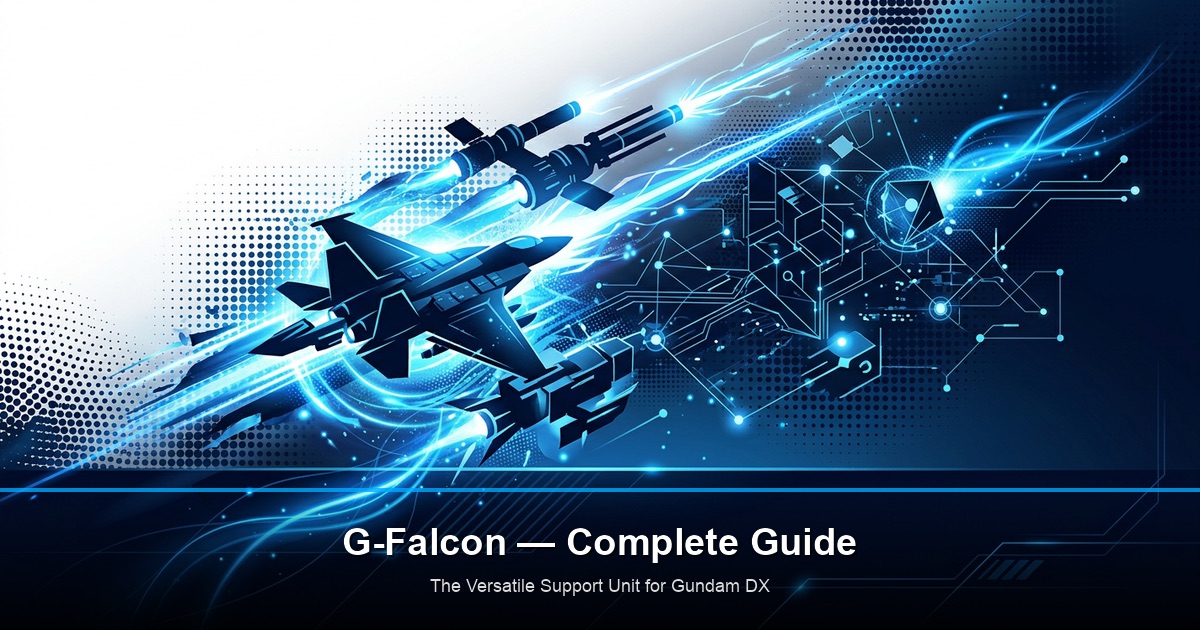
G-Falcon Complete Guide — The Versatile Support Unit That Became Gundam DX's Wings
When Garrod Ran's Gundam Double X was cornered in the depths of space, a high-speed fighter sliced through the darkness to save him — that was the G-Falcon.
As the episode title "That's the G-Falcon!" declares, this support craft's arrival was a turning point for the Freeden crew. Far more than a mere sidekick, it became the Gundam Double X's "other half," reshaping the tide of battle and even enabling the continuous firing of the Twin Satellite Cannon. In the After War world, the G-Falcon was the "wings" that pushed mobile suits beyond their limits.
This article digs into every aspect of the G-Falcon — from its design philosophy and armaments to every combination form, its pilot Pala Sys, and the most iconic scenes from the series.
What Is the G-Falcon?
The G-Falcon (model number: GS-9900) is a high-mobility large combat aircraft and mobile suit carrier developed by the old United Nations Earth (UNE) during the 7th Space War for the purpose of supporting Gundam-type mobile suits.
In simple terms, it is a "flying mothership that transports, protects, and powers up Gundams." While formidable as a standalone fighter, the G-Falcon was designed to reach its true potential when combined with a Gundam-type mobile suit.
Basic Specifications
| Item | Data |
|---|---|
| Model Number | GS-9900 |
| Classification | MS Carrier / High-Mobility Fighter |
| Overall Length | Approx. 30m (varies by combination form) |
| Armor Material | Luna Titanium Alloy |
| Power Plant | Ultra-compact Nuclear Fusion Reactor |
| Developer | Old United Nations Earth (UNE) |
| Purpose | Frontline deployment support and combat enhancement for Gundam-type MS |
| Pilot | Pala Sys |
| First Appearance | Episode 32: "That's the G-Falcon!" |
Its armor uses the same luna titanium alloy found on Gundam-type mobile suits. With durability sufficient to withstand atmospheric re-entry, the G-Falcon is fully operational in both space and atmospheric environments. Originally developed by the UNE as a "complete combat package" to be deployed alongside mobile suits on the front lines, it was designed to rapidly recover and reinforce allied Gundams isolated on the battlefield.
After the 7th Space War, the G-Falcon's whereabouts were unknown for years. It was eventually acquired by Satelicon, a resistance organization fighting against the Space Revolutionary Army, and piloted by Pala Sys.
Technical Features
What sets the G-Falcon apart from an ordinary transport craft is its extraordinary versatility. Let's examine its three core capabilities.
1. Standalone Flight and Combat Ability
The G-Falcon is not just a transport — it is a full-fledged combat aircraft. Armed with vulcan guns, scattering beam cannons, and infrared homing missiles, it boasts enough firepower to take on multiple mobile suits single-handedly. Its high-speed cruising performance is outstanding, allowing it to fly freely in both space and within the atmosphere.
2. A-Part and B-Part Separation/Combination Mechanism
The G-Falcon's defining feature is its ability to separate into a front "A-Part" and rear "B-Part."
- A-Part (Front Unit): The forward module containing the cockpit. During combination, it covers the front of the Gundam.
- B-Part (Rear Unit): Houses the primary armaments and large thruster arrays. The scattering beam cannons and infrared homing missiles are concentrated here.
When combining with a Gundam-type, the A-Part and B-Part sandwich the mobile suit between them. This dramatically enhances the mobile suit's mobility and firepower. Notably, when combining with the Gundam Airmaster Burst or Gundam Leopard Destroy, only the B-Part is used, allowing for flexible tactical deployment depending on the situation.
3. Integration with the Satellite System
The G-Falcon possesses receiver functions equivalent to the Satellite System originally installed on the old UNE's Gundam X. It can receive and store energy from the microwave transmission facility on the lunar surface.
When combined with the Gundam Double X, the G-Falcon's energy packs connect directly to the Double X's Twin Satellite Cannon. This enables a capability that would normally be impossible — firing the Twin Satellite Cannon continuously without receiving a microwave transmission from the Moon.
A single satellite charge can reportedly sustain energy storage for approximately one week, and the stored energy can be diverted to weapons and propulsion systems as well. The G-Falcon essentially serves as a "flying fuel tank."
Combination Forms
The G-Falcon's greatest strength lies in its ability to combine with multiple Gundam types, dramatically multiplying their combat effectiveness. It has four operational configurations.
| Form Name | Combination Partner | Parts Used | Primary Enhancement |
|---|---|---|---|
| G-Falcon Double X | Gundam Double X | A+B Parts (Full) | Mobility, Twin Satellite Cannon continuous fire, atmospheric re-entry |
| G-Falcon Airmaster Burst | Gundam Airmaster Burst | B-Part Only | Ultra-high-speed flight, thruster output boost |
| G-Falcon Leopard Destroy | Gundam Leopard Destroy | B-Part Only | Atmospheric flight capability, 360-degree firing arc |
| Standalone Form | None | A+B Parts Combined | Reconnaissance, high-speed cruising, solo combat |
G-Falcon Double X (GS-9900 + GX-9901-DX)
The most iconic combination form. The A-Part and B-Part sandwich the Gundam Double X between them.
This form has two modes:
- MS Form (Combat Mode): The Double X stands upright within the G-Falcon. It retains full melee and ranged combat capability while gaining the G-Falcon's thrust and firepower.
- DX Storage Form (High-Speed Flight Mode): The Double X lies face-down and is completely enclosed. This mode enables ultra-high-speed travel and atmospheric re-entry.
The greatest advantage of this combination is the direct link between the G-Falcon's energy packs and the Double X's Satellite System, which grants the Twin Satellite Cannon its continuous firing capability. Normally, the Twin Satellite Cannon requires a microwave charge from the Moon before each shot, but with the G-Falcon's energy supply, it can fire without reception.
In the series' final arc, the combined unit fired three consecutive blasts of the Twin Satellite Cannon from satellite orbit at a colony laser — beams as wide as the cannon's muzzle. The combat strength of this combined form is said to rival an entire fleet.
G-Falcon Airmaster Burst (GS-9900 B-Part + GW-9800-B)
This form combines only the B-Part with the Gundam Airmaster Burst, piloted by Witz Sou. The B-Part attaches to the Airmaster Burst's back during Fighter Mode.
With this combination, the Airmaster Burst's flight speed surpasses that of high-speed space cruisers from the 7th Space War era. It takes the Airmaster Burst's natural advantage in speed combat and pushes it to the absolute limit.
In space, it achieves pursuit-impossible speeds, excelling in hit-and-run tactics.
G-Falcon Leopard Destroy (GS-9900 B-Part + GT-9600-D)
The B-Part connects to the backpack section of the Gundam Leopard Destroy, piloted by Roybea Loy.
The Leopard Destroy is a heavily armed, high-firepower unit, but it was originally specialized for ground combat and lacked flight capability. Combining with the G-Falcon grants it atmospheric flight and improved beam weapon efficiency.
Furthermore, in space combat, the combined form gains 360-degree firing coverage with no blind spots, effectively becoming a "flying fortress." Its firepower in this configuration is said to exceed even the Gundam Double X in normal combat, fully unlocking the heavy-artillery machine's latent potential.
Standalone Form
Even without a combination partner, the G-Falcon functions as a capable independent fighter. Its vulcan guns, scattering beam cannons, and infrared homing missiles provide respectable firepower, and the luna titanium alloy armor shrugs off all but the most powerful attacks.
For reconnaissance missions, high-speed liaison runs, and rapid battlefield deployment, the G-Falcon's versatility remains fully intact.
Armaments
For a "support craft," the G-Falcon's arsenal is impressively robust.
| Weapon | Mount Location | Characteristics |
|---|---|---|
| Vulcan Guns × 2 | Nose (A-Part) | Rapid-fire guns for close-range interception. Used to shoot down small targets and provide suppressive fire |
| Scattering Beam Cannons × 2 | Under main wings (B-Part) | Disperses beam fire across a wide area. Capable of engaging multiple enemies simultaneously |
| Infrared Homing Missile Pods × 2 | Missile pods (B-Part) | Heat-seeking guided missiles. Effective at medium to long range |
Vulcan Guns
Two rapid-fire cannons mounted in the nose. With a high rate of fire, they serve as the primary defense against incoming missiles and small craft. While their individual shot power is not enough to penetrate mobile suit armor, precision fire targeting weak points can be quite effective. As the G-Falcon's standard armament, these see the most frequent use.
Scattering Beam Cannons
One cannon is mounted under each main wing of the B-Part, making these the G-Falcon's primary offensive weapons. By dispersing beam fire across a wide area, they can engage multiple enemies in a single volley. The series depicts scenes where these cannons neutralize several mobile suits at once — a terrifying "area suppression" capability for a single craft.
In combination forms, these can be used alongside the Gundam's own weapons, enabling devastating simultaneous attacks from all directions.
Infrared Homing Missiles
Guided missiles launched from the B-Part's missile pods. These heat-seeking projectiles track enemy engine and thruster signatures, making them difficult to evade. Effective at medium range and beyond, they are used for opening salvos and suppressive attacks.
In Gunpla kits, the missile pod opening/closing mechanism is faithfully reproduced, giving the weapon a commanding presence even in model form.
Pilot Profile — Pala Sys
The pilot who commands the G-Falcon is Pala Sys, a 15-year-old girl.
Pala Sys Profile
| Item | Data |
|---|---|
| Name | Pala Sys |
| Age | 15 |
| Height | 165cm |
| Weight | 47kg |
| Affiliation | Satelicon |
| Mobile Craft | G-Falcon (GS-9900) |
| Voice Actress | Miki Nagasawa |
Character
Pala Sys is a member of Satelicon, a resistance organization that opposes the Space Revolutionary Army. Having grown up surrounded by older members, she developed a spirited, tomboyish personality. She is fearless and direct, approaching even Garrod with confidence from their very first meeting.
Satelicon was formed after the 7th Space War by people who refused to accept the Space Revolutionary Army's dominance, continuing the fight using salvaged UNE weaponry. The G-Falcon was Satelicon's ace in the hole, and Pala was entrusted as its dedicated pilot — a testament to her exceptional skill.
Relationship with Garrod Ran
Pala first appears when Garrod, freshly arrived in space, is being overwhelmed by a Space Revolutionary Army mobile suit team led by Lancerow Dawell. With no experience in zero-gravity combat, Garrod is on the verge of defeat when Pala swoops in with the G-Falcon to rescue him, initiating the first combination with the Gundam Double X and turning the tide.
She continues to fight alongside the Freeden crew, deepening her bonds with Garrod, Tiffa, and the others. Her portrayal captures the tension between the resolve of "having to fight" and the wish for "the fighting to end" — the inner conflict of a young woman living in the After War era.
Key Moments in the Series — Memorable Scenes and Critical Battles
The G-Falcon appears from the latter half of After War Gundam X, beginning with the space arc. Here are the most memorable highlights.
Episode 32: "That's the G-Falcon!" — A Dramatic Debut
Having escaped to space aboard the Bartolk, Garrod found himself disoriented in his first experience of zero-gravity combat. The Space Revolutionary Army, led by the former Newtype officer Lancerow Dawell, launched a relentless assault. Garrod's ground-combat instincts proved useless in space, and the Gundam Double X was being systematically overwhelmed.
At that desperate moment, Pala Sys and her G-Falcon arrived from Satelicon. Though startled by the unfamiliar craft, Garrod followed Pala's guidance and achieved the first combination between the Gundam Double X and G-Falcon. The overwhelming mobility and firepower of the combined form drove back the Revolutionary Army forces.
The fact that "G-Falcon" was used as the episode's title underscores how the production team viewed this craft's debut as a pivotal turning point in the story.
Combination Battles with Airmaster and Leopard
The G-Falcon's true versatility was proven when it combined not only with the Double X, but also with the Airmaster Burst and Leopard Destroy.
The G-Falcon was originally designed for compatibility with all UNE-era Gundam types, but 15 years of post-war modifications to each machine had created compatibility issues. Kid Salsamil, the Freeden's chief mechanic, developed adaptation programs that enabled the G-Falcon to combine with the Airmaster Burst and Leopard Destroy.
When Witz's Airmaster Burst combined with the B-Part, it achieved speeds exceeding high-speed space cruisers. When Roybea's Leopard Destroy combined with the B-Part, it gained flight capability and 360-degree firing coverage, becoming a "fortress without blind spots."
Twin Satellite Cannon Triple Blast — The Final Battle
In the story's climax, the G-Falcon Double X delivers its most staggering feat.
From satellite orbit, facing a colony laser poised to scorch the Earth, Garrod fires the Twin Satellite Cannon. This ultimate weapon normally exhausts its energy after a single shot, but the G-Falcon's energy packs enabled three consecutive blasts.
The sight of beams as wide as the cannon's muzzle firing in rapid succession is one of the franchise's most legendary scenes. It was an achievement impossible without the G-Falcon — a moment that embodies the very reason this support craft exists.
Pala Sys in Combat
Pala's contributions extend far beyond simply piloting the G-Falcon. Her courage standing alongside her Satelicon comrades against the Space Revolutionary Army, the tension of her first encounter with the Freeden crew, and the growing trust she develops through battle — Pala's growth is inseparable from the G-Falcon's story of triumph.
The G-Falcon in the 7th Space War — Deployment with the Freeden Crew
The Original Design Philosophy
The G-Falcon was developed during the 7th Space War, a massive conflict between the old United Nations Earth and the Space Revolutionary Army. During this war, the UNE deployed numerous Gundam-type mobile suits including the Gundam X (GX-9900), and the G-Falcon was designed as their dedicated support unit.
The original operational concept was to "form a single complete combat unit from a Gundam and a G-Falcon." The G-Falcon compensated for capabilities that a Gundam alone could not cover — long-range transport, aerial combat, and atmospheric re-entry — and only when paired together could both machines realize 100% of their design potential.
Post-War Rediscovery and Satelicon's Operations
After the 7th Space War ended, vast quantities of UNE military hardware were scattered across the Earth Sphere. The G-Falcon was among them, its location unknown for years. It was eventually discovered and recovered by Satelicon, the resistance organization fighting against the Space Revolutionary Army.
Satelicon deployed the G-Falcon as one of its primary weapons, with Pala Sys assigned as its dedicated pilot. For Satelicon — an organization fighting the Revolutionary Army with severely limited resources — a craft capable of multiplying a Gundam's combat effectiveness several times over was nothing short of a lifeline.
Joining the Freeden Crew
When Pala and the G-Falcon joined forces with the Freeden crew in the story's latter half, the tactical value multiplied dramatically. The Freeden already fielded three Gundam types: the Gundam Double X, Gundam Airmaster Burst, and Gundam Leopard Destroy. A single G-Falcon that could enhance all three opened up a world of flexible tactical possibilities.
Kid Salsamil's development of combination adaptation programs for the Airmaster Burst and Leopard Destroy was a crucial turning point that fully unlocked the G-Falcon's versatility. Through this work, the G-Falcon evolved from "a machine for the Double X" into "a machine for the entire Freeden team."
Gunpla and Merchandise
The G-Falcon has been released in several physical product forms.
Product Lineup
| Product Name | Scale | Release Year | Price (Tax Included) | Features |
|---|---|---|---|---|
| HG 1/100 G-Falcon Unit Gundam Double X | 1/100 | 1996 | ¥3,300 | TV-era kit. Full combination gimmick with DX |
| 1/100 G-Falcon (Standalone) | 1/100 | 1996 | ¥1,650 | G-Falcon standalone kit |
| ROBOT Spirits G-Falcon | Approx. 200mm | 2014 | ¥4,950 | Premium Bandai exclusive. Combination/storage gimmick |
| Mobile Suit Ensemble EX18 GDX & G-Falcon | Non-scale | 2021 | — | Mini-figure with combination capability |
| Mobile Suit Ensemble EX19 Leopard D & Airmaster B Set | Non-scale | 2022 | — | G-Falcon combination forms reproduced |
HG 1/100 G-Falcon Unit Gundam Double X
Released in 1996 during the TV broadcast, this HG 1/100 scale kit includes both the G-Falcon and Gundam Double X, fully reproducing the combination and transformation gimmicks.
Key features include:
- Twin Satellite Cannon firing mode reproduction
- Infrared homing missile pod opening mechanism
- Energy pack swing mechanism for scattering beam cannon articulation
- Buster Rifle and Beam Saber included
- Metal-plated parts (antenna, etc.) and waterslide decal sheet included
As a 1996 release, this kit is now out of production, though it circulates on the secondary market at premium prices. It remains one of the most sought-after Gundam X kits, with fans consistently calling for a reissue.
ROBOT Spirits G-Falcon
Released as a Premium Bandai exclusive in 2014, this completed figure measures approximately 200mm in length and is precisely molded in ABS plastic. It fully reproduces the combination and storage gimmick with the separately sold ROBOT Spirits Gundam Double X, making it the definitive physical representation of the craft's anime proportions.
Included accessories are two energy packs and a dedicated display stand (TAMASHII STAGE), allowing for standalone flight display poses.
Related Articles
For a deeper understanding of the G-Falcon, check out these related guides.
- Gundam Double X Mobile Suit Guide — Complete breakdown of the Double X that combines with the G-Falcon
- After War Gundam X Complete Guide — Full overview of the After War world and story
- Garrod Ran Character Guide — In-depth look at the Double X's pilot, Garrod
- Gundam Airmaster Mobile Suit Guide — Full details on the Airmaster, which combines with the G-Falcon
- Gundam Leopard Mobile Suit Guide — Full details on the Leopard, which combines with the G-Falcon
Sources
- TV Anime After War Gundam X (1996, produced by Sunrise)
- After War Gundam X Official Website (https://www.gundam-x.net/)
- Gundam Channel Mechanic Manual — GS-9900 G-Falcon (https://www.gundam-c.com/manual/mechanic/x/g-falcon.html)
- The Gundam Wiki — GS-9900 G-Falcon (https://gundam.fandom.com/wiki/GS-9900_G-Falcon)
- MAHQ — GS-9900 G-Falcon (https://www.mahq.net/gs-9900/)
- Bandai Hobby Site — 1/100 G-Falcon Unit Gundam Double X (https://bandai-hobby.net/item/01_1561/)
- Premium Bandai — ROBOT Spirits G-Falcon (https://p-bandai.jp/item/item-1000082741/)