Gundam SEED Destiny — Complete Guide— Story, Mobile Suits & Controversial Ending
Contents
- 01What Is Mobile Suit Gundam SEED Destiny? The Most Controversial Sequel in Gundam History
- 02The World of Cosmic Era 73 — Two Years After the War, Conflict Reignites
- 03Complete Story Guide — All 50 Episodes in Four Phases
- 04Character Guide — Three Protagonists and the Forces That Drive Them
- Shinn Asuka — The Hero Who Was Denied His Story
- Kira Yamato — The Returning Hero and What His Comeback Cost
- Athrun Zala — The Perpetually Torn Third Protagonist
- Gilbert Durandal — The Charismatic Intellectual Villain
- Stella Loussier — The Show's Greatest Tragedy
- Meer Campbell — The Imposter's Tears
- Rey Za Burrel — Another Clone's Sorrow
- 05Mobile Suit Guide — Destiny vs. Strike Freedom and the Machines of War
- 06The Destiny Plan Explained — Should Genes Decide Your Fate?
- 07The Protagonist Switch — Why Shinn Asuka Lost His Own Show
- 08SEED vs. SEED Destiny — What Changed and What Was Lost
- 09An Honest Assessment — What Went Wrong and What Went Right
- 10HD Remaster — SEED Destiny Reborn
- 11SEED Freedom — The Answer That Took 19 Years
- 12Viewing Guide and Related Works — Getting the Most Out of SEED Destiny
What Is Mobile Suit Gundam SEED Destiny? The Most Controversial Sequel in Gundam History
Mobile Suit Gundam SEED Destiny is a television anime that aired from October 9, 2004, to October 1, 2005, on the TBS network in Japan. Spanning 50 episodes (including recap episodes), it serves as the direct sequel to the massively successful Mobile Suit Gundam SEED, set in the Cosmic Era (C.E.) timeline, two years after the events of its predecessor.
If SEED was the savior that resurrected the Gundam franchise for the 21st century, then SEED Destiny is the "problem child" that buckled under the weight of those expectations. It introduced a new protagonist, Shinn Asuka, only to gradually shift focus back to SEED's original hero, Kira Yamato, in one of anime's most infamous protagonist switches. Add to that script inconsistencies, an excessive number of recap episodes, and heavy reliance on stock footage (known as "bank" animation in anime production), and you have a show that attracted as much criticism as it did viewers.
Yet the numbers tell a different story. SEED Destiny outperformed its predecessor in television ratings, disc sales, and Gunpla (model kit) revenue. Its mobile suit designs remain iconic, with the Destiny Gundam and Strike Freedom Gundam ranking among the franchise's most popular and commercially successful mecha. And in January 2024, the theatrical film Mobile Suit Gundam SEED Freedom finally addressed the narrative debts left by Destiny, transforming the series' legacy.
This guide covers every aspect of SEED Destiny honestly, examining both its failures and its genuine strengths. Whether you love it, hate it, or have yet to watch it, this is the complete picture.
Basic Series Information
| Official Title | Mobile Suit Gundam SEED Destiny (Kidou Senshi Gundam SEED Destiny) |
|---|---|
| Broadcast Period | October 9, 2004 – October 1, 2005 (50 episodes) |
| Network | TBS (produced by Mainichi Broadcasting System) |
| Studio | Sunrise (now Bandai Namco Filmworks) |
| Director | Mitsuo Fukuda |
| Series Composition | Chiaki Morosawa |
| Character Design | Hisashi Hirai |
| Mechanical Design | Kunio Okawara, Kimitoshi Yamane |
| Music | Toshihiko Sahashi |
| OP Themes | "ignited -イグナイテッド-" by T.M.Revolution / "PRIDE" by HIGH and MIGHTY COLOR / "Bokutachi no Yukue" by Hitomi Takahashi / "Wings of Words" by CHEMISTRY |
| ED Themes | "Reason" by Nami Tamaki / "Life Goes On" by Mika Arisaka / "I Wanna Go To A Place..." by Rie fu / "Kimi wa Boku ni Niteiru" by See-Saw |
| Insert Song | "Vestige -ヴェスティージ-" by T.M.Revolution and others |
| Timeline | Cosmic Era (C.E.) 73 |
| Predecessor | Mobile Suit Gundam SEED (2002-2003) |
| Theatrical Sequel | Mobile Suit Gundam SEED Freedom (2024) |
Why a Sequel Was Made — The Legacy of SEED
Mobile Suit Gundam SEED, which aired from 2002 to 2003, was a phenomenon. It averaged 6.2% viewership ratings, sold over one million DVD and Blu-ray units, and generated explosive Gunpla sales. Through the late 1990s and early 2000s, the Gundam franchise had seen diminishing commercial returns, with ∀ Gundam underperforming commercially despite critical acclaim. SEED reversed that decline and brought an entirely new generation into the fandom.
A sequel was inevitable. It would be the first direct TV sequel in the Gundam franchise since Mobile Suit Gundam ZZ in 1986 — an 18-year gap. With Bandai (the primary sponsor), Sunrise (the studio), and MBS (the broadcaster) all expecting even bigger commercial success, the production carried enormous pressure from the start.
Behind the Scenes — A Production Under Siege
The core creative team returned from SEED: director Mitsuo Fukuda and head writer Chiaki Morosawa, who was also Fukuda's wife. However, only about a year had passed between the end of SEED's production and the start of Destiny's broadcast. The team had barely recovered from the grueling schedule of the first series before being thrown into an even more demanding production.
Morosawa's health problems compounded the issue. As the series progressed, scripts fell behind schedule, leading to an unprecedented five recap episodes out of 50 total — effectively 10% of the series. Heavy reliance on flashback sequences and stock footage filled the gaps.
These production challenges directly impacted the story's coherence and character development. This is not an excuse for the show's shortcomings, but it is essential context for understanding why the final product turned out the way it did.
The World of Cosmic Era 73 — Two Years After the War, Conflict Reignites
Understanding SEED Destiny requires knowing what happened between the end of SEED and the beginning of this story. Two years after the devastating First Alliance-PLANT War ended in C.E. 71, the world appeared to be at peace. Beneath the surface, however, old hatreds simmered.
Naturals vs. Coordinators — The Root of All Conflict
The Cosmic Era world is divided between two types of humans: Naturals, who are born without genetic modification, and Coordinators, whose genes have been artificially optimized before birth. Coordinators surpass Naturals in virtually every physical and intellectual metric, but they face declining birth rates — a critical existential threat.
In SEED, this division escalated into total war between the Earth Alliance (primarily Naturals) and PLANT (the Coordinator nation-state). The war ended at the Battle of Jachin Due, but with massive casualties on both sides and the underlying hatred unresolved.
The Junius Seven Drop — The Spark That Reignites War
In C.E. 73, Cagalli Yula Athha, representative of the Orb Union, visits PLANT at the invitation of Chairman Gilbert Durandal. During this visit, three new ZAFT mobile suits are stolen by Phantom Pain, a covert unit of the Earth Alliance. This "Armory One Incident" sets the story in motion.
But the true turning point comes immediately after: the Junius Seven Drop. The remains of the agricultural colony Junius Seven — destroyed during the Bloody Valentine of the previous war — are deliberately de-orbited by rogue ZAFT soldiers, crashing into Earth and causing catastrophic destruction. This event reignites anti-Coordinator hatred among Naturals and triggers the Second Alliance-PLANT War.
Three Factions — The Earth Alliance, PLANT (ZAFT), and Orb
| Faction | Key Leader | Core Ideology/Goal |
|---|---|---|
| Earth Alliance | Lord Djibril (head of Logos) | Extermination of Coordinators. Blue Cosmos (anti-Coordinator extremist group) controls the real power |
| PLANT (ZAFT) | Chairman Gilbert Durandal | Publicly advocates peaceful resolution, but secretly works toward implementing the "Destiny Plan" for global control |
| Orb Union | Cagalli Yula Athha | Seeks neutrality but is politically maneuvered into the Earth Alliance camp by the Seiran family |
Adding to this three-way struggle is a "fourth faction" — Kira Yamato and Lacus Clyne aboard the Archangel and Eternal, operating independently of any nation and intervening according to their own convictions.
The Fragile Peace That Shattered
At the end of SEED, Kira and Athrun achieved a ceasefire, but the fundamental cause of conflict — mutual distrust between Naturals and Coordinators — was never resolved. The Junius Seven Drop brutally proved how fragile that peace had been.
Where SEED told the story of ending a war, SEED Destiny tells the story of a war that should have stayed ended but didn't. This premise is genuinely compelling and had enormous dramatic potential. The question is whether the execution lived up to it.
Complete Story Guide — All 50 Episodes in Four Phases
SEED Destiny's narrative can be understood most clearly by dividing it into four distinct phases. Here is a detailed breakdown of each.
Phase 1 (Episodes 1–13): The War Begins and a New Protagonist Emerges
The story opens from the perspective of Shinn Asuka, a young pilot assigned to the ZAFT battleship Minerva. Shinn is an Orb-born Coordinator who lost his entire family — parents and younger sister Mayu — when Orb became a battlefield in the previous war. Blaming Orb's leadership for his family's death, he emigrated to PLANT and enlisted in ZAFT.
The early episodes follow the Minerva's pursuit of the three stolen Gundams (Chaos, Gaia, and Abyss), the response to the Junius Seven Drop, and the outbreak of war. The pacing is tight, and Shinn's anger-driven but sympathetic characterization earned positive reception.
During this phase, Shinn works as a compelling protagonist — a young man scarred by loss who desperately seeks the power to protect what matters to him. His battles in the Impulse Gundam are dynamically animated and carry genuine intensity.
Phase 2 (Episodes 14–34): The War Escalates and Stella's Tragedy
The middle act sees the war between the Earth Alliance and ZAFT intensify as multiple dramatic threads develop simultaneously. The emotional centerpiece is the relationship between Shinn and Stella Loussier.
Stella is an Extended (artificially enhanced human) serving the Earth Alliance — technically Shinn's enemy. Through a chance encounter, the two connect emotionally, and Shinn swears to protect her. But Stella is a product of inhumane military experimentation, psychologically unstable and conditioned to panic at the mere mention of death.
In Episode 32, "Stella," the massive mobile armor Destroy Gundam lays waste to Berlin, and its pilot is revealed to be Stella. Shinn desperately tries to reach her, momentarily breaking through her conditioning, but Kira Yamato in the Freedom Gundam intervenes and destroys the Destroy. Stella dies in Shinn's arms.
Stella's death is the most tragic and dramatically important moment in the series. The person Shinn swore to protect is killed by the previous show's protagonist — a devastating structural irony that gives Shinn's rage against Kira overwhelming emotional weight. This event cements their conflict for the remainder of the show.
Phase 3 (Episodes 34–42): The Protagonist Switch and Durandal's Ambition
In the second half, the narrative focus gradually shifts from Shinn to Kira Yamato and Athrun Zala. This is the point of maximum controversy — the "protagonist switch."
Episode 34, "Nightmare," features one of the series' most celebrated battle sequences: Shinn's Impulse Gundam destroys Kira's Freedom Gundam. It is a stunning reversal — the new protagonist defeats the old one. But Kira survives, and in Episode 39 he returns in the brand-new Strike Freedom Gundam. From this point forward, Kira effectively becomes the show's protagonist.
Meanwhile, Shinn falls increasingly under Chairman Durandal's influence. He receives the powerful Destiny Gundam but increasingly acts as Durandal's instrument rather than as an independent character. Athrun, recognizing Durandal's true intentions, defects from ZAFT and joins the Archangel crew.
This period also introduces the subplot of Meer Campbell, a young woman surgically altered to impersonate Lacus Clyne. Used by Durandal as a propaganda tool, Meer struggles between her desire for recognition and her disintegrating sense of self — a tragic parallel to the show's themes of identity and agency.
Phase 4 (Episodes 43–50): The Destiny Plan and the Final Battle
In the climax, Chairman Durandal publicly announces the Destiny Plan — a system for using genetic analysis to assign every human their optimal societal role, eliminating conflict by eliminating choice. The plan's details are explored in depth later in this guide.
Kira and Lacus oppose the plan and lead the Archangel and Eternal in an assault on PLANT's space fortress Messiah. The final battle pits Kira's Strike Freedom against Shinn's Destiny Gundam and Athrun's Infinite Justice against supporting ZAFT forces. Shinn and his wingman Rey Za Burrel are defeated. Durandal dies, and the Destiny Plan is dismantled.
The epilogue shows Shinn reconciling with Athrun and weeping at Stella's grave. For many viewers, however, the ending lacked catharsis. Shinn's arc felt incomplete — how exactly he grew or what he learned was left frustratingly vague. This sense of narrative incompleteness is the single greatest source of viewer dissatisfaction with the series.
Character Guide — Three Protagonists and the Forces That Drive Them
Any discussion of SEED Destiny's characters must begin with an uncomfortable question: who is the actual protagonist? Officially, the show claims three protagonists — Shinn Asuka, Kira Yamato, and Athrun Zala. The reality is considerably more complicated.
Shinn Asuka — The Hero Who Was Denied His Story
Voice Actor: Kenichi Suzumura
Shinn Asuka was designed from the planning stage as SEED Destiny's new protagonist. An Orb-born Coordinator, he lost his family during the previous war when Orb's leader Uzumi Nara Athha triggered the nation's self-destruct protocol. This backstory gives Shinn a deeply personal grudge against Orb and, by extension, against Cagalli and Kira, who represent Orb's ideals.
The character concept was strong. "What if the previous show's heroes were the villains from someone else's perspective?" is a classic Gundam premise — the franchise has always been about showing war from multiple angles. In the first half of the series, Shinn is a genuinely compelling character: angry but vulnerable, driven but sympathetic.
The problems emerge in the second half. As Shinn falls under Durandal's sway, he loses agency and independent judgment. The narrative increasingly frames Kira's faction as "right" and Shinn as "wrong," until Shinn exits the story as a defeated antagonist. Many viewers felt that Shinn's character arc was simply abandoned.
Yet the core of Shinn's character — grief transformed into rage — resonated universally. Losing his family, losing the person he swore to protect, and discovering that his chosen path was wrong — that depth of despair would eventually be redeemed in the 2024 film SEED Freedom.
Kira Yamato — The Returning Hero and What His Comeback Cost
Voice Actor: Soichiro Hoshi
SEED's protagonist Kira Yamato initially occupies a background role in Destiny, living peacefully with Lacus in Orb. When war breaks out again, he returns to combat as the pilot of the Freedom Gundam, fighting alongside the Archangel crew.
Kira's combat philosophy carries over from SEED: he fights to disable rather than kill, targeting weapons and thrusters to neutralize enemies without taking lives. This idealism is central to his character, but in Destiny it becomes a point of contention. Shinn's perspective — that such restraint is naive and dangerous in the middle of a war — has legitimate weight, creating an ambiguity about Kira's "righteousness" that may or may not have been intentional.
After his Freedom is destroyed by Shinn's Impulse in Episode 34, Kira returns in Episode 39 with the Strike Freedom Gundam, and the story's center of gravity shifts to him. While his comeback is dramatically exciting, it comes at the cost of overwriting Shinn's narrative.
Athrun Zala — The Perpetually Torn Third Protagonist
Voice Actor: Akira Ishida
Athrun serves as the "third perspective" — neither fully aligned with Shinn nor with Kira. In Destiny, he returns to ZAFT at Durandal's request and is assigned to the Minerva alongside Shinn.
Having learned in SEED to "see with his own eyes and fight on his own terms," Athrun was supposed to have grown beyond indecision. Yet in Destiny, he falls into a similar pattern: wavering, being used by Durandal, and ultimately defecting from ZAFT again. Critics rightfully point out that this retreads his SEED arc.
Defenders argue that Athrun's struggle embodies the show's central ambiguity — that neither side holds a monopoly on justice. His scenes confronting Shinn about what truly matters represent genuine attempts to explore this theme, even if the execution was inconsistent.
Gilbert Durandal — The Charismatic Intellectual Villain
Voice Actor: Shuichi Ikeda
PLANT Supreme Council Chairman Gilbert Durandal is the series' primary antagonist, but he is no simple dictator. Soft-spoken, intellectually brilliant, and genuinely charismatic, he is arguably the show's most compelling character.
Durandal's ultimate goal is the implementation of the Destiny Plan — using genetic analysis to create a conflict-free society. The plan's logic is not easily dismissed, and many characters within the story support it. What makes Durandal dangerous is that his "ideal world" requires the complete abolition of individual free will.
His voice actor, Shuichi Ikeda, is the legendary voice of Char Aznable — Gundam's most iconic antagonist. For longtime fans, hearing Ikeda's voice coming from a new charismatic villain added an extra layer of significance to the character.
Stella Loussier — The Show's Greatest Tragedy
Voice Actor: Houko Kuwashima
An Extended (artificially enhanced human) serving as the pilot of the Gaia Gundam for the Earth Alliance. Stella is Shinn's enemy on the battlefield, but through a chance meeting, the two form a genuine emotional bond.
Stella is a victim — conditioned through drugs and psychological manipulation into a combat weapon. She suffers from severe trauma, panicking uncontrollably at any mention of death. Her repeated plea, "I won't die? I'm not going to die, right?" is one of the series' most heartbreaking recurring motifs.
Ultimately forced into the cockpit of the massive Destroy Gundam, Stella is used as a disposable weapon of mass destruction before being killed by Kira's Freedom. For Shinn, her death represents the ultimate failure — having the power to fight but not the power to protect.
Meer Campbell — The Imposter's Tears
Voice Actor: Rie Tanaka
A young woman surgically altered by Durandal to impersonate Lacus Clyne, Meer serves as a propaganda figure and idol for PLANT's citizens. She is not simply a "fake" — she was originally an aspiring singer who leapt at the chance to become someone important. But as she lives as "Lacus," her own identity erodes, leaving her trapped between the validation she craves and the self she has lost.
Episode 47, "Meer," in which she meets the real Lacus and ultimately dies shielding her from an assassin's bullet, is widely regarded as one of the series' finest episodes. The diary she leaves behind — documenting her desperate struggle to understand who she really was — provides a poignant coda to her story.
Rey Za Burrel — Another Clone's Sorrow
Voice Actor: Toshihiko Seki
Shinn's wingman aboard the Minerva, Rey is a clone of Al Da Flaga — the same genetic origin as SEED's final antagonist, Rau Le Creuset. Where Creuset sought humanity's destruction out of nihilistic despair, Rey channels his existence into devotion to Durandal and his ideals.
Rey's tragedy lies in his shortened lifespan due to telomere degradation and his inability to find purpose outside his relationship with Durandal. In the final episode, when Kira asks whether he truly does not wish to live, Rey ultimately turns his gun on Durandal — the first and last time he makes a choice entirely his own.
Mobile Suit Guide — Destiny vs. Strike Freedom and the Machines of War
Whatever criticisms one may level at SEED Destiny's story, its mobile suit designs and battle choreography consistently receive high marks. The mecha designs have endured as some of the franchise's most popular, driving Gunpla sales for two decades.
ZAFT Mobile Suits (Minerva)
| Mobile Suit | Model Number | Pilot | Key Features |
|---|---|---|---|
| Impulse Gundam | ZGMF-X56S | Shinn Asuka | Modular design using the Core Splendor and Silhouette System. Three configurations: Force (mobility), Sword (melee), and Blast (ranged). The unit that destroyed the Freedom Gundam |
| Destiny Gundam | ZGMF-X42S | Shinn Asuka | Shinn's final unit. Armed with the Palma Fiocina palm beam cannons, Arondight anti-ship sword, and Wings of Light. The show's titular machine |
| Legend Gundam | ZGMF-X666S | Rey Za Burrel | Equipped with the DRAGOON all-range attack system. The successor to SEED's Providence Gundam |
| Saviour Gundam | ZGMF-X23S | Athrun Zala | Transformable mobile suit. Athrun's early-series unit, unceremoniously destroyed mid-series |
| Gouf Ignited | ZGMF-2000 | Heine Westenfluss and others | Advanced mass-production unit. Heine's distinctive orange unit has a memorable but brief appearance |
| ZAKU Warrior / ZAKU Phantom | ZGMF-1000 / ZGMF-1001 | Lunamaria Hawke and others | ZAFT's main line mobile suit. Its design, evoking the original Zaku, proved extremely popular with fans |
Archangel / Eternal Faction Mobile Suits
| Mobile Suit | Model Number | Pilot | Key Features |
|---|---|---|---|
| Freedom Gundam | ZGMF-X10A | Kira Yamato | Returning from SEED. High-mobility combat specialist, destroyed by the Impulse in Episode 34 |
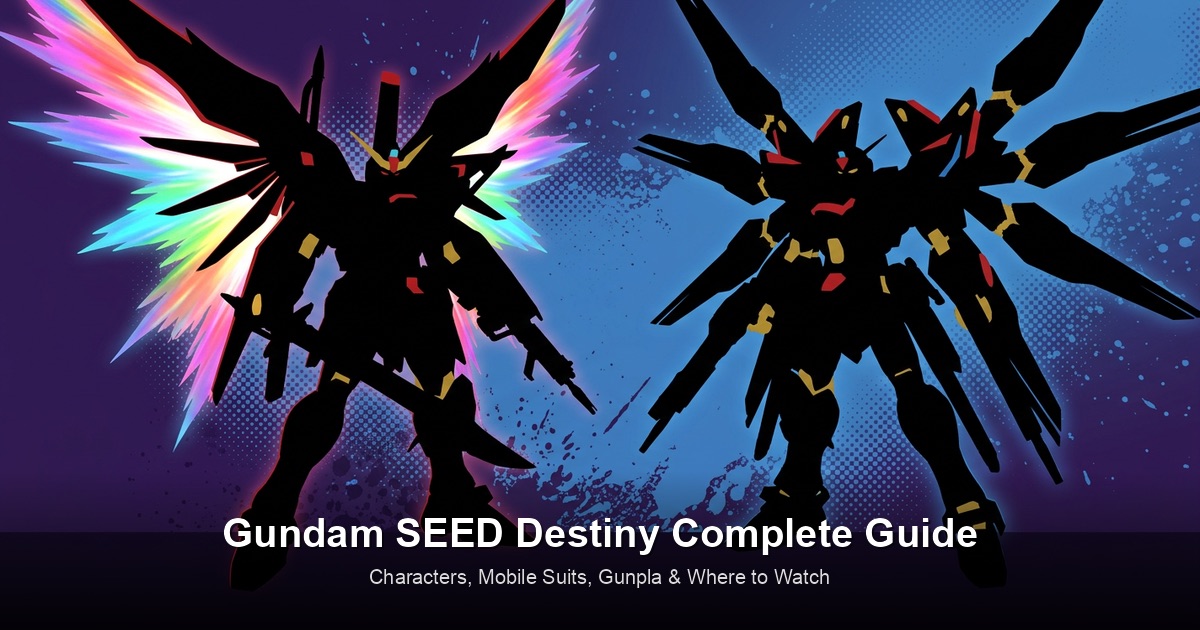
| Strike Freedom Gundam | ZGMF-X20A | Kira Yamato | The Freedom's successor. Features Super DRAGOON all-range pods and iconic gold inner frame. One of the most popular mobile suits in all of Gundam |
| Infinite Justice Gundam | ZGMF-X19A | Athrun Zala | The Justice's successor. Specializes in close combat with the Fatum-01 subflight lifter. Athrun's late-series unit |
| Akatsuki | ORB-01 | Mu La Flaga / Cagalli | Orb's secret golden mobile suit. Its Yata-no-Kagami armor reflects beam attacks |
| DOM Trooper | ZGMF-XX09T | Hilda, Mars, Herbert | Used by pro-Lacus ZAFT soldiers. Its design pays homage to the original Dom from the One Year War |
Earth Alliance Mobile Suits
| Mobile Suit | Model Number | Pilot | Key Features |
|---|---|---|---|
| Chaos Gundam | ZGMF-X24S | Sting Oakley | One of three stolen units. Aerial combat specialist |
| Gaia Gundam | ZGMF-X88S | Stella Loussier | One of three stolen units. Transforms into a quadrupedal beast mode |
| Abyss Gundam | ZGMF-X31S | Auel Neider | One of three stolen units. Underwater combat specialist |
| Destroy Gundam | GFAS-X1 | Stella Loussier | The massive mobile armor that devastated Berlin. Armed with positron reflectors and numerous beam weapons |
| Windam | GAT-04 | Various pilots | The Earth Alliance's main mass-production unit. Successor to the Strike Dagger |
From Impulse to Destiny — The Meaning of Shinn's Mid-Series Upgrade
In Gundam tradition, a protagonist's mid-series mobile suit change marks a critical narrative turning point. Amuro's shift from the Gundam to the Nu Gundam, Kamille's from the Mk-II to the Zeta Gundam — each reflects character growth and story progression.
Shinn transitions from the Impulse to the Destiny in Episode 37. The Impulse was a versatile unit requiring the pilot to choose the right configuration for each situation. The Destiny consolidates everything into one all-purpose machine — symbolizing Shinn's move from "making choices" to "raw consolidated power."
Ironically, the moment Shinn receives the Destiny Gundam is also the moment he begins losing his role as the story's protagonist. Gaining the most powerful machine coincides with the start of his character's narrative descent.
The Destiny Plan Explained — Should Genes Decide Your Fate?
The Destiny Plan gives the series its title and represents its central thematic concept. Proposed by Chairman Durandal, it is both the story's ultimate threat and its most intellectually provocative element.
How the Destiny Plan Works
The plan's core mechanism is straightforward: analyze every human being's genetic code, scientifically determine each person's innate aptitudes, and assign them the social role (career, position, function) for which they are genetically best suited.
Durandal's reasoning: people fight because they don't know where they belong. A person placed in the wrong role becomes dissatisfied, envious, and eventually aggressive. If science can identify the optimal place for every individual, then dissatisfaction — and therefore war — can be eliminated.
In the context of the Cosmic Era, where the genetic divide between Naturals and Coordinators has caused two catastrophic wars, there is a seductive logic to this proposal. If genetic differences are the root of conflict, then genetic analysis as the basis for social organization seems almost reasonable.
Why Kira and Lacus Oppose the Plan
The fundamental objection is that the Destiny Plan annihilates individual free will.
A person's genetic "aptitude" does not necessarily align with their desires or dreams. What happens to someone who wants to be a singer but whose genes say "office worker"? To a boy who dreams of being a pilot but whose DNA prescribes "agricultural laborer"? The Destiny Plan strips every person of the right to choose who they want to become.
Beyond that, the plan negates the value of effort. No amount of training, practice, or determination can overcome a genetic verdict of "unsuitable." This effectively creates a genetic caste system — permanent, inescapable, and scientifically enforced.
Director Fukuda himself described the Destiny Plan's society as "the negation of evolution." A world that eliminates unexpected talent, unplanned breakthroughs, and accidental genius — a world without "hope beyond calculation" — is a species choosing its own slow death.
Real-World Parallels — Eugenics and AI Sorting
The Destiny Plan's implications extend well beyond fiction.
Historically, the 20th century's eugenics movements represent a real-world parallel. The idea that "superior" genetic traits should be promoted and "inferior" ones suppressed reached its most horrific conclusion in Nazi Germany's racial policies.
In the modern era, advancing technology has made "genetic aptitude profiling" increasingly feasible. AI-driven hiring algorithms, consumer genetic testing services, and behavioral prediction through big data all share a common thread with the Destiny Plan: using technology to narrow, rather than expand, human possibility.
What felt like science fiction in 2004 has become alarmingly relevant in the 2020s. The Destiny Plan may be the show's most enduring contribution to discourse.
Was the Destiny Plan Truly "Evil"?
Within the show, Kira's side wins, and the Destiny Plan is defeated. But careful analysis reveals that Durandal's underlying observation was never refuted. The conflict between Naturals and Coordinators persists. Kira's answer — "believe in human potential" — is aspirational but vague, especially given that such "potential" produced two devastating wars.
This absence of a clear counter-argument can be read as either the show's narrative weakness or a deliberate provocation. The 2024 film SEED Freedom addresses this ambiguity by depicting a new threat born from the Destiny Plan's philosophical lineage, finally providing the series' answer to Durandal's challenge.
The Protagonist Switch — Why Shinn Asuka Lost His Own Show
The shift from Shinn to Kira as the functional protagonist is not merely a fan complaint — it is one of the most discussed structural issues in anime history.
The Official Line vs. Reality
Before the show aired, director Fukuda stated clearly in interviews that Destiny was "Shinn's story, not a continuation of Kira and Athrun's." As the broadcast progressed, however, Shinn's screen time diminished while Kira and Athrun's expanded dramatically.
The production team later revised their position to claim that all three — Shinn, Kira, and Athrun — were co-protagonists. Most viewers received this as retroactive justification rather than original intent.
Why the Switch Happened — Multiple Contributing Factors
- Sponsor pressure: Bandai and other sponsors had a proven commercial track record with Kira and the Freedom/Strike Freedom brand. A new character was a riskier bet for merchandise sales.
- Structural writing challenges: Writing a protagonist who gradually falls to the antagonist's side requires meticulous attention to internal conflict and moral complexity. The production's resource constraints — evident in the five recap episodes — left insufficient room for this nuance, causing Shinn's turn to feel abrupt and unsympathetic.
- Creative attachment to Kira: The director and head writer's evident affection for Kira, documented across multiple interviews, likely influenced the script's gravitational pull toward the returning hero.
- Shinn's inherent difficulty as a protagonist: A hero driven by anger and resentment is harder to root for than one driven by reluctant heroism. SEED's Kira was a gentle boy forced to fight; Destiny's Shinn is a rage-fueled young man who chose to fight. The empathy barrier was higher from the start.
How This Compares to Other Gundam Series
Protagonists losing spotlight is not unique to SEED Destiny. Zeta Gundam's Kamille Bidan is somewhat overshadowed by Char and Haman in the later episodes, and ZZ Gundam's Judau Ashta sees the narrative density shift as Char's Counterattack is foreshadowed. But in neither case does the protagonist end the show as the losing side's defeated combatant.
What makes SEED Destiny's case unique is that Shinn is narratively positioned as "wrong." He loses the final battle to Kira and Athrun and is treated as someone who backed the wrong cause. For a character introduced as the protagonist, this treatment is virtually unprecedented.
The Answer, 20 Years Later — SEED Freedom's Redemption
The 2024 theatrical film Mobile Suit Gundam SEED Freedom directly addressed the "Shinn problem" that had lingered for two decades.
In the film, Shinn serves alongside Kira in Compass, a global peacekeeping organization. He is no longer the rage-driven boy of Destiny but a young man who fights to protect refugees and prevent the kind of tragedy he once experienced. This is the growth arc that Destiny failed to deliver.
The film's highlight for Destiny fans is Shinn's sortie in the Destiny Gundam Spec II — a heroic, triumphant launch sequence that audiences greeted with applause and tears. Director Fukuda himself stated that "redeeming Shinn was something I had always wanted to do."
SEED vs. SEED Destiny — What Changed and What Was Lost
A fair assessment of SEED Destiny requires direct comparison with its predecessor. Here is a multi-dimensional analysis of the two shows.
Structural Comparison
| Category | SEED | SEED Destiny |
|---|---|---|
| Protagonist | Kira Yamato (consistent throughout) | Shinn Asuka → Kira Yamato (mid-series switch) |
| Protagonist's Role | Reluctant hero (civilian dragged into war) | Volunteer soldier (chose military service) |
| Conflict Structure | Clear (Earth Alliance vs. PLANT, Kira vs. Athrun) | Complex (three-way plus independent faction) |
| Central Theme | The horror of war, friendship vs. duty | Fate vs. free will, the relativity of justice |
| Recap Episodes | 3 | 5 |
| Final Antagonist | Rau Le Creuset (ideologically clear villain) | Chairman Durandal (sympathetic, arguable villain) |
Where Destiny Surpassed SEED
- Opening momentum: The Armory One Incident through the Junius Seven Drop (Episodes 1–8) delivers tighter pacing than SEED's somewhat drawn-out Heliopolis escape arc.
- Battle animation quality: Shinn's Impulse combat sequences are spectacular regardless of the story's quality. The Impulse vs. Freedom duel in Episode 34 ranks among the best mecha battles in all of Gundam.
- Antagonist depth: Durandal is a more nuanced villain than Rau Le Creuset. His plan is harder to simply dismiss, making him more intellectually engaging.
- Music: T.M.Revolution's "ignited" and "Vestige" are franchise-defining tracks. The battle scene set to "Vestige" may be the single most cathartic moment in the SEED universe.
- Mass-production mobile suit prominence: The ZAKU Warrior, Gouf Ignited, and other line units receive meaningful screen time, an improvement over SEED.
Where Destiny Fell Short
- Narrative coherence: SEED maintained a clear through-line as Kira's coming-of-age story. Destiny's shifting perspective between Shinn, Kira, and Athrun left the story feeling unfocused.
- Character growth: SEED showed clear development for both Kira and Athrun. In Destiny, Shinn's arc is one of decline rather than growth, and Athrun largely repeats his SEED-era indecision.
- Emotional stakes in rivalry: Kira vs. Athrun in SEED was devastating — best friends forced to try to kill each other. Shinn vs. Kira in Destiny lacks that personal connection.
- Final act quality: SEED's closing episodes skillfully converge multiple threads. Destiny's ending feels rushed, with numerous plot elements left unresolved.
The Numbers — A Commercial Comparison
| Metric | SEED | SEED Destiny |
|---|---|---|
| Average Ratings | ~6.2% | ~6.8% (higher than SEED) |
| Peak Ratings | 8.0% | 8.2% |
| DVD/BD Sales | ~1 million units cumulative | ~1.2 million units cumulative (franchise best) |
| Gunpla Sales | Massive hit | Exceeded predecessor |
| Merchandise | Cultural phenomenon | Equal or greater |
The irony is inescapable: the most criticized Gundam series of its era was also the most commercially successful. Ratings, disc sales, and merchandise revenue all surpassed SEED. This proves that "controversial" does not mean "unpopular," and "popular" does not necessarily mean "good."
An Honest Assessment — What Went Wrong and What Went Right
No Gundam series has divided its audience as sharply as SEED Destiny. This section examines the most common criticisms and the show's genuine merits with equal weight.
The Case Against
1. The protagonist switch and narrative breakdown
As detailed above, the shift from Shinn to Kira destroyed the story's structural integrity. Viewers who invested emotionally in Shinn during the first half were left stranded.
2. Excessive recap episodes
Five recap episodes out of 50 means 10% of the series was not new content. For weekly viewers, repeated recaps were a source of significant frustration.
3. Heavy stock footage usage
Bank animation was already a criticism of SEED; Destiny made it worse. Launch sequences, combination scenes, and attack animations were visibly recycled, revealing the strain on the production schedule.
4. Returning characters as invincible forces
The Strike Freedom and Infinite Justice are functionally invulnerable in the final battle. Kira and Athrun never face genuine danger, draining the climax of tension. "Previous protagonist plot armor" remains a persistent criticism.
5. Underdeveloped new characters
Many new characters were introduced and discarded without adequate development. Heine Westenfluss (voiced by T.M.Revolution's Takanori Nishikawa) was the most egregious case — introduced with fanfare and killed off within a few episodes, leading to accusations that he existed solely for cross-promotional purposes.
The Case For
1. Thematically ahead of its time
The Destiny Plan's exploration of genetic determinism and managed societies has only become more relevant with the rise of AI-driven sorting, algorithmic hiring, and genetic testing. As speculative fiction, the show was prescient.
2. Outstanding mobile suit design
The Destiny Gundam, Strike Freedom Gundam, and Infinite Justice Gundam remain franchise icons and Gunpla bestsellers over two decades later. The Strike Freedom's gold frame and Super DRAGOON design is a masterpiece of mecha aesthetics.
3. Exceptional music
Every opening, ending, and insert song maintains a high standard. T.M.Revolution's "ignited" and "Vestige" consistently rank among the top Gundam theme songs. See-Saw's "Kimi wa Boku ni Niteiru" is a haunting closing theme that has aged beautifully.
4. Individual episode excellence
Episode 34 "Nightmare" (Impulse vs. Freedom), Episode 32 "Stella," and Episode 47 "Meer" stand as individually outstanding episodes. The show's parts can be brilliant even when the whole is flawed.
5. Commercial success as evidence of appeal
Record disc sales and explosive Gunpla revenue are objective evidence that the show had genuine drawing power. Criticism is valid, but the fact that millions of people were captivated deserves acknowledgment.
"Bad Show" or "Flawed Ambitious Work"?
Calling SEED Destiny "bad" is easy but imprecise. "Bad" implies a show without merit, and Destiny has genuine merits: Stella's tragedy, the Destiny Plan's intellectual depth, the Impulse vs. Freedom battle, and some of the finest mecha designs in the franchise.
The most accurate description is "an ambitious show that couldn't fully realize its ambitions." It had grand ideas and a compelling premise but was undermined by production constraints and structural decisions. Its unrealized potential would finally bloom 19 years later in SEED Freedom.
HD Remaster — SEED Destiny Reborn
Between 2013 and 2014, SEED Destiny received an HD Remaster that re-edited and rebroadcast the series. Here are the key differences from the original.
Visual Changes
- Aspect ratio: Converted from 4:3 to 16:9 widescreen, significantly improving visual impact.
- Image quality: Full HD upconversion with color correction and line art cleanup. Scenes with notable animation quality drops received substantial redrawing.
- Redrawn mobile suit sequences: Select mobile suit battle scenes were entirely reanimated. The Strike Freedom's launch sequence, in particular, was rebuilt to a dramatically higher standard.
Structural Changes
- Recap episodes removed: All five original recap episodes were eliminated, substantially improving the show's pacing.
- New scenes added: Additional character moments were inserted, including scenes developing the Shinn-Lunamaria relationship and Athrun-Kira dialogue, addressing gaps in the original's characterization.
- Final episodes restructured: The climactic battle received significant re-editing with altered shot composition and pacing.
Audio Changes
- Theme song alterations: Some opening and ending themes were changed between versions.
- Sound effect remastering: Beam weapons, explosions, and ambient effects were remastered for 5.1 surround sound.
Should You Watch the HD Remaster?
For first-time viewers, the HD Remaster is the strongly recommended version. The reasons are clear:
- Recap episodes are removed, improving pacing
- Animation quality issues are corrected
- Widescreen presentation enhances visual impact
- New scenes supplement character development
However, the original version contains some unique scenes and directorial choices not present in the Remaster. Dedicated fans may wish to compare both versions.
SEED Freedom — The Answer That Took 19 Years
Mobile Suit Gundam SEED Freedom, released theatrically on January 26, 2024, served as the culmination of the Cosmic Era saga and, simultaneously, as a direct response to the narrative debts left by SEED Destiny.
Shinn Asuka's True Story
Shinn's role in SEED Freedom was the greatest reward for long-suffering Destiny fans. As a member of Compass alongside Kira, Shinn is no longer consumed by rage. He prioritizes protecting refugees and preventing the kind of civilian tragedy he once endured — the character growth that Destiny should have delivered but didn't.
The film's highlight is Shinn's sortie in the Destiny Gundam Spec II. His heroic launch — embodying the principle that power exists to protect — is the realization of Shinn's character potential, 19 years delayed. Theater audiences responded with standing ovations. Director Fukuda acknowledged that "redeeming Shinn was always something I wanted to accomplish."
Beyond the Destiny Plan — The Foundation Kingdom
SEED Freedom introduces the Foundation Kingdom, a nation-state that has taken the Destiny Plan's principles further than Durandal ever did. Through genetic manipulation, the Foundation creates "ideal humans" and seeks global domination — representing what happens when genetic determinism is pursued to its ultimate conclusion.
The Foundation's existence validates Kira's opposition to the Destiny Plan while simultaneously proving that Durandal's underlying question — how do you resolve genetic conflict? — was never truly answered until this film.
The True Reconciliation of Kira and Shinn
Destiny's epilogue showed a hasty, unconvincing reconciliation between Shinn and Athrun. SEED Freedom earns what Destiny could only gesture at: Shinn and Kira fighting side by side, respecting each other as comrades. This reconciliation works because it had 19 years to breathe — the passage of real-world time grants it an emotional weight that no single TV episode could have achieved.
Lunamaria Hawke and Shinn's Future
The Shinn-Lunamaria relationship in Destiny's final episodes felt rushed and unconvincing. SEED Freedom develops it into something organic, showing Lunamaria as Shinn's genuine emotional anchor. Their relationship represents one more aspect of Shinn's maturation — his ability to build new bonds while carrying the memory of Stella.
Redefining the SEED Trilogy
SEED Freedom's success fundamentally altered how the entire SEED saga is perceived. What was once "a great show followed by a disappointing sequel" became a three-part narrative:
- SEED: The story of ending a war (hope)
- SEED Destiny: The story of a peace that fails and questions left unanswered (despair)
- SEED Freedom: The story of finding the real answer (redemption)
In this framework, Destiny's incompleteness becomes almost structurally necessary. Whether this was intentional design or fortunate reinterpretation will likely be debated forever.
Viewing Guide and Related Works — Getting the Most Out of SEED Destiny
This section provides practical guidance for those approaching SEED Destiny for the first time or considering a rewatch.
Essential Pre-Viewing
| Title | Necessity | Reason |
|---|---|---|
| Mobile Suit Gundam SEED (50 episodes / HD Remaster 48 episodes) | Required | The character relationships, world-building, and thematic foundation cannot be understood without the original series |
| Mobile Suit Gundam SEED Special Edition (3 parts) | Recommended | Compilation films summarizing SEED. A viable alternative if time is limited |
Post-Viewing Recommendations
| Title | Priority | Reason |
|---|---|---|
| Gundam SEED Destiny Special Edition (4 parts) | Optional | Compilation films with some new scenes providing additional context |
| Mobile Suit Gundam SEED C.E. 73: Stargazer | Recommended | A short OVA set during Destiny's timeline from a different perspective. Very highly regarded by fans |
| Mobile Suit Gundam SEED Freedom | Required | The narrative completion of Destiny's unresolved threads. Essential viewing after Destiny |
Recommended Merchandise
Comparative Viewing with Other Gundam Series
For those interested in examining SEED Destiny through the lens of other Gundam sequels, these comparisons are particularly instructive:
- Mobile Suit Zeta Gundam: The original Gundam's direct sequel. Introduces new protagonist Kamille while featuring returning characters Amuro and Char. The handling of legacy characters provides an illuminating contrast to Destiny's approach.
- Mobile Suit Gundam ZZ: Zeta's sequel, which dramatically changed the series' tone and divided fans — a parallel to Destiny's own divisive reception.
- Mobile Suit Gundam: The Witch from Mercury: The 2022-2023 Gundam series that delivered a complete, tightly structured story in 25 episodes — offering a counterpoint to Destiny's narrative sprawl.
Final Thoughts — The Meaning of SEED Destiny's Journey
Mobile Suit Gundam SEED Destiny is not a perfect show. The script lost its way. The protagonist was abandoned. The production schedule collapsed. These are valid criticisms that should be acknowledged.
But this show also gave us moments, characters, machines, and music that would not exist otherwise. Shinn's grief, Stella's tragedy, Meer's loneliness, Durandal's impossible dream — each left its mark on viewers' hearts.
And without SEED Destiny, there would have been no SEED Freedom. When Shinn's redemption was finally realized on the big screen 19 years later, the tears and applause that filled theaters worldwide were emotions that only existed because Destiny had first created the wound.
Imperfect, contradictory, and endlessly debated — yet it continues to captivate audiences two decades later. That is what Mobile Suit Gundam SEED Destiny is.