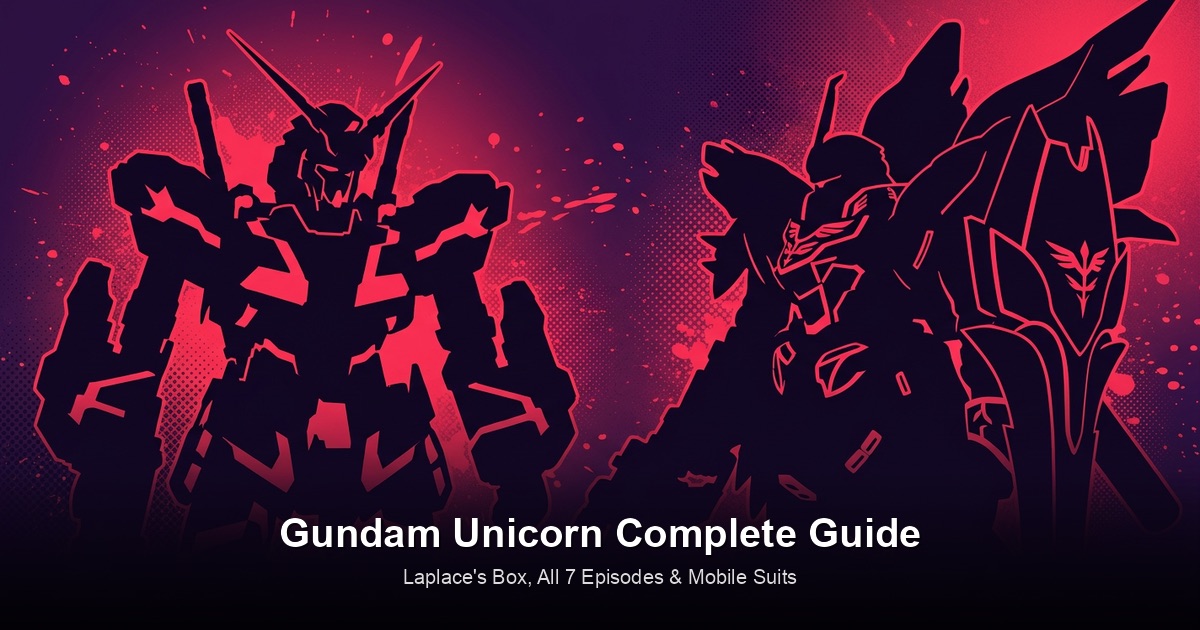
Mobile Suit Gundam UC (Unicorn) — Complete Guide— Story, Mobile Suits & the Truth of Laplace's Box
Contents
- 01What Is Mobile Suit Gundam UC? — The Masterpiece That Filled the Universal Century's Gap
- 02Story Background — What Was Universal Century 0096?
- 03All 7 Episodes — Complete Story Breakdown
- Episode 1: "Day of the Unicorn" (Released March 2010)
- Episode 2: "The Second Coming of Char" (Released November 2010)
- Episode 3: "The Ghost of Laplace" (Released March 2011)
- Episode 4: "At the Bottom of the Gravity Well" (Released November 2011)
- Episode 5: "Black Unicorn" (Released May 2012)
- Episode 6: "Two Worlds, Two Tomorrows" (Released September 2013)
- Episode 7: "Over the Rainbow" (Released May 2014)
- 04Main Characters
- Banagher Links — An Ordinary Boy Burdened with a Mission Too Heavy to Bear
- Audrey Burne (Mineva Lao Zabi) — The Last Zabi Who Carries the Future
- Full Frontal — The Will Dwelling in Char's Shadow
- Riddhe Marcenas — The Tragedy Born of Warped Good Intentions
- Marida Cruz — A Short-Lived Flower Blooming on the Battlefield
- 05Mobile Suits — The Masterful MS Designs of Gundam UC
- RX-0 Unicorn Gundam — A Pure-White Machine with Two Faces
- MSN-06S Sinanju — The Machine That Embodies the Red Comet's Return
- RX-0[N] Unicorn Gundam Unit 2 "Banshee" — The Jet-Black Counterpart
- NZ-666 Kshatriya — The Four-Winged Queen
- Delta Plus — Riddhe's First Federation Machine
- Other Key Mobile Suits
- 06The Truth of Laplace's Box — A Complete Breakdown of the Universal Century's Greatest Mystery
- 07Music and Production — Why Gundam UC Is Called a "Visual Revolution"
- 08Where to Watch and Viewing Order
- 09Related Works — Stories Before and After Gundam UC
- 10Frequently Asked Questions (FAQ)
- 11Conclusion — Why Is Gundam UC Called "the Culmination of the Universal Century"?
What Is Mobile Suit Gundam UC? — The Masterpiece That Filled the Universal Century's Gap
Mobile Suit Gundam UC (Unicorn) is called the culmination of Universal Century Gundam.
Released as an OVA in 2010 — 24 years after Char's Counterattack (1988) — it tells the story set three years after Char's rebellion, filling a blank period in the Universal Century timeline that had long fascinated fans. Hiroyuki Sawano's full-orchestra score, breathtaking animation quality, and the mystery of "Laplace's Box" — the greatest secret in the Universal Century — all combine at the highest level to make this one of the finest entries in all of Gundam history.
Whether you're watching for the first time or returning after years away, this guide covers the complete story of all 7 episodes. Every question — "What was actually inside Laplace's Box?" "What does the Unicorn Gundam's white light mean?" — is answered here.
Basic Series Information
| Official Title | Mobile Suit Gundam UC (Unicorn) |
|---|---|
| English Title | Mobile Suit Gundam Unicorn |
| Format | OVA (7 episodes) + TV re-edit "RE:0096" |
| Episode 1 Release | March 12, 2010 |
| Final Episode Release | May 22, 2014 |
| Studio | Sunrise |
| Director | Kazuhiro Furuhashi |
| Screenplay | Yasuyuki Muto |
| Original Novel | Harutoshi Fukui |
| Character Design | Kumiko Takahashi |
| Mechanical Design | Hajime Katoki and others |
| Music | Hiroyuki Sawano |
| Setting | Universal Century 0096 |
| Relation to Previous Work | 3 years after Char's Counterattack (UC0093) |
The Special OVA Format
One of the biggest differences between Gundam UC and other Gundam works is that it was released as an OVA (Original Video Animation).
While TV anime airs weekly, OVAs are released as individual home video or theatrical titles every six months to a year. This allows ample production time for each episode. Because all 7 episodes of Gundam UC were produced as OVAs, the visuals, music, and story all achieve a theatrical film level of quality.
A re-edited TV version, Mobile Suit Gundam Unicorn RE:0096 (22 episodes), was later produced for broadcast. Each episode is shorter and split into more digestible segments, making it easier for newcomers.
Story Background — What Was Universal Century 0096?
To understand Gundam UC, it helps to know a little about Universal Century 0096, the era in which it takes place.
A Century of Space Migration
The Universal Century is a calendar system that marks the year humanity began its large-scale migration to space as year 0001. To address Earth's overpopulation and resource depletion, mankind built enormous space colonies — giant cities orbiting in space — and relocated more than 6 billion people into them.
But a deep rift formed between the people who moved to space (Spacenoids) and those who remained on Earth (Earthnoids). The Earth Federation government continued to protect Earth's privileges, treating the people of space as second-class citizens.
That resentment erupted in UC0079 with the One Year War, when the Principality of Zeon launched an independence war against the Earth Federation — resulting in a catastrophic conflict that killed half of humanity. Even after that, war kept recurring: the Gryps Conflict (0087), the Neo Zeon War (0088–0089), and Char's Rebellion (0093).
Three Years After "Char's Rebellion"
Gundam UC's story begins in Universal Century 0096, three years after Char's Counterattack — covered in detail in the Char's Counterattack Complete Guide.
Char's rebellion is over. Amuro Ray and Char Aznable vanished in the miracle known as the Axis Shock. All that remains is an exhausted Earth Federation and the shattered remnants of Neo Zeon.
Yet peace had not arrived. The Federation's corruption continued, and the Neo Zeon remnants known as the "Sleeves" were reassembling. And a struggle was about to begin over a mysterious "box" with the power to overturn the entire history of the Universal Century — Laplace's Box.
All 7 Episodes — Complete Story Breakdown
Episode 1: "Day of the Unicorn" (Released March 2010)
Universal Century 0096. Banagher Links (age 16), a boy living in the space colony "Industrial 7," is just an ordinary student at an industrial school. One day, he unexpectedly meets a mysterious girl calling herself "Audrey Burne" and is instantly drawn to her.
Audrey's true identity is Mineva Lao Zabi, the last surviving heir of the Zabi family. She has come alone to Industrial 7 to stop a deal involving Laplace's Box — the greatest forbidden secret in the Universal Century, said to grant whoever possesses it leverage over the Earth Federation itself.
Combat suddenly breaks out at the deal's location, turning the colony into a battlefield. As Banagher tries to protect Audrey in the chaos, he encounters a machine that will define his fate — the RX-0 Unicorn Gundam.
Banagher's father, Cardeas Vist, entrusts the Unicorn Gundam to Banagher as the "key to Laplace's Box," then gives his life to help his son escape. Overwhelmed with grief and confusion, Banagher climbs into the Unicorn and clashes with Full Frontal, the masked leader of the Sleeves, who pilots the Sinanju.
Episode 2: "The Second Coming of Char" (Released November 2010)
The warship Nahel Argama takes Banagher and the Unicorn Gundam aboard and flees, pursued by both the Earth Federation and the Sleeves.
Full Frontal — called "the second coming of the Red Comet" — is a man of mystery who bears an identical face and voice to Char Aznable, and wears the same mask. He leads the Neo Zeon remnants who revere Char's memory, and seeks to obtain Laplace's Box.
Meanwhile, Banagher meets Marida Cruz — a Sleeves Cyber-Newtype pilot — and forms a genuine human bond with her. Filled with doubts and conflict about fighting, Banagher continues to pilot the Unicorn.
Episode 3: "The Ghost of Laplace" (Released March 2011)
Pursued by Full Frontal, Banagher is captured and taken to the Sleeves' base, Palau. There he confronts Frontal directly, encountering the political machinations surrounding Laplace's Box and the darkness woven into the Universal Century.
Federation officer Major Daguza launches a surprise assault on Palau, but is betrayed by forces within the Federation and killed. Determined not to let his sacrifice be in vain, Banagher escapes in the Unicorn Gundam. The Unicorn reveals new coordinates, and the story moves to its next stage.
Episode 4: "At the Bottom of the Gravity Well" (Released November 2011)
The coordinates the Unicorn revealed are on Earth itself. Banagher and the Sleeves' Garencieres team descend to the planet.
On Earth, the corrupt schemes of the Federation's internal faction "Luio & Co.," the confrontation with Earth's natural environment, and the physical weight of gravity all color the story. Through the fighting on Earth, Banagher feels firsthand the senselessness of war and the weight of human lives.
This episode repeatedly depicts Banagher awakening the Unicorn's Destroy Mode, and the terrible price that pays — the extreme physical toll on the pilot.
Episode 5: "Black Unicorn" (Released May 2012)
The Unicorn Gundam's sister unit appears: the RX-0[N] Unicorn Gundam Unit 2 "Banshee". Piloting the jet-black machine is Riddhe Marcenas, a Newtype who stands in stark contrast to Banagher.
The Banshee confronts Banagher and the Unicorn in a fierce battle between identical machine types. The duel between the white Unicorn and the black Banshee is one of Gundam UC's most iconic scenes.
The episode portrays the cruel irony of two sides each believing they are doing what is right, yet only causing each other pain.
Episode 6: "Two Worlds, Two Tomorrows" (Released September 2013)
Banagher is captured and transferred to a research facility. There he meets Dr. Synapses of Anaheim Electronics and elderly Spacenoids, and begins to learn the true history of the Universal Century.
What is Laplace's Box? Why does it have the power to topple the Earth Federation? The truth begins to reveal itself to Banagher.
Captain Bright Noa of the Londo Bell forces (the unit Amuro Ray once belonged to) also appears, a reunion that deeply moves fans of the earlier works. Bright sees in Banagher's eyes the same light he once saw in Amuro's and Kamille's, and entrusts the future to him.
Episode 7: "Over the Rainbow" (Released May 2014)
The location of Laplace's Box is finally revealed — deep within "Magallanica," hidden inside Industrial 7, the place where the story began.
Banagher pilots the Unicorn into the final battle against Frontal. In this fight, Frontal's true nature is revealed — who he really is. A supernatural phenomenon occurs as voices of the dead are heard, painting the spiritual foundation of the Universal Century.
Laplace's Box is opened. Confronted with the truth of its contents, Banagher makes the decision to "reveal the Box to the world." Mineva declares the contents of Laplace's Box to all of humanity, entrusting the choice of what to do with it to the people themselves.
And the Unicorn Gundam shines with its final light — and Banagher returns to his companions, from beyond the rainbow.
Main Characters
Banagher Links — An Ordinary Boy Burdened with a Mission Too Heavy to Bear
Voice Actor: Kouki Uchiyama
The story's protagonist. A 16-year-old student at an industrial school on the space colony "Industrial 7." Academically gifted and caring, he's the kind of person everyone in class relies on. His mother has passed away, and he has been living apart from his father, Cardeas, for many years.
A "normal student," he is entrusted with the Unicorn Gundam and pulled into the greatest mystery of the Universal Century. His defining trait is the contradiction of fighting to protect the lives he cares about while refusing to fight at all.
Many Gundam protagonists are portrayed as geniuses, but Banagher has no exceptional talent. What he has is an acute sensitivity to others' pain and a deep resistance to hurting anyone. That richness of feeling connects to his awakening as a Newtype, and ultimately leads him to merge with the Unicorn Gundam itself.
Audrey Burne (Mineva Lao Zabi) — The Last Zabi Who Carries the Future
Voice Actor: Ayumi Fujimura
The story's heroine. The mysterious girl Banagher meets, "Audrey Burne," is a false name. Her true identity is Mineva Lao Zabi, the last surviving heir of the Zabi family — the ruling dynasty of the Principality of Zeon.
The Zabi family ruled Zeon and triggered the One Year War. Most of them died during the war, and Mineva spent her childhood being used as a political pawn. Yet she carries that heavy legacy with the strength to refuse — through her own mind and will — to become anyone's tool.
Despite being the same age as Banagher, her manner conveys a composure and dignity that exceeds her years. She thinks more deeply than anyone about what Laplace's Box would mean for the world, and sets out to change humanity's future with her own hands.
At the story's end, Mineva declares the truth of Laplace's Box to the entire world. It is the moment she chooses to live as herself — freed at last from the identity of "heir to the Zabi family."
Full Frontal — The Will Dwelling in Char's Shadow
Voice Actor: Shuichi Ikeda (the same voice actor as Char Aznable)
The leader of the Sleeves and the most enigmatic character in Gundam UC. His appearance is identical to Char Aznable's. His voice is the same. Even his mask. Called "the second coming of the Red Comet," he appeared like Char's ghost.
He inherits Char's will and seeks to overthrow the corrupt Federation system of the Universal Century. His method: obtain Laplace's Box and force the Federation to recognize Spacenoids' rights. Or — by more radical means — cut Earth loose entirely.
[Final Episode Spoiler] Frontal's true nature was that of a "vessel" containing Char Aznable's spirit — a body into which Char's memories, philosophy, and will had been poured. He is not the real Char, only Char's "shadow." In the final battle, Banagher engages Frontal in dialogue through "the voices of the dead," touching the real Char's heart. In the end, Char — once a believer in Newtypes — entrusts that belief to Banagher.
Riddhe Marcenas — The Tragedy Born of Warped Good Intentions
Voice Actor: Daisuke Namikawa
An officer candidate in the Earth Federation Forces. Where Banagher represents one pole, Riddhe represents the other: a pure Earth-side human. He starts out as something like Banagher's friend, but as the story progresses their differing positions bring them into conflict.
Riddhe harbors romantic feelings for Mineva and is driven by the desire to "protect her," but his chosen method is violence and domination by force. Once he becomes the Banshee's pilot, he tries to annihilate opposing forces in the name of the Federation's "justice."
He embodies the question: "If I'm doing the right thing, why does it feel wrong?" He also exists to show how dangerous the combination of good intentions and raw power can be.
Marida Cruz — A Short-Lived Flower Blooming on the Battlefield
Voice Actor: Fumiko Orikasa
Pilot of the Sleeves' Kshatriya. Born as the 12th clone of Elpeo Ple (a character from ZZ Gundam), she is a Cyber-Newtype raised from childhood to be a soldier — knowing nothing but combat.
Through her encounter with Banagher, she experiences for the first time what it means to be treated as an ordinary human being. Her brief life, and the way she dedicates it to protecting others, is one of the most emotionally resonant sequences in Gundam UC. Her connection to the original Ple character also strikes a deep chord with longtime Gundam fans.
Mobile Suits — The Masterful MS Designs of Gundam UC
RX-0 Unicorn Gundam — A Pure-White Machine with Two Faces
The protagonist's unit of Gundam UC, and the most uniquely capable Gundam in the series' history.
It has two modes: Unicorn Mode and Destroy Mode. In its default Unicorn Mode, it appears as an all-white machine with a single horn, like a unicorn. But when a Newtype pilot activates its abilities, the armored panels across the entire body unfold and transform, glowing red as it shifts into Destroy Mode.
The NT-D System (Newtype Destroyer System)
The special system at the Unicorn Gundam's core. It was developed for the cold-blooded purpose of "detecting and destroying Newtypes."
When activated:
- The Psycho-Frame embedded throughout the body (a special alloy that amplifies mental energy) resonates
- The pilot's thoughts are transmitted directly to the machine, enabling "thought-controlled piloting"
- Enemy Newtype-linked weapons (like funnels) can be seized via "Psycho-Jamming"
- Superhuman-speed maneuverability beyond human limits becomes possible
However, the operating time is only about 5 minutes. Beyond that, the machine begins to consume the pilot — and in the worst case, the pilot is absorbed into the machine itself.
What Is Psycho-Frame?
Psycho-Frame is a special alloy designed to amplify and transmit a Newtype's "mental energy." Because of it, the pilot's emotions and will are directly reflected in the machine's behavior.
The Unicorn Gundam is uniquely constructed with Psycho-Frame throughout its entire body. This is what leads to the final scene in Episode 7 — Banagher's powerful desire to "return" pulls him back from a state where he had nearly been scattered into space along with the machine.
MSN-06S Sinanju — The Machine That Embodies the Red Comet's Return
Full Frontal's personal unit. A deep crimson machine with gold ornamentation, it is the symbol of the Sleeves.
Designed as a successor to Char Aznable's Sazabi, the design was taken from Anaheim Electronics to the Sleeves during development. Its distinctive propellant tanks and thrusters mounted on the back — wing-like propulsors — are its most recognizable feature, and these "sleeves" are the very origin of the Sleeves' name.
Combined with Frontal's overwhelming piloting skill, the Sinanju is among the most powerful units in Gundam UC — capable of fighting on par with or better than the Unicorn Gundam's Destroy Mode.
RX-0[N] Unicorn Gundam Unit 2 "Banshee" — The Jet-Black Counterpart
The Unicorn Gundam's sister unit. If the Unicorn is white, the Banshee is jet-black. If the Unicorn represents hope, the Banshee represents despair — that is the contrast the machine is built to embody.
"Banshee" refers to a fairy from Irish legend said to foretell death. Its golden glow pattern forms a pair with the Unicorn's red, and its distinctive "Arm Ray" and "Beam Magnum" weapons set it apart.
Initially piloted by Riddhe Marcenas as an enemy of Banagher's group, the Banshee's role transforms by the final episode — when white and black Unicorns stand side by side in the story's climax.
NZ-666 Kshatriya — The Four-Winged Queen
The large Mobile Suit piloted by Marida Cruz for the Sleeves. Its four large wing-like binders are its most recognizable feature, each carrying funnels — remote-controlled beam turrets.
"Kshatriya" is the warrior and noble caste in the Indian caste system. True to its name, it is a machine of overwhelming firepower — but that strength comes at the cost of Marida's own suffering.
Delta Plus — Riddhe's First Federation Machine
A variable-form Mobile Suit of the Earth Federation Forces. It can transform into a high-speed flight configuration (Wave Rider mode). Riddhe Marcenas pilots it in the early episodes before switching to the Banshee.
Designed by Hajime Katoki as an homage to the Z Gundam, it is known for its elegant silhouette.
Other Key Mobile Suits
| Mobile Suit | Faction | Notes |
|---|---|---|
| Jesta | Earth Federation | Jegan successor. Standard unit of Londo Bell |
| ReZEL | Earth Federation | Variable mass-production unit. Bawoo successor |
| Geara Zulu | Sleeves | Inheritor of the Zaku lineage. Sleeves' main unit |
| Rozen Zulu | Sleeves | Large Psycommu-equipped unit. Fights using mental energy |
| Shturm-Galss | Sleeves | Unique close-combat MS with enormous claw arms |
| Byarlant Custom | Earth Federation | Modified unit for atmospheric combat. Plays a key role in Episode 7 |
The Truth of Laplace's Box — A Complete Breakdown of the Universal Century's Greatest Mystery
"Laplace's Box" is the central theme running through all of Gundam UC. The mystery of "what's inside" is sustained across all 7 episodes and revealed in the finale. Here is a complete explanation.
What Is "Laplace"?
"Laplace" is the name of the space station where the ceremony marking the beginning of the Universal Century was held in UC0001. At the very moment the Universal Century began, the Earth Federation's prime minister delivered a speech there, declaring the dawn of a new era.
But immediately after the ceremony, Laplace was destroyed in a mysterious explosion. Many lives were lost, and the "Laplace Incident" was inscribed in history — that, at least, is the public account.
The Box Contains "The Original Universal Century Charter"
The true form of Laplace's Box is a stone monument inscribed with the original text of the Universal Century Charter.
The Universal Century Charter is a document that established the fundamental rules of human society at the start of the space migration era. The version that circulates in the world today is missing "Chapter 7: The Future." But in the original, that chapter was clearly present.
The Content of the Hidden Clause
The deleted "Chapter 7: The Future" contained the following:
"In the event that a new humanity adapted to space is confirmed to have emerged in the future, those individuals shall be given priority participation in the administration of government."
In other words — the Federation government had written into its own charter that Newtypes (humanity's next evolutionary step, adapted to space) would hold political leadership.
Why Is This Clause So Dangerous?
If this content were made public, the Earth Federation government would be proven to have "broken the very rules it established for itself."
Zeon Zum Deikun's "Newtype Theory" — the idea that space-dwelling humanity would evolve to the next stage — is entirely aligned with this charter's spirit. Zeon's independence war would be proven to have been "a fight for what was right," by the Federation's own admission.
The Vist Foundation had guarded this secret for nearly 100 years, using the "box" as a trump card in back-room deals with the Federation — amassing enormous wealth in the process.
What Happened After the Box Was Opened?
What happened after Mineva revealed the contents of Laplace's Box to the world?
The Federation government did not immediately collapse. Newtypes did not seize power. The change was gradual. But the disclosure became a declaration that "the possibilities of humanity cannot be suppressed by force." People learned the truth of the Universal Century's history, and little by little, slowly — they began to think about their own future.
This was not a "quick cure" but a "planting of seeds." What Banagher chose was not instant resolution — but trust in humanity.
The Truth of the Laplace Incident
The explosion at Laplace in UC0001 was, in fact, deliberately caused. Someone who knew of this one clause destroyed the entire station to eliminate the evidence. Only the stone monument was recovered and hidden — handed over to the Vist Foundation. The "beginning" of the Universal Century was already "built on a lie."
Music and Production — Why Gundam UC Is Called a "Visual Revolution"
Hiroyuki Sawano and the New Sound of Gundam
Gundam UC's music was composed by Hiroyuki Sawano. The series launched him to wide recognition, and he went on to compose for numerous anime and films including Attack on Titan and Mobile Suit Gundam: Iron-Blooded Orphans.
What sets his work here apart from earlier Gundam music is the approach of fusing full orchestra with electronics. Soaring strings layered with electronic sound, intense beats added to battle scenes — it achieves a scale resembling Hollywood film soundtracks, draping the world of Gundam in a new sonic identity.
Signature tracks:
- "MOBILE SUIT" — The driving, propulsive theme of battle sequences
- "A LETTER" — A piano piece expressing the bond between Banagher and Audrey
- "UNICORN" — The majestic theme that plays when Destroy Mode activates
- "Sternengesang" — The emotionally overwhelming choral piece for the Episode 7 climax
Multiple songs serve as theme music across the series, including CHiAKi KURiYAMA's "Ryuusei no Namida" (EP1) and tracks by Kylee for subsequent episodes.
The Visual Quality That Only an OVA Could Achieve
The animation of Gundam UC stands apart even among 2010s anime.
Because OVA production carries no broadcast schedule pressure, the staff can spend all the time needed on each cut. Budgets are more generous than for TV series. The result: metallic textures on mobile suits, detailed explosions, nuanced character expressions — every element was executed at theatrical film quality.
The Voice Cast
- Kouki Uchiyama (Banagher Links): A relatively new voice actor at the time, he gained immediate recognition through this work.
- Ayumi Fujimura (Audrey): Delicately conveyed both composed intelligence and emotional vulnerability.
- Shuichi Ikeda (Full Frontal): Having the same voice actor as Char Aznable gave fans chills — a deliberate artistic choice.
- Daisuke Namikawa (Riddhe): Delivered a passionate performance as a character whose good intentions curdle into something dark.
Where to Watch and Viewing Order
Streaming Services (as of 2026)
| Service | Content | Notes |
|---|---|---|
| U-NEXT | Both RE:0096 (TV) and OVA versions | Unlimited |
| Amazon Prime Video | RE:0096 (TV version) | Unlimited |
| d Anime Store | RE:0096 (TV version) | Unlimited |
| Amazon Rental | OVA version (per episode) | From ¥408/episode |
| Bandai Channel | OVA and RE:0096 | Unlimited plan available |
OVA or RE:0096 — Which Should You Watch?
For first-timers, "RE:0096 (TV version)" is recommended.
Each OVA episode runs 50–90 minutes, released once every six months to a year, so there can be some sense of pacing disruption between episodes.
RE:0096 is a re-edit of all 7 OVA episodes into 22 TV-length installments, each about 25 minutes. New footage and music were added, making it easy to watch as a TV series. Streaming access is also well supported.
On the other hand, the OVA version is for those who want to experience the original cinematography and direction in its truest form. Each episode feels like watching a movie, and Episode 7 "Over the Rainbow" generated enormous excitement when it was screened in theaters.
Viewing Order
Gundam UC is enjoyable without prior knowledge of the Universal Century, but familiarity with earlier works makes it dramatically richer.
As covered in the Watch Order Guide, the recommended sequence is:
- Mobile Suit Gundam (One Year War) — Foundation of the world
- Z Gundam — The Gryps Conflict
- Char's Counterattack — The story just before UC
- Gundam UC — This work
- Gundam NT (Narrative) — Direct continuation of UC
UC is fully enjoyable on its own. However, watching Char's Counterattack first makes the meaning of Full Frontal as a character many times more profound.
For those who want to understand the broader Universal Century timeline, see the Universal Century Timeline.
Related Works — Stories Before and After Gundam UC
Direct Predecessor: Mobile Suit Gundam: Char's Counterattack (1988)
Universal Century 0093. A theatrical film depicting the final battle between Amuro and Char. Many of Gundam UC's core themes originate here. Essential viewing to understand the mystery of Full Frontal. Covered in detail in the Char's Counterattack Complete Guide.
Direct Sequel: Mobile Suit Gundam NT (Narrative) (Theatrical, 2018)
Set in UC0097, one year after UC. The story follows Unicorn Unit 3 "Phenex," which went missing in UC. There are references to Banagher's fate, and it shows what happened to the world after UC. The first entry in the "UC NexT 0100" project.
Further Into the Future: Mobile Suit Gundam: Hathaway's Flash (2021–)
Universal Century 0105, roughly 10 years after UC. The protagonist is Hathaway, son of Bright Noa (who appeared in Char's Counterattack). It depicts what happened to the world after Laplace's Box was revealed — or what did not change — as the next chapter of the Universal Century story.
For the Past of Characters in Gundam UC: ZZ Gundam
Elpeo Ple, the original from whom Marida Cruz was cloned, appears in ZZ Gundam. Those who grew attached to Marida through Gundam UC will find her tragedy even more deeply moving after watching ZZ.
Frequently Asked Questions (FAQ)
Q. Is Full Frontal really Char?
A. Technically, he is "not Char" — but he is a being who contains Char's spirit. Char's physical body was destroyed in the Axis Shock. However, Char's intense "will" remained in space and came to inhabit a particular pilot's body — that is Frontal. He carries Char's memories, skill, and charisma intact, but he himself recognizes "I am nothing more than a vessel — not Char himself." The fact that Shuichi Ikeda voices him is a deliberate artistic choice designed to sustain this ambiguity.
Q. Was revealing Laplace's Box really the right choice?
A. This is the question the entire work poses. Revealing it did not cause the Federation government to immediately collapse. Newtypes did not take power. But in terms of "humanity's right to know the true history of itself" and "liberation from rule maintained through suppressed information," the revelation was the right choice. What Banagher chose was not "changing something by force" — but "trusting humanity."
Q. What is a Newtype?
A. In the Universal Century, a person whose "emotional sensitivity has been heightened" through extended time in space is called a Newtype. They possess quasi-telepathic abilities, heightened combat intuition, and the capacity to directly sense others' emotions. Throughout the Gundam series, the question of "can Newtypes end war?" has been asked again and again. Gundam UC presents one answer to that question.
Q. What does the Psycho-Frame's red glow mean?
A. The Psycho-Frame resonates and glows when a Newtype's brainwaves synchronize with it. The color varies by machine — red for Destroy Mode, gold in the Banshee's case. When the Unicorn radiates pure white light in the final episode, it is a state beyond Destroy Mode — a "full awakening" in which Banagher's will has synchronized with the entire Psycho-Frame.
Q. Can Gundam UC be enjoyed without knowing the Universal Century?
A. Yes. Because protagonist Banagher himself is an ordinary boy with no knowledge of Universal Century history, viewers can learn alongside him as he does. However, prior knowledge of the earlier works multiplies the emotional impact of moments like Full Frontal's identity, Bright Noa's appearance, and references to past characters.
Q. What happened to Banagher in the end?
A. In the final episode, Banagher merges with the Unicorn Gundam, entering a state where he might "never be able to return." But the voices of his companions — Audrey and the others — calling him back draw him to his senses and he returns. His survival is confirmed, and Gundam NT makes indirect reference to his whereabouts after the events of UC.
Conclusion — Why Is Gundam UC Called "the Culmination of the Universal Century"?
The reason Mobile Suit Gundam UC is called the culmination of the Universal Century is not simply that it "summarized the history up to this point" in chronological terms.
This work gave one answer to the questions that Universal Century Gundam has asked again and again since the 1970s.
"Can war be changed?" "Can Newtypes save humanity?" "Can the world change through trust rather than force?"
Banagher Links is not strong. He is not a genius. But until the very end, he never stopped believing in people. Rather than using Laplace's Box as a "weapon," he released it into the world as "a question posed to humanity."
That is the answer. The world does not change overnight. But there is a change that begins from knowing — that is the conviction at the heart of Gundam UC.
First-time viewers will be drawn in by the story's tension and Hiroyuki Sawano's music. Those who know the Universal Century will be moved by the countless homages to earlier works and the feeling of "so that's how it all connects." Both ways of experiencing this work are valid. Both are what the series prepared for you.
All 7 episodes. Roughly 350 minutes total. This work is genuinely worth every minute.
Related Articles