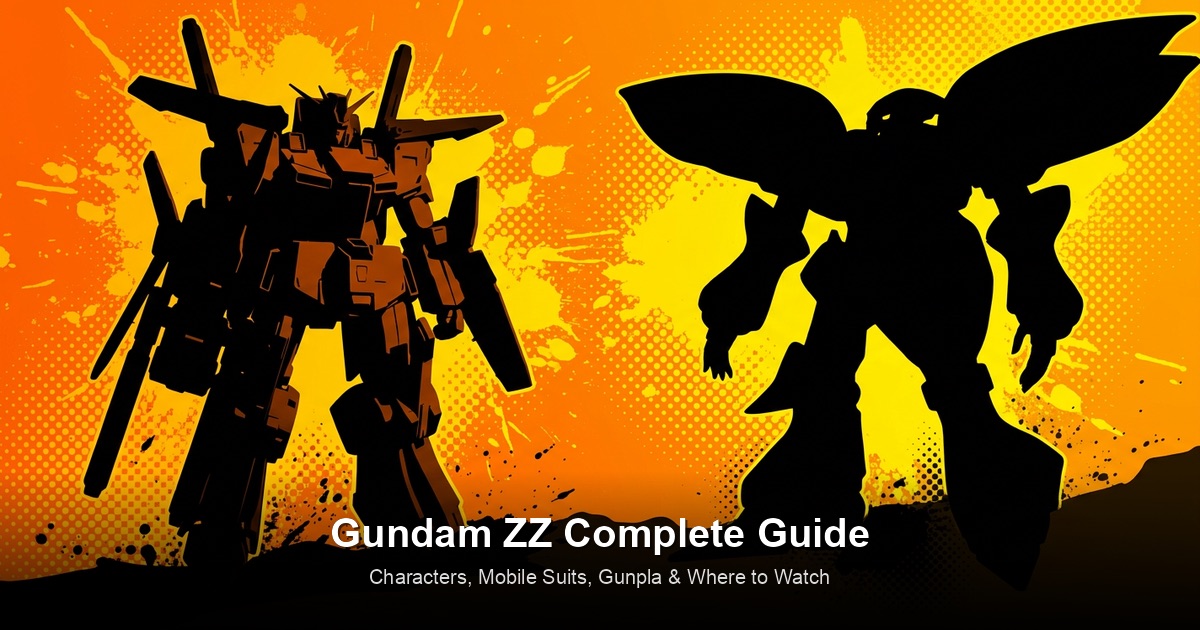
Mobile Suit Gundam ZZ — Complete Guide— Story, Mobile Suits & Ple's Tragedy
Contents
- 01What Is Mobile Suit Gundam ZZ? | Essential Information
- 02Historical Context | The First Neo Zeon War
- 03Complete Story Synopsis | All 47 Episodes
- 04Complete Character Guide
- 05Mobile Suit Catalog | MS and Warships
- 065 Reasons to Watch Gundam ZZ Now
- 07Why Did It Change from Comedy to Serious?
- 08Viewing Guide | Getting the Most Out of ZZ
- 09Music Guide | Opening and Ending Themes
- 10Reputation and Reassessment
- 11Connections to Other Works
- 12Frequently Asked Questions (FAQ)
- 13Conclusion
What Is Mobile Suit Gundam ZZ? | Essential Information
Mobile Suit Gundam ZZ (Double Zeta) is the most misunderstood entry in the Universal Century Gundam saga.
"The first half is too silly." "You can skip it." These reputations precede the show, and many fans pass it by without ever giving it a chance. But skipping ZZ means leaving a gaping hole in the Universal Century story. Haman Karn's final chapter, Judau Ashta's answer to the Newtype question, the tragedy of Ple and Ple Two -- all of these exist only here.
This guide aims to convey everything that makes ZZ essential. "You can skip it" could not be further from the truth.
Broadcast Details and Staff
| Official Title | Mobile Suit Gundam ZZ (Double Zeta) |
|---|---|
| Original Run | March 1, 1986 -- January 31, 1987 |
| Network | Nagoya TV (TV Asahi affiliate) |
| Time Slot | Saturdays, 17:30--18:00 |
| Episodes | 47 |
| Director | Yoshiyuki Tomino |
| Character Design | Hiroyuki Kitazume |
| Mechanical Design | Mika Akitaka, Makoto Kobayashi, Yutaka Izubuchi |
| Design Cooperation | Yoshikazu Yasuhiko, Kunio Okawara, Kazumi Fujita |
| 1st OP Theme | "Anime Ja Nai" (It's Not Anime) by Masato Arai |
| 2nd OP Theme | "Silent Voice" by Jun Hiroe |
| 1st ED Theme | "Jidai ga Naiteiru" (The Era Is Crying) by Masato Arai |
| 2nd ED Theme | "Issenmannen Ginga" (Ten-Million-Year Galaxy) by Jun Hiroe |
| Timeline | Universal Century 0088--0089 |
Relationship to Zeta Gundam
Gundam ZZ is a direct sequel to Mobile Suit Zeta Gundam. Its first episode aired the very week after Zeta's finale (episode 50). Much of the staff carried over, and the story continues on the same timeline without interruption.
At the end of Zeta, protagonist Kamille Bidan suffered a complete mental breakdown in the final battle of the Gryps War. ZZ picks up from that devastating conclusion. The battleship Argama, battered and short-handed, docks at the colony of Shangri-La in Side 1 -- where it encounters the new protagonist, Judau Ashta.
Setting in the Universal Century (UC 0088--0089)
The story takes place in Universal Century 0088 to 0089, roughly nine years after the One Year War (UC 0079) and immediately following the Gryps War (UC 0087--0088).
The three-way Gryps War between the AEUG, the Titans, and Axis ended without a clear victor. In the ensuing chaos, Haman Karn's Axis -- now rebranded as Neo Zeon -- emerged as the dominant power. The Earth Federation was paralyzed, and the AEUG had been bled dry.
Into this age of exhaustion, a junk dealer's son from a ruined colony is dragged onto the stage of history. That is the story of ZZ.
How the "Bright Gundam" Concept Was Born
During pre-production, ZZ was pitched with an unprecedented concept for the franchise: "a bright, cheerful Gundam."
Why? Its predecessor Zeta Gundam had ended with the protagonist's mental collapse -- a harrowing conclusion to an already dark and heavy narrative. The network wanted a show with broader appeal, particularly to younger audiences, while sponsors pushed for a concept that would boost Gunpla sales.
Director Yoshiyuki Tomino himself later acknowledged the strategy in interviews, saying he "decided to use Gundam as a combining-robot show while teaching the younger staff how to create humorous works." The "bright Gundam" concept was not accidental -- it was a deliberate choice driven by multiple converging pressures.
But how that brightness would transform over the course of the series is ZZ's greatest source of fascination -- and its most enduring controversy.
Historical Context | The First Neo Zeon War
From the End of the Gryps War to ZZ
To understand ZZ, you first need to know how Zeta Gundam ended -- specifically, the aftermath of the Gryps War.
The Gryps War pitted the AEUG (Anti-Earth Union Group) against the Titans, an authoritarian faction within the Earth Federation military. Haman Karn's Axis intervened as a third force. In the end, the Titans were annihilated. But the AEUG suffered catastrophic losses too, losing most of its frontline pilots. Kamille Bidan's mind shattered. Quattro Bajeena (Char Aznable) vanished. Only Haman Karn emerged with her forces largely intact.
The Rise of Neo Zeon (Axis)
After the Gryps War, Axis formally declared itself "Neo Zeon" and proclaimed the restoration of the Principality of Zeon. Its leader was Haman Karn.
She installed Mineva Lao Zabi -- the young heir of the Zabi dynasty -- as a puppet figurehead to legitimize her rule. With a robust military and a steady stream of new mobile suits, Neo Zeon quickly expanded its influence across the Earth Sphere, beginning with the reoccupation of Side 3 (the former Zeon homeland).
This conflict between Neo Zeon and the AEUG is known as the "First Neo Zeon War" and serves as ZZ's central axis.
The AEUG's Exhaustion and the Federation's Impotence
What strikes you early in ZZ is how weak the AEUG has become. The Argama is understaffed, its mobile suits barely maintained. Bright Noa commands the ship, but the force shortage is dire.
Meanwhile, the Earth Federation has been rendered completely ineffectual. With the Titans -- its primary military arm -- destroyed, the Federation can only watch as Neo Zeon ascends. This "helplessness of adults" is what forces the teenagers of Shangri-La to the front lines, giving ZZ's story its distinctive undercurrent of sadness.
Complete Story Synopsis | All 47 Episodes
Part 1: The Shangri-La Arc (Episodes 1--13)
Side 1, Colony "Shangri-La." In this rundown colony, a young junk dealer named Judau Ashta scrapes by with his friends -- Beecha, Mondo, Elle, and Iino -- while trying to earn enough to keep his younger sister Leina in school.
Then the Argama, battered from the Gryps War, docks at the colony. Judau tries to steal the Zeta Gundam for money, but ends up clashing with Neo Zeon pilot Mashymre Cello. Judau's latent Newtype abilities begin to awaken.
Through a series of misadventures, Judau and his Shangri-La friends become the Argama's new crew. But they are neither soldiers nor aspiring heroes. They bicker, try to hijack the ship, and even consider defecting to Neo Zeon. This "playing at war" atmosphere is exactly why ZZ's first half earned its "bright Gundam" reputation.
Yet beneath the comedy, the story's skeleton is being assembled. The fateful connection between Judau and Haman, Mashymre's chivalric devotion, and the handover of the new ZZ Gundam to Judau -- dismissing the first half as "just goofing around" means missing how carefully the groundwork is being laid.
Part 2: The Earth Descent Arc (Episodes 14--29)
The turning point comes with the Argama's descent to Earth. Neo Zeon launches an invasion of Earth, and the Argama follows, plunging through the atmosphere.
On Earth, Judau and his friends begin to feel the reality of war. Battles in Africa, political intrigue in Dakar, and a parade of colorful Neo Zeon commanders test them at every turn. ZZ's tone gradually shifts toward the serious.
The most important character introduced in this arc is Elpeo Ple. A Newtype girl serving under Glemy Toto in Neo Zeon, Ple appears as an enemy but quickly latches onto Judau, eventually joining the Argama's crew. Her cheerful cry of "Judau! Judau!" as she clings to him won over audiences instantly.
At the same time, eccentric antagonists like Chara Soon add color to the narrative, while Mashymre Cello begins his transformation into an enhanced human. Comedy lingers, but the weight of being "inside a war" steadily grows.
Part 3: Return to Space and the Final Battle (Episodes 30--47)
When Judau and the crew return to space, what awaits them is a rapid plunge into tragedy.
Within Neo Zeon, a power struggle between Haman Karn's faction and Glemy Toto's faction erupts. Glemy claims Zabi bloodline heritage and launches a rebellion, commanding Ple Two and the "Ple Series" -- an army of clone soldiers -- as his weapons.
This second half is where ZZ reveals its true power.
Ple is killed in battle against Ple Two, who is piloting the Psyco Gundam Mk-II. Her final words are: "Judau, Ple will always be with you." The death of this girl -- who had been laughing and playing in the first half -- hits with devastating force, amplified by the contrast with everything that came before.
Ple Two, in turn, is gradually changed by Ple's lingering memories and emotions, opening her heart to Judau. But she too perishes in the final battle aboard the Queen Mansa. The twin tragedy of these Newtype girls is one of ZZ's greatest legacies.
Meanwhile, Mashymre Cello, once the lovably chivalric knight, has been transformed by enhancement procedures into a warrior consumed by madness. Chara Soon, the comedic antagonist, meets a similarly tragic end. Characters who made you laugh in the first half are destroyed by tragedy in the second -- this is ZZ's structural horror.
In the final battle, Judau faces Haman Karn one-on-one. He reaches out his hand to her, offering a way out. But Haman refuses, choosing her own path and perishing on her own terms. Judau's cry -- "Come back, Lady Haman!" -- is one of ZZ's most powerful moments, transcending the boundary between enemy and ally.
The Ending and Its Aftermath
After the First Neo Zeon War concludes, Judau joins a Jupiter transport fleet and departs for the Jupiter sphere. This is an extraordinary ending for a Universal Century protagonist. Amuro and Kamille both remained in the Earth Sphere, but Judau leaves by his own choice.
This "forward-looking departure" stands in stark contrast to Amuro's fate (eventually confined by the military) and Kamille's (mental collapse). It is unmistakably a symbol of hope. Perhaps the "brightness" Tomino wanted for ZZ was never about the first half's comedy -- perhaps it was always about this ending.
Judau's sister Leina survives and sees him off. As a conclusion to the TV trilogy, it is a profoundly satisfying landing.
Complete Character Guide
AEUG / Argama Crew
| Character | Voice Actor | Description |
|---|---|---|
| Judau Ashta | Kazuki Yao | The protagonist. A 14-year-old junk dealer from Shangri-La with powerful Newtype abilities. Pilots the ZZ Gundam. Bright, optimistic, and fiercely protective of his sister and friends |
| Leina Ashta | Maya Okamoto | Judau's younger sister. Her temporary disappearance mid-story becomes Judau's strongest motivation to fight |
| Roux Louka | Naoko Matsui | A skilled AEUG pilot who primarily flies the Zeta Gundam. Proud and headstrong, she gradually bonds with Judau's group |
| Elle Vianno | Eriko Hara | A Shangri-La girl and one of Judau's friends. Occasionally pilots the Gundam Mk-II |
| Beecha Oleg | Masaaki Mori | A scheming but likable Shangri-La youth. Later serves as acting captain of the Nahel Argama |
| Mondo Agake | Kozo Shioya | Beecha's partner in mischief. Pilots the Gun Cannon Detector among other units |
| Iino Abbav | Tatsuya Matsuda | The most technically minded of the Shangri-La group, with strong mechanical knowledge |
| Bright Noa | Hirotaka Suzuoki | Captain of the Argama. A veteran commander since the One Year War who endures the chaos of his teenage crew while guiding them forward |
Neo Zeon
| Character | Voice Actor | Description |
|---|---|---|
| Haman Karn | Yoshiko Sakakibara | The de facto leader of Neo Zeon at age 20. A supreme Newtype and Qubeley pilot. A ruthless politician who nonetheless carries deep loneliness |
| Mashymre Cello | Kenyu Horiuchi | A chivalrous Neo Zeon officer devoted to Haman. Comic in the first half, he undergoes enhancement procedures in the second half and meets a tragic end |
| Chara Soon | Hazuki Monma | An impulsive, emotionally volatile Neo Zeon officer. Memorable for her eccentric behavior. Like Mashymre, she is swept into tragedy in the latter half |
| Glemy Toto | Tsutomu Kashiwakura | A young Neo Zeon officer who starts out naive but claims Zabi lineage in the second half and leads a rebellion. Commands the Ple Series |
| Rakan Dahkaran | Ryusuke Obayashi | A veteran Neo Zeon ace who pilots the Doven Wolf. Not a Newtype, but his skill rivals that of enhanced humans |
| Mineva Lao Zabi | -- | The orphaned heir of the Zabi dynasty. Used as Haman's puppet, she later plays a pivotal role in Gundam Unicorn |
The Newtype Girls -- Elpeo Ple, Ple Two, and the Ple Series
The greatest legacy ZZ left to the Universal Century is the story of Ple.
| Character | Voice Actor | Description |
|---|---|---|
| Elpeo Ple | Chieko Honda | A 10-year-old Newtype girl from Neo Zeon. Despite being an enhanced human, she has a boundlessly cheerful personality. She grows attached to Judau, joins the Argama, and is killed in battle against Ple Two's Psyco Gundam Mk-II |
| Ple Two | Chieko Honda | A clone of Elpeo Ple. Raised as a cold combat weapon, she gradually regains her humanity through the influence of Ple's lingering memories and emotions. She dies in the final battle |
Ple is often cited as a pioneer of the "moe" character archetype in anime. Her innocent cries of "Judau! Judau!" as she clung to the protagonist were groundbreaking for 1986. The "adoring little-sister figure" character type that proliferated in later anime can trace its origins back to Ple.
But Ple's true significance is not about "cuteness." It is about the tragedy of a girl created as a weapon of war, burning through a short life. The existence of Ple and Ple Two gave rise to the "Ple Series" -- a lineage of clone soldiers that would be developed further in Gundam Unicorn and Gundam Narrative. The story of Marida Cruz (Ple Twelve) in UC carries its full emotional weight only when you know what happened to the original Ple.
Chieko Honda, who voiced both Ple and Ple Two, passed away in 2013.
Mobile Suit Catalog | MS and Warships
AEUG Mobile Suits
| Model Number | Name | Pilot | Description |
|---|---|---|---|
| MSZ-010 | ZZ Gundam | Judau Ashta | The series' titular mobile suit. Height: 22.11m, weight: 32.7t. A combining/transforming MS formed by the union of the Core Top and Core Base. Its head-mounted High Mega Cannon has battleship-class destructive power. Developed as part of the AEUG and Anaheim Electronics' "Zeta Project" |
| MSZ-006 | Zeta Gundam | Roux Louka / Judau | The transformable MS that starred in the previous series. Primarily piloted by Roux Louka in ZZ |
| RX-178 | Gundam Mk-II | Elle Vianno, others | Originally a Titans unit captured by the AEUG. Used as a secondary machine in ZZ |
| MSR-100 | Hyaku Shiki (Type 100) | Beecha Oleg, others | The gold-colored MS formerly piloted by Quattro (Char) in Zeta. In ZZ, Judau's friends take turns piloting it |
| MSZ-010S | Enhanced ZZ Gundam | Judau Ashta | An upgraded version of the ZZ with improved power output and armor. Appears near the end of the series |
| FXA-07GB | Mega Rider | Various | A support sub-flight system equipped with a high-powered mega particle cannon. Can carry an MS at high speed while providing fire support |
Neo Zeon Mobile Suits
| Model Number | Name | Pilot | Description |
|---|---|---|---|
| AMX-004 | Qubeley | Haman Karn | Haman's personal Newtype-use MS. Famous for its funnel-based all-range attacks and elegant design -- one of the most iconic mobile suits in Gundam history |
| AMX-004-2 | Qubeley Mk-II | Ple / Ple Two | A prototype mass-production variant of the Qubeley. Ple's unit is red; Ple Two's is black |
| AMX-103 | Hamma Hamma | Mashymre Cello | Mashymre's signature unit, equipped with wired incoms (quasi-psycommu weapons) for mid-range combat |
| NZ-000 | Queen Mansa | Ple Two | A massive 39.2m Newtype-use MS bristling with funnels and mega particle cannons. Ple Two's final machine, and one of the most powerful MS in the Universal Century |
| AMX-014 | Doven Wolf | Rakan Dahkaran, others | A high-performance mass-production MS equipped with incoms, allowing even non-Newtypes to fight effectively |
| AMX-102 | Zssa | Various | A missile-heavy MS that can combine with a booster pod for long-range cruising |
| AMX-009 | Dreissen | Various | A heavy MS in the lineage of the original Zeon Dom. Versatile enough for both Earth and space operations |
| AMX-011S | Zaku III Custom | Mashymre Cello | Mashymre's late-series unit, custom-built to channel the power of his enhanced human abilities |
| AMX-015 | Geymalk | Chara Soon | A large Newtype-use MS featuring "Mother Funnels" that deploy their own sub-funnels for multi-stage attacks |
| AMX-107 | Bawoo | Glemy Toto, others | A transformable MS that can split into two flight components (Bawoo Nutter and Bawoo Attacker) |
Major Warships
- Argama (AEUG) -- The AEUG's main warship, carried over from Zeta Gundam. Commanded by Bright Noa
- Nahel Argama (AEUG) -- Replaces the Argama as flagship in the second half. Later appears in Gundam Unicorn
- Sadalahn (Neo Zeon) -- Haman's flagship
- Sandra (Neo Zeon) -- Glemy faction's base ship
5 Reasons to Watch Gundam ZZ Now
1. The Whiplash Between Comedy and Tragedy
This is ZZ's defining characteristic and its most debated aspect. The first half's slapstick absurdity gives way to the second half's devastating seriousness. The contrast itself is both ZZ's method and its effect.
Consider Ple's death. In the first half, she was the cheerful girl who clung to Judau like a puppy. When she dies, what viewers feel is not simply "a character has been killed." It is the crushing collapse of an entire world of brightness. The comedy existed so the tragedy could cut deeper. Whether this was calculated or accidental, only Tomino knows -- but the result is devastating.
2. Elpeo Ple's Lasting Impact on Anime
Ple pioneered the archetype of "the innocent girl who adores an older-brother figure." In 1986, this character template was fresh and original. The lineage of similar characters in later anime can be traced back to Ple.
More importantly, her "cuteness" functions as a device to underscore the cruelty of war. That such an innocent child could be manufactured and discarded as a weapon -- this is the uniquely Tomino-esque fusion of tenderness and brutality.
3. ZZ as Haman Karn's Finale
Haman Karn was already a formidable presence in Zeta Gundam. But her story reaches its conclusion in ZZ.
In ZZ, Haman holds absolute power as Neo Zeon's regent. Yet as the story progresses, her inner world -- her loneliness, her lingering feelings for Char, her anguish at being understood by no one -- gradually comes to the surface.
The scene where Judau extends his hand to Haman in the final battle is both ZZ's climax and an attempt to offer salvation to this woman. That she refuses and perishes on her own terms is deeply moving -- especially for viewers who have watched her journey from Zeta all the way through. To skip ZZ is to never witness Haman's ending, and that is an irreplaceable loss.
4. Judau's Answer to the Newtype Question
The three protagonists of the UC TV trilogy each demonstrate a different Newtype "ending."
- Amuro Ray: Possesses Newtype power but is exploited by the military, eventually confined (in Char's Counterattack, he sacrifices himself to save Earth)
- Kamille Bidan: His extreme Newtype sensitivity leaves him unable to withstand the horrors of war, resulting in mental collapse
- Judau Ashta: Uses his Newtype abilities on his own terms, protects his friends, and voluntarily departs for Jupiter as a new frontier
Judau was neither exploited like Amuro nor broken like Kamille. This is because, before being "a boy with special talent," he was "a tough kid from Shangri-La." Even dragged into war, he never lost his ability to laugh with his friends.
This "brightness" may be what ZZ was trying to depict all along. Judau's journey to Jupiter is an answer to the entire series: "Newtypes can be a source of hope."
5. The Weight of Completing the UC TV Trilogy
Mobile Suit Gundam, Zeta Gundam, and Gundam ZZ form the Universal Century's TV trilogy. The original shows the beginning of the Zeon-Federation conflict, Zeta depicts an internal civil war with the Titans, and ZZ brings the Neo Zeon conflict to a conclusion.
Viewed as a complete trilogy, ZZ's "brightness" takes on new meaning. After the tragedy of child soldiers in the original and the political conspiracy and mental destruction of Zeta, ZZ's young heroes survive the war and walk forward. That ending carries profound significance as the trilogy's culmination.
You can skip ZZ and go straight to Char's Counterattack. But with a third of the trilogy missing, the Universal Century story remains incomplete.
Why Did It Change from Comedy to Serious?
Tomino's Intent and Behind-the-Scenes Realities
Director Yoshiyuki Tomino has said that the tonal shift was planned from the start.
In an interview published in the Gundam Complete Works collection, he stated plainly: "The course change was naturally planned." The transition from first-half comedy to second-half drama was not improvised -- it was built into the concept from the beginning.
That said, whether the plan was executed exactly as intended is another matter. Tomino himself has expressed ambivalence about ZZ in later interviews and rarely discusses it with unqualified enthusiasm. Network demands, sponsor expectations, the trends of 1980s robot anime, staff capabilities -- ZZ was shaped by a complex web of forces.
The mid-production launch of the Char's Counterattack film project also had a major impact. Char, originally planned to appear in ZZ, was reserved for the movie, forcing changes to the show's narrative direction.
Key Turning Points in the Tonal Shift
ZZ's tonal evolution is gradual, but several clear turning points stand out.
- Around Episode 14 (Earth Descent): The comedy begins to fade as ground combat introduces genuine tension
- Late Episode 20s (After Ple's Arrival): Ple's story intensifies, making the war feel personal rather than distant
- Episode 35, "The Fallen Sky": Ple's death. From this point, ZZ enters full serious mode
- Episode 37 Onward (Glemy's Rebellion): Civil war erupts within Neo Zeon, accelerating toward the final confrontation
The switch from "Anime Ja Nai" to "Silent Voice" as the opening theme is also symbolic. From a provocative, comedic pop song to a quietly sorrowful ballad -- the music mirrors the show's transformation.
Was the "Bright Gundam" Concept a Failure?
This is ZZ's most fundamental question.
The honest answer: it cannot simply be called a failure.
It is true that viewers who could not adjust to the first half's comedy dropped the show, and the "you can skip ZZ" reputation took hold. But the structural effect of the comedy-to-tragedy arc is undeniable when experienced in full. Mashymre's transformation, Ple's death, Haman's end -- all are amplified by the contrast with the first half's brightness.
Furthermore, Judau's cheerfulness never wavers through to the finale. That brightness is continuous with the first half's slapstick. To reject the first half is to reject Judau's character itself.
"Bright Gundam" was not abandoned midway. Maintaining brightness while confronting the seriousness of war -- that was ZZ's achievement. Whether it succeeded or failed depends on the viewer. But it is certainly not a boring show. That much is beyond dispute.
Viewing Guide | Getting the Most Out of ZZ
What to Watch Before ZZ
The ideal viewing order to maximize your ZZ experience:
- Mobile Suit Gundam (43 TV episodes or the movie trilogy) -- Not strictly required, but provides background on Bright Noa and Char
- Mobile Suit Zeta Gundam (50 TV episodes or the movie trilogy) -- Practically essential. Kamille's breakdown, Haman's introduction, Quattro (Char)'s disappearance, and other premises for ZZ all originate here
In other words, at minimum, watch Zeta Gundam before starting ZZ. Watching from the original series is ideal, but if time is limited, the Zeta movie trilogy is a viable shortcut (though note that the movies alter Zeta's ending).
Survival Tips for the First Half
Let's be honest: the first half of ZZ does not work for everyone. Coming directly from Zeta's intensity, the tonal gap can be jarring.
Here are some strategies for those struggling with the early episodes:
- The "Push Through to Episode 14" Rule: The show improves dramatically once the Earth Descent arc begins. Give it at least 14 episodes before judging
- The "Learn to Love the Characters" Approach: Instead of being annoyed by the kids' antics, try to see them as "ordinary teenagers who have never experienced war." It reframes everything
- The "The First Half Exists for the Second Half" Mindset: Knowing that the comedy characters will face tragedy later can actually make the first half endearing in retrospect
- Skip-Watching as a Last Resort: If you truly cannot endure it, you can watch episodes 1--3 and then jump to around episode 14. But Ple's death will lose half its impact, so this is not recommended
Streaming Information (2026)
| Service | Notes |
|---|---|
| Crunchyroll | Available for streaming |
| Amazon Prime Video | Included with subscription (availability varies by region) |
| Bandai Channel | Included with subscription (Japan) |
| U-NEXT | Included with subscription (Japan) |
| d Anime Store | Included with subscription (Japan) |
As of March 2026, Gundam ZZ is available on multiple major streaming platforms. Availability may vary by region, so check your local listings.
Music Guide | Opening and Ending Themes
The Shock of "Anime Ja Nai"
ZZ's first opening, "Anime Ja Nai ~Yume wo Wasureta Furui Chikyuujin yo~" ("It's Not Anime ~You Old Earthlings Who've Forgotten Your Dreams~"), performed by Masato Arai with lyrics by Yasushi Akimoto, may be the most controversial theme song in Gundam history.
"It's not anime! It's not anime! This is the real thing!"
A Gundam opening that declares "this isn't anime." The provocative lyrics bewildered fans in 1986. Coming from Zeta's solemn "Theme of Zeta" and the beloved "Mizu no Hoshi e Ai wo Komete" (Water Star), this relentlessly upbeat pop song was a shock. The confusion it caused bled directly into the show's overall reception.
And yet, the song articulates the show's concept. "Don't dismiss us because we're anime -- what's depicted here is real." Read that way, it is a profoundly Gundam-like message. The craftsmanship of lyricist Yasushi Akimoto shines through.
The Shift to "Silent Voice"
From episode 26, the opening changes to "Silent Voice" (performed by Jun Hiroe, lyrics by Masao Urino, composed by Hiroaki Serizawa).
This wistful, transparent ballad embodies the show's tonal transformation in musical form. From "Anime Ja Nai"'s brash energy to "Silent Voice"'s quiet sorrow -- the moment the OP changes, you feel the show declaring its intent to get serious.
The endings follow the same trajectory: from "Jidai ga Naiteiru" (Masato Arai, lyrics by Akimoto) to "Issenmannen Ginga" (Jun Hiroe, lyrics by Rin Iogi -- Tomino's pen name). The latter, penned by Tomino himself, beautifully captures the vastness of space and the solitude of the characters.
Reputation and Reassessment
Why People Say "You Can Skip It"
ZZ's "skippable" reputation stems from three main factors:
- The first half's comedy doesn't sit well with many viewers: Coming from Zeta's intensity, the slapstick is jarring. Many drop the show at this point
- The misconception that "it doesn't connect to Char's Counterattack": Judau and his crew do not appear in the next UC project, Char's Counterattack. This leads people to assume ZZ can be safely skipped. But Haman's conclusion and Neo Zeon's history exist only in ZZ
- It is discussed less than the original or Zeta: For years, ZZ was the least talked-about entry in the UC saga. This created a cycle: "If it were great, people would talk about it. People don't talk about it, so it must not be great"
But this "skippable" reputation has been steadily overturned since the 2010s.
How Gundam UC and NT Revived Interest
The decisive moment in ZZ's reassessment came with Mobile Suit Gundam Unicorn (UC), which began in 2010.
Gundam UC is packed with story elements drawn from ZZ:
- Marida Cruz: One of the Ple Series, designated "Ple Twelve." Knowing the tragedy of Ple and Ple Two multiplies the emotional weight of her story many times over
- Mineva Lao Zabi: The girl who was Haman's puppet in ZZ awakens as a self-determined individual in UC
- Neo Zeon Remnants: Many of UC's Zeon remnant characters are survivors of the First Neo Zeon War depicted in ZZ
- The "Sleeves" Mobile Suits: Many MS used by UC's Neo Zeon remnants descend from ZZ-era machines
Additionally, 2018's Gundam Narrative (NT) further developed the Ple Series lore, confirming that ZZ's story threads remain actively woven into Universal Century history.
Viewers who watched UC and NT and asked "Who is this character?" or "What is the Ple Series?" found themselves tracing the thread back to ZZ. This reverse-flow reassessment has been steadily growing.
Connections to Other Works
Carried Over from Zeta Gundam
ZZ directly inherits numerous elements from Zeta Gundam:
- Bright Noa: Continues as Argama captain, a veteran commander since the One Year War
- The Battleship Argama: Serves as the home ship for ZZ's first half, later replaced by the Nahel Argama
- Mobile Suits: The Zeta Gundam, Gundam Mk-II, and Hyaku Shiki all carry over from Zeta
- Kamille Bidan: Present aboard the Argama in his catatonic state, occasionally showing flickers of Newtype awareness. Near the finale, signs of recovery appear
- Fa Yuiry: Continues caring for Kamille while also serving as a pilot
- Haman Karn: The most critical character carried from Zeta. Her story concludes in ZZ
Foreshadowing for Char's Counterattack
While ZZ and Char's Counterattack share few direct character links, several thematic threads connect them:
- Char's Absence: Quattro Bajeena (Char) vanished at the end of Zeta. He does not appear once in all 47 episodes of ZZ. This conspicuous absence becomes the setup for "what was Char doing?" in Char's Counterattack
- The Collapse of Neo Zeon: Haman's Neo Zeon collapses in ZZ, which provides the narrative necessity for Char to establish his "new" Neo Zeon in CCA
- Federation Corruption: The Federation's impotence portrayed in ZZ forms part of the basis for Char's despair with Earth's government in CCA
- Bright Noa: Having endured the trials of ZZ, Bright goes on to command the Londo Bell task force in CCA
Gundam UC and the Ple Series Legacy
ZZ's single greatest contribution to the later Universal Century is the "Ple Series" concept.
In ZZ, clones were produced from Elpeo Ple's genetic material, and the resulting "Ple Series" were deployed as weapons. This premise was dramatically expanded in the 2010s:
- Marida Cruz (Gundam UC): Ple Series No. 12, "Ple Twelve." Taken in by Zeon remnants and subjected to a harrowing life before becoming the pilot of the Kshatriya. Her story is a direct continuation of Ple and Ple Two's tragedy
- Rita Bernal (Gundam NT): The themes of Newtype power exploited by military interests echo the Ple Series lineage. NT further explores the darkness of Newtype and cloning technology
Whether you have witnessed Ple laugh, cry, fight, and die in ZZ fundamentally changes the depth of emotion you feel when watching UC and NT. ZZ is not a show you can afford to skip. ZZ is the show that influenced everything that followed.
Frequently Asked Questions (FAQ)
Q: Can I watch ZZ without seeing Zeta Gundam first?
A: Technically yes, but it is not recommended. ZZ is a direct sequel to Zeta, and key background -- Haman Karn's motivations, Bright Noa's history, Kamille's mental collapse -- will be lost without it. At minimum, watch the Zeta Gundam movie trilogy first (though note the movies alter Zeta's ending).
Q: Can I skip ZZ and go straight to Char's Counterattack?
A: You can understand Char's Counterattack on its own. However, Haman's conclusion, Neo Zeon's history, and the origins of the Ple Series exist only in ZZ. If you plan to watch Gundam UC or NT afterward, ZZ becomes essential.
Q: When does ZZ get good?
A: The general consensus is that the show improves significantly around episode 14 with the Earth Descent. Episodes 30 onward feel like a different show entirely. That said, the second half's emotional impact is strongest when you have watched the first half, so watching all the way through is recommended.
Q: Is Episode 1 "Prelude ZZ" a recap? Should I watch it?
A: Episode 1 is a special recap-style episode that reviews Zeta Gundam while introducing the new characters. If you have seen Zeta, it serves as a refresher. If not, it provides the bare minimum of background. Skippable, but it smooths the transition.
Q: What is the deal with ZZ Gundam's "combining" mechanic?
A: The ZZ Gundam is formed by combining the Core Top and Core Base, reflecting the "bright Gundam" concept's incorporation of super-robot-style combining elements. This was unusual for the Gundam franchise but was consistent with 1980s robot anime trends. The combining sequences are used effectively in key narrative moments.
Q: Does Char appear in ZZ?
A: No. Quattro Bajeena (Char) disappeared at the end of Zeta and does not appear in any of ZZ's 47 episodes. It is said that Char was originally planned to appear, but was held back once the Char's Counterattack film project gained momentum.
Q: What is the difference between Ple and Ple Two?
A: Elpeo Ple is the original Newtype girl -- cheerful, innocent, and deeply attached to Judau. Ple Two is her clone, raised as a cold-blooded combat weapon. Over time, Ple's lingering memories and emotions influence Ple Two, gradually restoring her humanity. Both are voiced by Chieko Honda.
Conclusion
Mobile Suit Gundam ZZ is, contrary to its reputation, an indispensable chapter of the Universal Century saga.
The first half's comedy is divisive, yes. But that brightness is precisely what makes the second half's darkness cut so deep. Ple's death, Mashymre's transformation, Haman's final stand -- they carry the weight they do because we saw these characters in their "everyday" first.
Above all, there is Judau Ashta. He was not exploited like Amuro. He did not break like Kamille. Even in the middle of war, he never lost his ability to smile. And in the end, he chose to set out for Jupiter -- a new horizon, on his own terms. What is a Newtype? One answer lives in Judau.
To discuss the Universal Century while skipping ZZ is like declaring a jigsaw puzzle complete with the center piece missing. Witness Haman's conclusion. Know Ple's tears. Be there for Judau's departure. Only then is the Universal Century TV trilogy truly complete.
If you have not watched it yet, now is the time. All 47 episodes are waiting for you on your favorite streaming service.
If you spot any inaccuracies, please let us know. We value accuracy above all.