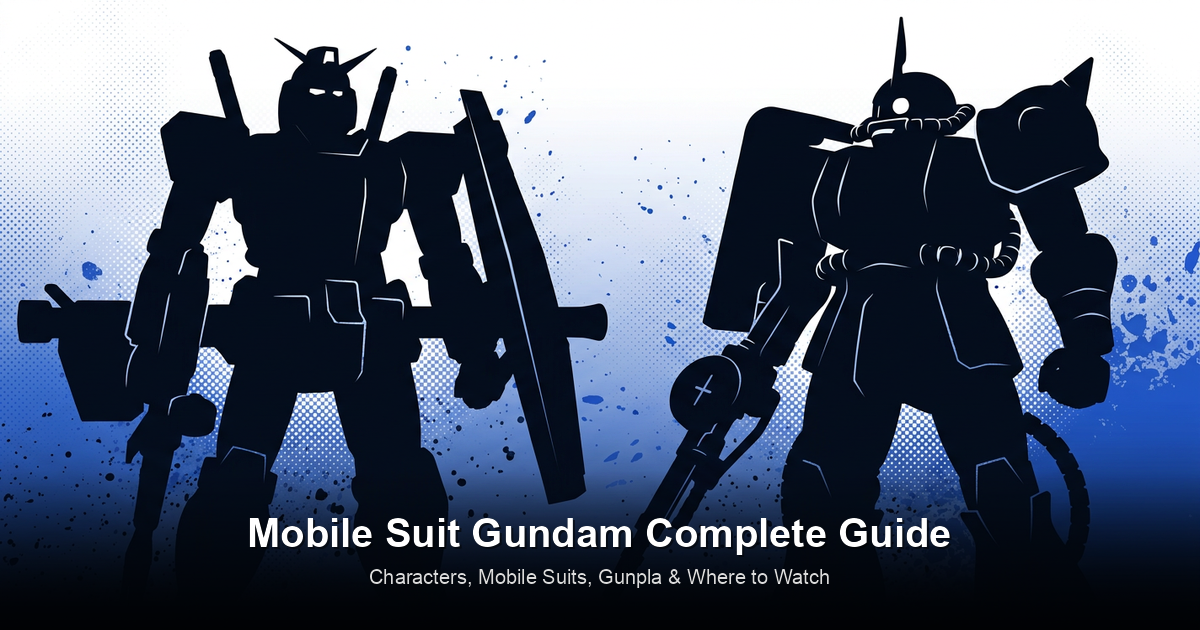
- What Is Mobile Suit Gundam? The Anime That Changed Everything, Over 45 Years Ago
- Understanding the World: The Universal Century and the One Year War
- Full Story Breakdown: All 43 Episodes
- Opening Arc: The Tragedy of Side 7 and the Gundam’s Activation (Episodes 1-10)
- First Half: Earth Descent and the Duel with Ramba Ral (Episodes 11-20)
- Middle Arc: Across Desert, Sea, and Jungle (Episodes 21-30)
- Second Half: Return to Space and the Newtype Awakening (Episodes 31-38)
- Final Arc: The Battle of A Baoa Qu and the Conclusion (Episodes 39-43)
- Compilation Films vs. TV Series: Which Should You Watch?
- Complete Character Guide
- Amuro Ray: From Introverted Boy to Legendary Pilot
- Char Aznable: The Red Comet’s True Identity and Motive for Revenge
- Bright Noa: The Weight of Command at Age 19
- Sayla Mass: The Path Char’s Sister Chose
- Lalah Sune: A Newtype’s Tragedy
- The White Base Crew
- The Zabi Family: A Dynasty of Power and Ambition
- Notable Pilots (Ramba Ral, Black Tri-Stars, M’Quve)
- Mobile Suit & Mecha Encyclopedia
- 10 Iconic Scenes and Quotes That Define the Series
- Essential Terms and Concepts
- Behind the Scenes: From Cancellation to Cultural Phenomenon
- Viewing Guide (2026 Edition)
- After First Gundam: Your Next Steps
- Frequently Asked Questions (FAQ)
- Conclusion
What Is Mobile Suit Gundam? The Anime That Changed Everything, Over 45 Years Ago
Mobile Suit Gundam is a Japanese animated television series that aired from April 7, 1979 to January 26, 1980 on Nagoya Television (now Metele) and the TV Asahi network. It ran for 43 episodes. The series was produced by Nippon Sunrise (now Bandai Namco Filmworks), with Yoshiyuki Tomino serving as chief director.
The show initially struggled with low ratings and was cut short from its planned 52 episodes to just 43, effectively making it a cancelled series. However, reruns ignited an explosive wave of popularity. A trilogy of compilation films followed starting in 1981, and Bandai’s plastic model kits, known as “Gunpla,” triggered a nationwide craze that fundamentally transformed Japanese anime and hobby culture.
As of 2026, the Gundam franchise continues to thrive. From the latest series Mobile Suit Gundam GQuuuuuuX to an ever-expanding universe of films, games, model kits, and merchandise, the franchise shows no signs of slowing down. And it all started here, with the original Mobile Suit Gundam, often called “First Gundam” by fans.
Essential Information (Broadcast, Studio, Staff)
| Official Title | Mobile Suit Gundam (Kidou Senshi Gundam) |
|---|---|
| Broadcast Period | April 7, 1979 – January 26, 1980 (43 episodes) |
| Network | Nagoya Television (Metele) / TV Asahi affiliates |
| Studio | Nippon Sunrise (now Bandai Namco Filmworks) |
| Chief Director | Yoshiyuki Tomino |
| Original Creator | Hajime Yatate, Yoshiyuki Tomino |
| Character Design | Yoshikazu Yasuhiko |
| Mechanical Design | Kunio Okawara |
| Screenwriters | Hiroyuki Hoshiyama, Kenichi Matsuzaki, Yoshihisa Araki, Yu Yamamoto, Yoshiyuki Tomino, and others |
| Music | Takeo Watanabe, Yuji Matsuyama |
| Opening Theme | “Tobe! Gundam” by Kou Ikeda |
| Ending Theme | “Eien ni Amuro” by Kou Ikeda |
| Production | Nagoya Television, Sotsu Agency, Nippon Sunrise |
“Hajime Yatate” is a collective pen name used to credit the planning group at Sunrise, rather than a real individual.
Why Is It Called “First Gundam”?
The official title is simply Mobile Suit Gundam. However, as sequels began to appear, from Zeta Gundam in 1985 and Gundam ZZ in 1986 to Char’s Counterattack, F91, and Victory Gundam, fans needed a way to distinguish the original. The nickname “First Gundam” (or simply “0079,” after its in-universe year) became the standard shorthand. While not an official title, it is universally understood among Gundam fans worldwide.
How Gundam Broke the Mold of Robot Anime
Before Gundam, robot anime in Japan was dominated by “super robot” shows like Mazinger Z and Getter Robo, which featured heroes piloting giant robots to defeat weekly villains in straightforward good-versus-evil narratives.
Gundam shattered those conventions in several fundamental ways:
- It depicted war, not heroism: Instead of good versus evil, Gundam told the story of a war between nations. Both sides had their reasons for fighting, and neither was entirely right or wrong.
- Robots as weapons: Mobile suits were industrial products, military hardware developed and mass-produced by armies. They needed ammunition resupply and repairs, just like real military equipment.
- An unheroic protagonist: Amuro Ray was not a brave hero but an introverted, socially awkward 15-year-old boy. Thrown into battle against his will, he experienced fear, doubt, and even desertion before gradually growing as both a pilot and a person.
- Compelling antagonists: Char Aznable and other enemy characters had deep backstories and complex motivations, sometimes becoming even more popular than the protagonist.
These innovations established Gundam as the progenitor of the “real robot” genre, influencing countless anime and science fiction works that followed.
Understanding the World: The Universal Century and the One Year War
To fully appreciate First Gundam, it helps to understand the setting: a future timeline called the Universal Century and the devastating conflict known as the One Year War.
What Is the Universal Century (U.C.)?
The story takes place in a fictional calendar era called the Universal Century (U.C.), which succeeded the Anno Domini system. As Earth’s population grew beyond what the planet could sustain, humanity began constructing massive cylindrical space habitats called space colonies and relocating people to orbit. The Universal Century calendar marks the beginning of this great migration to space.
First Gundam takes place in Universal Century 0079.
Space Colonies and the Earth Federation
In the U.C. world, clusters of space colonies called “Sides” orbit the Earth-Moon system. Numbered Side 1 through Side 7, each Side consists of dozens to hundreds of individual colony cylinders. A single colony is roughly 6 km in diameter and 30 km long, with cities, farmland, and artificial weather systems recreating Earth-like conditions on the interior surface.
Governing both Earth and the colonies is the Earth Federation. However, the Federation is dominated by Earth-based elites, and the colonists, known as Spacenoids, face systematic political and economic discrimination. This inequality between Earth and space is the root cause of the coming war.
The Rise of Zeon and the Road to War
At Side 3, the colony cluster farthest from Earth, a philosopher named Zeon Zum Deikun advocated for Spacenoid autonomy and independence. After Deikun’s death, his supporter Degwin Sodo Zabi seized power and declared Side 3 the independent “Principality of Zeon.” Degwin’s eldest son, Gihren Zabi, built an authoritarian military state bent on full independence from the Federation.
On January 3, U.C. 0079, the Principality of Zeon declared war on the Earth Federation. This was the beginning of the One Year War.
Timeline of the One Year War
| U.C. 0079, January | War breaks out — Zeon executes Operation British, dropping a space colony onto Earth. The impact devastates the Australian continent. In what becomes known as the “One Week Battle,” roughly half of humanity is killed |
|---|---|
| January 15-31 | Battle of Loum — The Federation and Zeon fleets clash near Side 5. Zeon’s mobile suit forces achieve a decisive victory, and Federation General Revil is captured |
| January 31 | Antarctic Treaty signed — Both sides agree to ban the use of nuclear weapons, chemical weapons, and further colony drops |
| February onward | Zeon’s Earth Invasion — Leveraging their mobile suit advantage, Zeon forces occupy large portions of the Earth’s surface |
| September 18 | Battle of Side 7 (Episode 1) — Zeon Zakus infiltrate Side 7. Amuro boards the Gundam, and the TV series begins here |
| November | Federation counteroffensive — Jaburo is successfully defended; Operation Odessa drives Zeon from Earth |
| December | Final battles in space — The Battles of Solomon and A Baoa Qu lead to Zeon’s surrender |
| U.C. 0080, January 1 | Armistice signed — The One Year War officially ends |
The TV series covers roughly the final three months of the One Year War (September to December U.C. 0079). In other words, Amuro’s story takes place during the climactic final act of a much larger conflict.
Full Story Breakdown: All 43 Episodes
Here is a block-by-block overview of the TV series. Spoilers are kept to a minimum so new viewers can follow the narrative arc without having key moments ruined.
Opening Arc: The Tragedy of Side 7 and the Gundam’s Activation (Episodes 1-10)
In September U.C. 0079, a Zeon reconnaissance force led by Char Aznable approaches Side 7, where the Earth Federation has been secretly testing new prototype mobile suits. Two of Char’s subordinates infiltrate the colony in their Zakus, and combat erupts inside the colony.
Fifteen-year-old Amuro Ray, who lives at Side 7 with his father Tem Ray (a Federation mobile suit engineer), stumbles into the cockpit of the prototype Gundam during the chaos. Reading through the operating manual on the fly, he manages to activate the machine and destroy the enemy Zakus, but Side 7 sustains catastrophic damage in the process.
The survivors evacuate aboard the new Federation warship White Base. With almost no trained military personnel left, 19-year-old officer cadet Bright Noa is forced to take command. Amuro, whether he likes it or not, becomes the Gundam’s pilot.
The first major dramatic turning point comes with Char’s elaborate scheme to betray his supposed friend, Garma Zabi, the youngest son of the ruling Zabi family. Garma’s dramatic death sends shockwaves through the Principality and raises the stakes of the entire story.
First Half: Earth Descent and the Duel with Ramba Ral (Episodes 11-20)
White Base descends to Earth, aiming for the Federation’s Jaburo headquarters in South America. But Zeon forces control much of the planet’s surface, and the journey is anything but safe.
On Earth, the crew faces veteran Zeon soldier Ramba Ral, piloting the new close-combat mobile suit Gouf. Ral is Amuro’s first encounter with a truly skilled and honorable enemy. Unlike the faceless soldiers Amuro has fought before, Ral is a complex figure whose warrior’s pride commands respect even from his opponents.
During this stretch, Amuro begins to crack under the pressure of combat. He resents being ordered to fight by Bright, and in a dramatic episode, he deserts White Base, taking the Gundam with him. The “Amuro desertion” arc is one of the series’ most psychologically intense sequences.
Through the final confrontation with Ramba Ral, Amuro begins to understand the weight of combat and the value of his comrades. Ral’s noble end leaves a lasting impression that goes far beyond a simple enemy defeat.
Middle Arc: Across Desert, Sea, and Jungle (Episodes 21-30)
Seeking to avenge Ramba Ral, the Black Tri-Stars (Gaia, Mash, and Ortega) attack White Base with their Dom mobile suits. Their signature “Jet Stream Attack” formation proves devastatingly effective, and the crew suffers significant losses.
The other major conflict in this arc pits the crew against M’Quve, the Zeon commander at Odessa. A ruthless strategist willing to launch nuclear missiles in violation of the Antarctic Treaty, M’Quve represents the dark side of Zeon’s war effort. Operation Odessa, the Federation’s massive offensive to reclaim Zeon-occupied Earth territory, marks a decisive turning point in the story.
White Base’s journey across desert, ocean, and jungle introduces encounters with Zeon’s amphibious mobile suits, including the Gogg, Z’Gok, and Acguy, adding visual variety to the combat.
Meanwhile, Amuro’s abilities are growing at an extraordinary rate. His reaction time and tactical instincts become almost superhuman, foreshadowing his awakening as a “Newtype.”
Second Half: Return to Space and the Newtype Awakening (Episodes 31-38)
The Federation counteroffensive intensifies. White Base reaches the Jaburo base for resupply and repairs, then receives orders to return to space for the final campaign.
Back in space, White Base participates in the Battle of Solomon, an assault on Zeon’s massive space fortress. The Federation deploys its new superweapon, the Solar System, while Zeon’s Dozle Zabi sorties in the colossal mobile armor Big Zam for a desperate last stand.
Amuro’s Newtype abilities now manifest unmistakably. He can sense enemy attacks before they happen and demonstrates near-superhuman combat performance. At Side 6, he encounters Lalah Sune, a young Newtype woman fighting for Zeon. Despite being on opposite sides of the war, Amuro and Lalah experience a profound psychic resonance. This encounter sets the stage for the story’s tragic climax.
Final Arc: The Battle of A Baoa Qu and the Conclusion (Episodes 39-43)
The story reaches its climax at Zeon’s last stronghold, the space fortress A Baoa Qu.
Amuro faces Char, now piloting Zeon’s most powerful mobile suit, the Zeong. Char, too, has awakened Newtype abilities, and the rivalry between the two reaches its peak in a fierce duel that intertwines with the larger chaos of the final battle.
Internal power struggles within the Zabi family, the suffering of soldiers on both sides, and the intertwined fates of Amuro and Char all converge in the finale. The story’s conclusion is a powerful meditation on the futility of war and the resilience of the human spirit.
The final episode, “Escape,” depicts the desperate evacuation from the crumbling fortress. What awaits Amuro and the surviving crew of White Base at the end? That is best experienced firsthand.
Compilation Films vs. TV Series: Which Should You Watch?
The 43-episode TV series was condensed into a trilogy of theatrical compilation films:
| Film 1 | Mobile Suit Gundam (March 14, 1981) |
|---|---|
| Film 2 | Mobile Suit Gundam II: Soldiers of Sorrow (July 11, 1981) |
| Film 3 | Mobile Suit Gundam III: Encounters in Space (March 13, 1982) |
The films re-edit the TV footage with some new animation added, removing several episodes while improving the quality of key scenes. Director Tomino considers the films to be the “definitive version” of the story, and subsequent Gundam series generally follow the film continuity.
For newcomers, the film trilogy is the recommended starting point. At roughly seven hours total, it offers an efficient overview of the entire story. If you enjoy the films, watching the full TV series afterward rewards you with additional character development and episodes that were cut from the theatrical versions.
Complete Character Guide
Amuro Ray: From Introverted Boy to Legendary Pilot
| Name | Amuro Ray |
|---|---|
| Voice Actor | Toru Furuya |
| Age | 15 |
| Affiliation | Earth Federation Forces (civilian conscript) |
| Mobile Suit | RX-78-2 Gundam |
A mechanically inclined teenager who would rather tinker with computers than interact with people. His father Tem Ray is a Federation MS engineer, and his parents are separated. Amuro is the antithesis of the typical action hero, and that is precisely what makes him resonate with audiences. His growth from a frightened civilian into a formidable pilot, from a boy who deserts his comrades to a young man who fights to protect them, forms the emotional core of the entire series.
Char Aznable: The Red Comet’s True Identity and Motive for Revenge
| Name | Char Aznable |
|---|---|
| Voice Actor | Shuichi Ikeda |
| Age | 20 |
| Affiliation | Principality of Zeon |
| Mobile Suits | MS-06S Zaku II (Red) → MSN-02 Zeong |
| Alias | The Red Comet |
The greatest rival character in the Gundam franchise and one of the most iconic antagonists in anime history. Known for his red mobile suits and the legend that he moves “three times faster than normal,” Char sank five Federation battleships at the Battle of Loum. Behind his signature mask lies his true identity: Casval Rem Deikun, son of Zeon’s founding philosopher. Convinced that the Zabi family was responsible for his father’s death, Char infiltrated the Zeon military to exact revenge from within, playing the role of a loyal ace pilot while secretly plotting to destroy the ruling family one member at a time.
His conflict with Amuro transcends a simple hero-villain dynamic. Newtype resonance, the tragic love triangle involving Lalah Sune, and a mutual respect that cannot prevent them from fighting, all these elements make Amuro and Char’s rivalry one of the richest in all of fiction, extending through Zeta Gundam and culminating in Char’s Counterattack.
Bright Noa: The Weight of Command at Age 19
| Name | Bright Noa |
|---|---|
| Voice Actor | Hirotaka Suzuoki |
| Age | 19 |
| Affiliation | Earth Federation Forces |
| Role | Acting Captain, White Base |
A freshly graduated officer cadet thrust into command when his superiors are killed at Side 7. With a crew of civilians and a handful of soldiers, Bright must hold White Base together through one battle after another. His clashes with the younger crew members, especially Amuro, are legendary among fans. Bright goes on to appear throughout multiple Gundam series, becoming the franchise’s most enduring captain figure.
Sayla Mass: The Path Char’s Sister Chose
| Name | Sayla Mass |
|---|---|
| Voice Actor | You Inoue |
| True Name | Artesia Som Deikun |
| Role | White Base communications officer / pilot |
An intelligent, strong-willed woman serving as White Base’s communications officer. Her true identity is Artesia Som Deikun, Char’s younger sister and another child of Zeon’s founding philosopher. While her brother chose revenge, Sayla chose to leave the Deikun name behind and fight for the Federation. The emotional weight of being on the opposite side of a war from her own brother adds layers of drama to her character.
Lalah Sune: A Newtype’s Tragedy
| Name | Lalah Sune |
|---|---|
| Voice Actor | Keiko Han |
| Affiliation | Principality of Zeon |
| Mobile Armor | MAN-08 Elmeth |
A young woman of South Asian heritage, discovered by Char and recognized as a powerful Newtype. She pilots the Elmeth mobile armor, controlling remote weapons called “bits” with her mind. Her psychic encounter with Amuro on the battlefield, a moment of mutual understanding between enemies, ends in tragedy that permanently scars both Amuro and Char, defining their rivalry for decades to come.
The White Base Crew
| Kai Shiden | VA: Toshio Furukawa. A cynical coward who gradually finds courage. Pilots the Guncannon |
|---|---|
| Hayato Kobayashi | VA: Kiyonobu Suzuki. Amuro’s childhood friend. Pilots the Guntank. Quiet but determined |
| Fraw Bow | VA: Rumiko Ukai. Amuro’s childhood friend who cares for the ship’s war orphans while supporting Amuro |
| Mirai Yashima | VA: Fuyumi Shiraishi. White Base’s helmsman. Calm and perceptive |
| Ryu Jose | VA: Shozo Iizuka. White Base’s co-pilot and backup MS pilot. A dependable big-brother figure whose fate carries emotional weight |
| Sleggar Law | VA: Tessho Genda. A veteran pilot who joins the crew mid-series. Cheerful, capable, and doomed to become unforgettable |
The Zabi Family: A Dynasty of Power and Ambition
| Degwin Sodo Zabi | VA: Ichiro Nagai. Sovereign of Zeon. Reluctant about the war’s escalation |
|---|---|
| Gihren Zabi | VA: Banjo Ginga. Supreme commander and dictator. His own father calls him “the tail of Hitler” |
| Dozle Zabi | VA: Daisuke Gouri. Space Attack Force commander. A hulking warrior and the most straightforward of the Zabis. Makes his final stand at Solomon in the Big Zam |
| Kycilia Zabi | VA: Mami Koyama. Mobile Assault Force commander. Cold, ambitious, and locked in a power struggle with Gihren |
| Garma Zabi | VA: Katsuji Mori. The youngest Zabi. A handsome young commander and Char’s academy friend, whose trust proves tragically misplaced |
Notable Pilots (Ramba Ral, Black Tri-Stars, M’Quve)
Ramba Ral (VA: Masashi Hirose) — A veteran Zeon soldier known as the “Blue Giant.” Piloting the Gouf, he brings warrior’s honor to the battlefield. His famous line, “This is no Zaku, boy! No Zaku!” perfectly captures his pride in his new machine and his contempt for anyone who underestimates it.
The Black Tri-Stars — Gaia (VA: Issei Masamune), Mash, and Ortega (VA: Kazunari Futamata) form an elite three-man team. Piloting Doms, they are famous for their coordinated “Jet Stream Attack” formation. These are the men who captured General Revil at Loum.
M’Quve (VA: Kaneto Shiozawa) — The Zeon officer commanding the Odessa mining base. An eccentric collector of fine pottery whose catchphrase about his beloved vase, “That is a fine piece,” belies a ruthless strategist willing to use nuclear weapons to win.
Mobile Suit & Mecha Encyclopedia
One of First Gundam’s greatest strengths is its diverse roster of mobile suits. Here are the key machines with their specifications.
RX-78-2 Gundam: The Federation’s White Devil
| Model Number | RX-78-2 |
|---|---|
| Affiliation | Earth Federation Forces |
| Head Height | 18.0 m |
| Base Weight | 43.4 t |
| Full Weight | 60.0 t |
| Generator Output | 1,380 kW |
| Total Thrust | 55,500 kg |
| Armor Material | Luna Titanium Alloy |
| Main Armament | Beam Rifle, Beam Saber x2, 60mm Head Vulcans x2, Hyper Bazooka, Shield |
| Pilot | Amuro Ray |
The Federation’s prototype mobile suit, developed under the top-secret “Project V.” Its Luna Titanium armor is impervious to Zaku machine gun fire, and it was the first MS to carry a beam rifle. This single machine upended Zeon’s entire military strategy and changed the course of the One Year War. Known to Zeon soldiers as the “White Devil,” the Gundam, amplified by Amuro’s Newtype awakening, became the most feared weapon on the battlefield. It is the template from which all subsequent Gundams descend and the defining icon of the entire franchise.
Federation Mobile Suits (Guncannon, Guntank, GM, Ball)
| RX-77-2 Guncannon |
|---|
| Head Height |
| Base Weight |
| Full Weight |
| Generator Output |
| Armor |
| Main Armament |
| Pilot |
A mid-range artillery MS developed under Project V. Its twin shoulder-mounted 240mm cannons provide heavy fire support while Luna Titanium armor keeps it well-protected.
| RX-75 Guntank |
|---|
| Height |
| Full Weight |
| Generator Output |
| Main Armament |
| Pilot |
A long-range bombardment MS with tank treads for legs. More “tank with arms” than true mobile suit, but its main guns boast a range of 260 km.
| RGM-79 GM |
|---|
| Head Height |
| Base Weight |
| Full Weight |
| Generator Output |
| Armor |
| Main Armament |
The Federation’s first mass-production mobile suit, based on the Gundam’s design but built for cost efficiency. Downgraded armor and a shorter-range beam weapon make it inferior to the Gundam, but it still outperforms the Zaku II. The GM was the workhorse that carried the Federation’s counteroffensive in the war’s final months.
| RB-79 Ball |
|---|
| Height |
| Base Weight |
| Full Weight |
| Generator Output |
| Armor |
| Main Armament |
A converted worker pod turned combat unit. Cheap, fragile, and limited in armament, but produced in massive numbers to support GMs through sheer numerical superiority.
Zaku II: The Mass-Production Masterpiece That Changed War
| Model Number | MS-06F (standard) / MS-06S (commander) |
|---|---|
| Affiliation | Principality of Zeon |
| Head Height | 17.5 m |
| Base Weight | 56.2 t |
| Full Weight | 73.3 t |
| Generator Output | 976 kW |
| Total Thrust | 43,300 kg |
| Armor | Super-Hard Steel Alloy |
| Main Armament | Zaku Machine Gun, Zaku Bazooka, Heat Hawk, Cracker Grenades |
The world’s first practical mass-produced mobile suit and the weapon that gave Zeon its early dominance. Char’s red commander variant (MS-06S) had 30% more thrust, giving rise to the legend that he moved “three times faster” than a normal Zaku.
Zeon MS Evolution (Gouf, Dom, Gelgoog, Zeong)
| MS-07B Gouf |
|---|
| Head Height |
| Base Weight |
| Generator Output |
| Main Armament |
| Notable Pilot |
A close-combat specialist designed to surpass the Zaku on the ground. The Heat Rod ensnares enemies while the Finger Vulcans provide unexpected ranged firepower. Made iconic by Ramba Ral’s famous declaration that it is decidedly not a Zaku.
| MS-09 Dom |
|---|
| Head Height |
| Base Weight |
| Main Armament |
| Notable Pilots |
A heavy assault MS that uses thermonuclear jet engines to hover across terrain at up to 381 km/h, deceptively fast for its bulk. The Black Tri-Stars’ “Jet Stream Attack” made the Dom one of the most feared machines in the war.
| MS-14A Gelgoog |
|---|
| Head Height |
| Base Weight |
| Generator Output |
| Total Thrust |
| Main Armament |
| Notable Pilot |
Zeon’s final mass-production MS, rivaling the Gundam in performance and the first Zeon suit with a standard beam rifle. Tragically, it arrived too late: by the time it reached the front lines, most of Zeon’s veteran pilots were already dead. “What if the Gelgoog had been deployed a few months earlier?” remains one of the great what-ifs among fans.
| MSN-02 Zeong |
|---|
| Head Height |
| Base Weight |
| Generator Output |
| Total Thrust |
| Main Armament |
| Pilot |
Zeon’s ultimate Newtype-use mobile suit. Its psycommu system allows detachable arms to attack independently. Deployed at only 80% completion (with unfinished legs), it was Char’s final mount in his duel with Amuro at A Baoa Qu.
Amphibious Mobile Suits (Gogg, Z’Gok, Acguy)
| MSM-03 Gogg |
|---|
| Head Height |
| Base Weight |
| Generator Output |
| Main Armament |
| MSM-07 Z’Gok |
|---|
| Head Height |
| Base Weight |
| Generator Output |
| Max Underwater Speed |
| Main Armament |
| MSM-04 Acguy |
|---|
| Head Height |
| Base Weight |
| Generator Output |
| Main Armament |
Zeon developed these amphibious suits for Earth invasion operations. The Gogg pioneered mega particle cannon integration, the Z’Gok perfected the concept (Char’s red Z’Gok impaling a GM at Jaburo is one of the show’s most iconic images), and the Acguy, with its comically large head, has become a fan-favorite mascot that is arguably more popular as merchandise than it ever was as a weapon.
10 Iconic Scenes and Quotes That Define the Series
-
“Let me see the performance of the Federation’s mobile suit.”
— Char Aznable (Episode 2)
Char’s first encounter with the Gundam. Cool, confident, analytical. The essence of his character in a single line.
2. “I’ll show you that the difference in mobile suit performance is not the decisive factor in battle!”— Char Aznable (Episode 3)
Outgunned in his Zaku against the Gundam, Char insists that pilot skill matters more than hardware.
3. “Because he was a spoiled brat.” (Bouya da kara sa)— Char Aznable (Episode 12)
During Garma’s state funeral, as Gihren delivers his famous speech asking why Garma died, Char mutters this ice-cold response. It crystallizes his contempt for the Zabi family in three devastating words.
4. “This is no Zaku, boy! No Zaku!”— Ramba Ral (Episode 20)
Ramba Ral in his Gouf, correcting Amuro’s assumption that he is facing another ordinary enemy. A line that has transcended the show to become a universal pop-culture reference in Japan.
5. “That is a fine piece.” (Are wa ii mono da)— M’Quve
M’Quve’s appreciation for his beloved vase, spoken with a connoisseur’s sincerity that makes his ruthlessness all the more unsettling.
6. “It’s sad, but this is war.”— Sleggar Law
A deceptively casual remark that carries the weight of everything that follows.
7. “Zeon has no soldiers left!”— Dozle Zabi (Battle of Solomon)
Dozle’s defiant cry as he launches in the Big Zam for a last stand against impossible odds.
8. “Garma, if you can hear me, curse the misfortune of your birth!”— Char Aznable (Episode 10)
The moment Char’s betrayal becomes explicit. He addresses his doomed “friend” with chilling detachment as he springs his trap.
9. “If it doesn’t hit, there’s nothing to worry about.”— Char Aznable
A line that sounds reckless but reflects absolute confidence in his own evasive abilities. Widely quoted online.
10. “Newtypes are not tools for killing!”— Amuro Ray (Final battle)
Amuro’s answer to those who would weaponize human evolution. The thematic heart of the entire series.
Essential Terms and Concepts
What Is a Newtype?
The concept of the Newtype was originally a philosophical idea proposed by Zeon Zum Deikun: that humanity, having migrated to space, would evolve new perceptive abilities enabling deeper mutual understanding, ultimately transcending the need for war.
In practice, Newtype abilities manifested most dramatically in combat: precognitive danger sense, the ability to perceive others’ emotions without words, and enhanced spatial awareness that made Newtype pilots almost supernaturally effective. Amuro, Char, and Lalah are the prime examples.
The tension between Deikun’s idealistic vision of human evolution and the military’s exploitation of Newtypes as weapons is one of the franchise’s most enduring and powerful themes.
Minovsky Particles: Why Giant Robots Make Sense
“Why would anyone fight a war with giant robots instead of guided missiles?” Minovsky particles are the answer.
In the Gundam universe, Minovsky particles are a fictional substance that, when dispersed in an area, jam radar and all forms of electronic communication and targeting. Long-range guided missiles become useless. Combat reverts to visual range, where the mobility and versatility of humanoid mobile suits become the most effective weapons platform.
This single piece of world-building elegantly justifies the entire premise of mobile suit warfare, giving the show’s giant robot battles a layer of plausibility that super robot shows never attempted.
Project V and the RX Series
Project V (V for Victory) was the Federation’s crash program to develop mobile suits after being devastated by Zeon’s MS forces early in the war. The project produced three prototype machines: the RX-78-2 Gundam (close combat), the RX-77-2 Guncannon (mid-range artillery), and the RX-75 Guntank (long-range bombardment). Combat data from these prototypes was used to develop the mass-production GM (RGM-79), enabling the Federation’s counteroffensive.
The Antarctic Treaty
After the catastrophic opening weeks of the One Year War, during which colony drops and nuclear weapons killed approximately half of humanity, the Earth Federation and Zeon signed the Antarctic Treaty on January 31, U.C. 0079. The treaty banned nuclear, biological, and chemical weapons, colony drops, and established rules for prisoner treatment. Think of it as the Geneva Convention of the Universal Century. M’Quve’s willingness to violate it with nuclear missiles at Odessa drives some of the series’ most tense episodes.
Behind the Scenes: From Cancellation to Cultural Phenomenon
A 5.3% Rating: Why Gundam Was Cancelled
When Mobile Suit Gundam premiered on April 7, 1979, it earned an average rating of just 5.3% in the Kanto region (9.1% in Nagoya). The planned 52-episode run was cut to 43. By any conventional measure, it was a failure.
The reasons were straightforward: robot anime in 1979 was children’s programming, sponsored by toy companies. But Gundam was a sophisticated war drama that challenged its young audience with moral ambiguity and psychological complexity. Additionally, its Saturday 5:30 PM time slot competed with children’s outdoor play hours.
Reruns Change Everything
Despite the poor ratings, a devoted fanbase of older teenagers and young adults was quietly growing, fueled by anime magazine coverage and word of mouth. The catalyst came with reruns.
Post-cancellation rebroadcasts shattered the original ratings: 17.9% average in Kanto, and an astonishing 29.1% peak (25.7% average) in Nagoya. A tidal wave of new fans discovered the show, and Gundam became a full-blown cultural phenomenon.
The Birth of the Gunpla Boom
The single biggest accelerant was Bandai’s plastic model kit line, universally known as “Gunpla.” The first kits went on sale in July 1980, after the TV broadcast had already ended. Initial sales were modest, but by early 1981, demand exploded. Kits sold out the instant they hit shelves. Model shops across Japan were besieged by customers. It was a genuine social phenomenon.
What made Gunpla different was the concept: these were not toys of super robots but realistic scale models of military hardware. This resonated with older hobbyists, and Gunpla helped establish a new culture of serious model building, painting, and weathering.
As of 2026, Gunpla remains one of Bandai Namco’s flagship product lines, sold worldwide across multiple grades (HG, MG, PG, RG, and more). Total shipments exceed 800 million units. It all began with this one show.
Viewing Guide (2026 Edition)
Streaming Services Comparison
Here are the major platforms where you can watch Mobile Suit Gundam (TV series and compilation films) as of 2026. Availability may vary by region.
| Service | Price | Free Trial | Notes |
|---|---|---|---|
| Crunchyroll | $7.99/month | 7 days | Major anime streaming platform with extensive Gundam catalog |
| Netflix | $6.99/month+ | None | Select Gundam titles available; catalog varies by region |
| Amazon Prime Video | $14.99/month | 30 days | Some titles require additional rental/purchase |
| Hulu | $7.99/month | 30 days | Available in select regions |
| Gundam.info YouTube | Free | N/A | Official Gundam YouTube channel occasionally streams episodes for free |
| Bandai Channel (Japan) | 1,100 yen/month | First month | Most comprehensive Gundam library; Japanese service |
TV Series vs. Film Trilogy: Which First?
| TV Series (43 episodes) | Film Trilogy | |
|---|---|---|
| Runtime | ~18 hours | ~7 hours |
| Pros | Richer character development; more episodes with side characters | Better pacing; improved animation in key scenes |
| Cons | Inconsistent early animation; lengthy | Some episodes and subplots removed |
| Best for | Deep-dive viewers; those who want every detail | Time-pressed viewers; first-timers wanting the full story efficiently |
Recommendation: Start with the film trilogy. Seven hours gives you the complete narrative with improved production values. If you want more afterward, the full TV series rewards repeat viewers with additional depth.
After First Gundam: Your Next Steps
Finished First Gundam and hungry for more? The Universal Century saga spans decades of in-universe history. Here is a recommended viewing order:
| Priority | Title | Setting | Description |
|---|---|---|---|
| Essential | Mobile Suit Zeta Gundam (1985) | U.C. 0087 | The direct sequel. Set seven years after the One Year War, featuring returning characters Amuro, Char, and Bright |
| Essential | Char’s Counterattack (1988) | U.C. 0093 | The epic film that concludes the Amuro vs. Char saga once and for all |
| Recommended | Mobile Suit Gundam ZZ (1986) | U.C. 0088 | Direct sequel to Zeta. Comedic early episodes give way to serious drama |
| Recommended | Gundam 0080: War in the Pocket (1989) | U.C. 0080 | A 6-episode OVA masterpiece depicting the One Year War through a child’s eyes |
| Recommended | Gundam 0083: Stardust Memory (1991) | U.C. 0083 | An OVA bridging First Gundam and Zeta, following Zeon remnants |
| Recommended | Gundam THE ORIGIN (2015) | U.C. 0068-0079 | A prequel by original character designer Yasuhiko, detailing Char’s backstory |
| Optional | Mobile Suit Gundam Unicorn (2010) | U.C. 0096 | Set three years after Char’s Counterattack, uncovering the Universal Century’s greatest secret |
If you are interested in standalone Gundam series set in their own universes (known as “Alternate Universe” or “AU” Gundam), consider Gundam SEED, G Gundam, Iron-Blooded Orphans, or The Witch from Mercury. These require no prior Gundam knowledge.
Frequently Asked Questions (FAQ)
Q. How many episodes does First Gundam have?
A. The TV series has 43 episodes (originally planned as 52 before cancellation). The compilation film trilogy runs approximately 7 hours total.
Q. Is it appropriate for children?
A. As a war story, it includes character deaths and mature themes. Generally suitable for ages 10 and up, though its deeper themes resonate most with teenagers and adults.
Q. Do I need to watch First Gundam to enjoy other Gundam series?
A. Not necessarily. Standalone series like Gundam SEED, Iron-Blooded Orphans, The Witch from Mercury, and GQuuuuuuX work independently. However, Universal Century sequels (Zeta, Char’s Counterattack, etc.) are significantly enhanced by First Gundam knowledge.
Q. Are there differences between the TV version and the films?
A. Yes. The G-Fighter support mech from the TV series becomes the Core Booster in the films. Some character introductions and episode sequences differ. Tomino considers the films the definitive version, and later UC series generally follow film continuity.
Q. What is the best first Gunpla kit for beginners?
A. The HG (High Grade) 1/144 scale line is ideal for beginners. Kits are affordable ($10-15), require no glue (snap-fit assembly), and need no special tools. The “HGUC RX-78-2 Gundam” is the classic starting point.
Q. Is Amuro a Newtype?
A. Yes. His Newtype abilities awaken during the series’ second half, allowing him to sense enemy attacks and communicate psychically with other Newtypes. He is arguably the most iconic Newtype in the franchise.
Q. Why does Char wear a mask?
A. Char’s real name is Casval Rem Deikun, son of Zeon’s founding philosopher. Believing the Zabi family murdered his father, he assumed a false identity and enlisted in the Zeon military to pursue revenge from within. The mask conceals his true identity.
Q. What is the difference between “Universal Century” and “Alternate Universe” Gundam?
A. Universal Century (UC) is the shared timeline originating from First Gundam, with deeply interconnected stories. Alternate Universe (AU) series (SEED, 00, Iron-Blooded Orphans, Witch from Mercury) each have their own independent settings and can be enjoyed without prior Gundam knowledge.
Conclusion
Mobile Suit Gundam has shaped the anime, hobby, and entertainment industries for over 45 years, and its influence shows no signs of fading.
The show’s real-world journey from cancelled flop to cultural juggernaut mirrors its own narrative of overcoming impossible odds. Amuro’s growth from a terrified teenager into a legendary pilot. Char’s labyrinthine rivalry driven by revenge, respect, and loss. The question at the heart of the Newtype concept: can humanity truly understand one another?
These are not just themes from a 1979 anime. They remain as relevant in 2026 as they were when the show first aired.
If you have never seen First Gundam, start with the film trilogy. In about seven hours, you will experience the story that launched a franchise worth billions and changed the face of Japanese animation forever. And if you are already a fan, we hope this guide has given you a new appreciation for the depth and enduring power of where it all began.
The Gundam universe is vast, but every corner of it traces back to one place. Mobile Suit Gundam is, and will always be, the origin of everything.
Comments