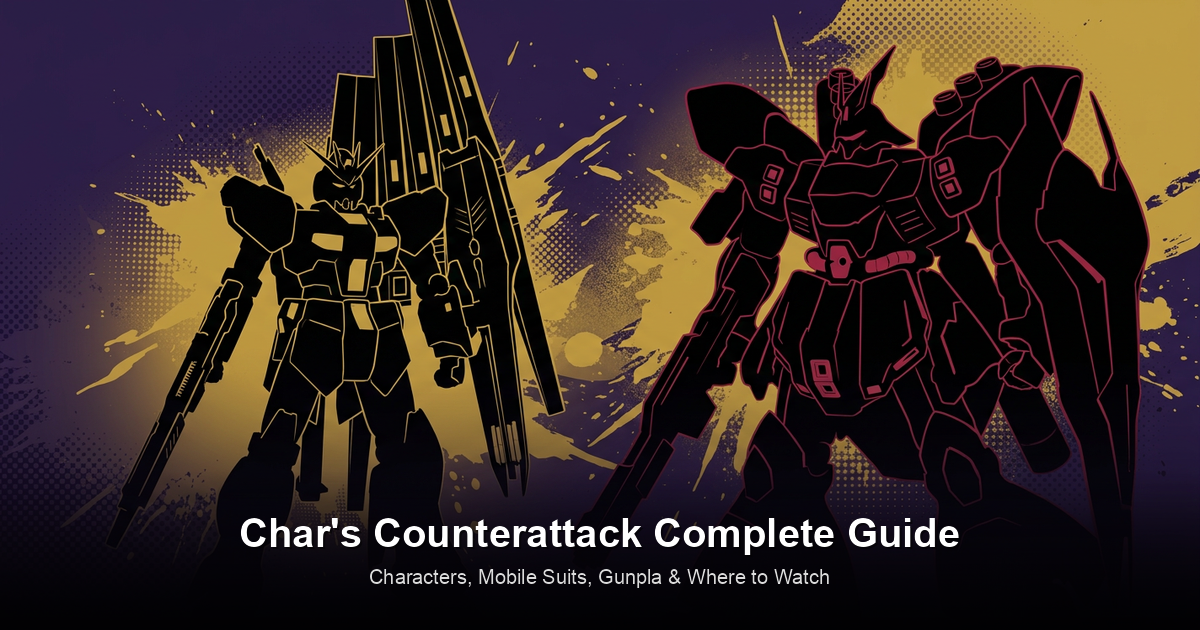
- What Is Char’s Counterattack? — Essential Information and Significance
- Complete Plot Synopsis
- Act 1 — The Fifth Luna Drop and Char’s Declaration of War
- Act 2 — The Sham Peace Negotiations at Londenion
- Act 3 — Quess Paraya’s Defection and Hathaway’s Anguish
- Act 4 — The Battle for Axis and the Nu Gundam’s Sortie
- Act 5 — Nu Gundam vs. Sazabi: The Final Duel
- The Final Act — The Axis Shock and the Disappearance of Two Men
- Complete Character Guide
- Complete Mobile Suit Catalog
- Deep Analysis — What Char’s Counterattack Is Really About
- The Axis Shock — A Thorough Explanation
- Top 10 Iconic Quotes and Scenes
- #10: “I was impressed when I met Amuro. He didn’t have the eyes of a soldier.” — Quess Paraya
- #9: “Amuro, I’m doing something despicable. If you’re nearby, try sensing who I really am.” — Char Aznable
- #8: “And I shall be called to my father Zeon’s side!” — Char Aznable
- #7: “The Earth is reaching a point where it can no longer sustain itself!” — Char Aznable
- #6: “A man of your caliber — how can you so easily give up on people!” — Amuro Ray
- #5: “I can see Lalah anytime I want.” — Amuro Ray
- #4: “That’s just ego!” — Amuro Ray
- #3: “What’s the point of beating me in a wretched mobile suit like that!” — Char Aznable
- #2: “Lalah Sune was a woman who could have been a mother to me.” — Char Aznable
- #1: “The Nu Gundam isn’t just for show!” — Amuro Ray
- Novel Versions and Differences from the Film
- Behind the Scenes
- Influence on Later Works (UC, NT, Hathaway’s Flash)
- Viewing Guide [2026 Edition]
- Gunpla Guide (Nu Gundam and Sazabi — Grade Comparison)
- FAQ
- Q. Can I enjoy Char’s Counterattack without having seen any previous Gundam?
- Q. What is the scientific explanation for the Axis Shock?
- Q. Did Amuro and Char die?
- Q. Why did Char give the Psycho-Frame technology to the enemy?
- Q. Why did Hathaway kill Chain?
- Q. Which novelization should I read?
- Q. If I can only buy one Gunpla kit, what should it be?
- Conclusion
What Is Char’s Counterattack? — Essential Information and Significance
Mobile Suit Gundam: Char’s Counterattack (commonly abbreviated as CCA) is the crowning achievement of the Gundam theatrical films.
The story of Amuro Ray and Char Aznable, which began in 1979, reaches its conclusion here. After the One Year War, the Gryps War, and the First Neo Zeon War — in Universal Century 0093, the two meet on the battlefield one final time. Friends, rivals, and the only people who truly understood each other, these two men clash with the fate of the Earth hanging in the balance.
This guide covers every facet of Char’s Counterattack. For first-time viewers, it serves as the ideal introduction. For those who have watched it many times, it offers fresh perspectives and deeper analysis.
Essential Production Data (Released March 12, 1988 / Director: Yoshiyuki Tomino / Runtime: 120 minutes)
| Official Title | Mobile Suit Gundam: Char’s Counterattack |
|---|---|
| Japanese Title | Kidou Senshi Gundam: Gyakushuu no Char |
| Release Date | March 12, 1988 |
| Distributor | Shochiku |
| Runtime | 120 minutes |
| Director / Screenplay / Original Story | Yoshiyuki Tomino |
| Character Design | Hiroyuki Kitazume |
| Mobile Suit Design | Yutaka Izubuchi |
| Mechanical Design | Gainax, Yoshinori Sayama |
| Music | Shigeaki Saegusa |
| Theme Song | “BEYOND THE TIME ~Mobius no Sora wo Koete~” by TM NETWORK |
| Production | Sunrise |
| Box Office | 1.13 billion yen |
| Attendance | 1.03 million viewers |
| Timeline | Universal Century 0093 |
| Common Abbreviations | CCA, Gyaku-Sha (Japan) |
Universal Century 0093 — The Era
The story is set in Universal Century 0093 — 14 years after the One Year War (UC 0079), five years after the Gryps War (UC 0087–0088), and four years after the First Neo Zeon War (UC 0088–0089).
The Earth Federation government remains as corrupt as ever. The discontent of the Spacenoids — people who live in space colonies — has reached a breaking point. The Federation clings to its terrestrial privileges and continues to look down upon those living in space. Fourteen years since the One Year War, nothing has changed. If anything, things have gotten worse.
One man has had enough. Char Aznable — once the ace pilot of the Principality of Zeon known as the “Red Comet,” later the AEUG officer Quattro Bajeena during the Gryps War — returns to the Earth Sphere as the supreme leader of the new Neo Zeon.
His objective: to drop an asteroid onto Earth, triggering a nuclear winter. By forcing all of humanity into space, he would compel them to evolve into Newtypes — this is the “counterattack” that Char has chosen.
Why It Matters — The Final Resolution of Amuro and Char’s 14-Year Rivalry
Within the Gundam franchise, the relationship between Amuro Ray and Char Aznable is the foundation upon which everything else is built.
Universal Century 0079: the One Year War. Amuro, a 15-year-old civilian, stumbles into the cockpit of the Gundam and clashes repeatedly with Char, Zeon’s legendary ace. Both awaken as Newtypes, and their fates become intertwined through Lalah Sune — a young woman whose death at Amuro’s hand leaves an indelible scar on both men.
In Zeta Gundam, they briefly fought on the same side, yet remained unable to bridge the gap between them. During the ZZ era, Char vanished entirely.
Now, 14 years later, the two face each other as enemies once more. Char’s Counterattack is the story that brings final resolution to their 14-year rivalry. It could not be anything less than extraordinary.
What You Should Know Before Watching
Char’s Counterattack is a standalone theatrical film, but knowledge of the preceding series deepens the experience immensely. Here are the essential points:
- Amuro Ray: Hero of the One Year War. Pilot of the original Gundam. A Newtype. After the war, he was essentially placed under house arrest by the Federation, but returned to active duty with the AEUG during the Gryps War. Now serves as the ace pilot of the Londo Bell task force
- Char Aznable: Son of Zeon Zum Deikun. Known as the “Red Comet” during the One Year War, he later joined the AEUG as “Quattro Bajeena” during the Gryps War. He disappeared during the ZZ era and has now returned as the leader of Neo Zeon
- Lalah Sune: A Newtype girl whom both men encountered during the One Year War. She died shielding Char from Amuro’s counterattack. Her death left an unhealing wound between the two
- Bright Noa: A veteran captain who has served since the One Year War. Commands the Londo Bell flagship Ra Cailum
- Newtypes: A new type of human adapted to living in space, possessing heightened spatial awareness and the ability to sense others’ thoughts and emotions
Complete Plot Synopsis
Act 1 — The Fifth Luna Drop and Char’s Declaration of War
Universal Century 0093, March. Neo Zeon leader Char Aznable drops the asteroid base Fifth Luna onto Lhasa, the seat of the Earth Federation government.
The Earth Federation’s independent task force, Londo Bell, sorties to prevent the drop. Ace pilot Amuro Ray, piloting the Re-GZ, engages Char’s Yakut Doga in combat. But Londo Bell is hopelessly outgunned, and they fail to stop Fifth Luna’s descent.
Fifth Luna strikes Lhasa directly, devastating the Federation’s central government. This was merely the first phase of Char’s plan to drop asteroids onto Earth.
Char broadcasts a declaration to the entire world: “I will carry out my plan to make the Earth uninhabitable for humankind.” It is a plan both grand and mad — to “purify” an Earth sullied by human ego, to force all of humanity into space, and to trigger their evolution into Newtypes.
Act 2 — The Sham Peace Negotiations at Londenion
After Fifth Luna’s descent, the Earth Federation initiates peace negotiations with Neo Zeon at the colony of Londenion in Side 1.
But the negotiations are a farce. Corrupt Federation officials secretly agree to transfer the asteroid Axis to Neo Zeon as a “resource.” Axis is the very weapon Char intends to drop on Earth — and the officials know this, or deliberately choose not to know.
At Londenion, Amuro and Char meet face to face once more. Their conversation is no longer a dialogue between former comrades. It is a collision between two irreconcilably divided convictions.
“You don’t know a thing about reforming the world. Revolutions are always started by intellectuals, and because they have these dreamy ideals, they always resort to extreme measures.” Amuro sees through the core of Char’s “idealism.” But Char has passed the point of no return.
Behind the scenes of the negotiations, a young girl is drawn into the vortex of fate — Quess Paraya, daughter of Federation official Adenauer Paraya.
Act 3 — Quess Paraya’s Defection and Hathaway’s Anguish
Quess Paraya is a 13-year-old girl starved for her father’s affection and consumed by loneliness. She possesses strong Newtype potential and is drawn to Amuro, but Amuro cannot handle her emotional needs.
Enter Char. He acknowledges Quess’s potential as a Newtype and gives her the validation she has been craving. Drawn by Char’s recognition, Quess defects to Neo Zeon.
The one most devastated by Quess’s defection is Hathaway Noa, son of Bright Noa. Hathaway is in love with Quess. His desperate desire to bring her back will eventually drive him to an irreversible act.
Within Neo Zeon, Quess pilots the massive mobile armor Alpha Azieru, demonstrating overwhelming combat power against the Federation forces. A girl who was never acknowledged by her father finds her only sense of worth on the battlefield — this tragedy is deeply intertwined with the work’s overarching themes.
Act 4 — The Battle for Axis and the Nu Gundam’s Sortie
Char’s ultimate objective is to drop the asteroid Axis onto Earth. If this rock — over ten kilometers in diameter — strikes the planet, a nuclear winter will follow, rendering Earth uninhabitable.
Londo Bell commits to an all-out offensive to prevent Axis’s descent. And here, Amuro’s new mobile suit makes its appearance.
Nu Gundam — the state-of-the-art Gundam that Amuro Ray personally helped design, built specifically for him and this final battle. Equipped with six Fin Funnels and a hastily installed Psycho-Frame, it transmits the pilot’s will directly to the machine.
“The Nu Gundam isn’t just for show!” — With this machine, Amuro heads into his last fight.
The battle over Axis is ferocious. Neo Zeon’s Gyunei Guss stands in the way with his Yakut Doga, and Quess in her Alpha Azieru. Gyunei is shot down in combat with Amuro. And Quess, too, loses her life — killed by a missile fired by Chain Agi.
Witnessing Quess’s death, Hathaway impulsively shoots and kills Chain. Amuro’s lover, killed by Bright’s son — this chain of tragedy epitomizes the madness of war.
Act 5 — Nu Gundam vs. Sazabi: The Final Duel
Axis is now on a collision course with Earth, propelled by nuclear pulse engines. Time is running out.
And then — Amuro’s Nu Gundam and Char’s Sazabi begin their final duel.
This battle is not merely a comparison of mobile suit performance or a contest of piloting skill. It is the culmination of 14 years of accumulated emotion between two men — hatred, respect, understanding, disappointment, and their shared feelings toward Lalah — all of it hurled at each other with every blow.
Beam rifles exchange fire. Fin Funnels and funnels clash in volleys. In close quarters, beam saber meets beam tomahawk in showers of sparks. The Nu Gundam’s agility and the Sazabi’s firepower collide head-on, turning the combat zone into a storm of light.
Amuro blasts through the Sazabi’s abdomen and, deducing that the cockpit is located in the head, concentrates his attack there. The Sazabi is critically damaged. Char ejects in an escape pod. Amuro captures the pod with the Nu Gundam’s manipulator arm.
“What’s the point of beating me in a wretched mobile suit like that!” — Char’s cry is not merely the frustration of defeat. It escapes his lips because he knows this duel was their final conversation.
The Final Act — The Axis Shock and the Disappearance of Two Men
Even with the Sazabi destroyed, Axis continues its fall toward Earth. Londo Bell’s demolition team plants nuclear charges inside Axis and detonates them, but the asteroid merely splits in two — and the rear half maintains its collision course.
Amuro presses the Nu Gundam’s body against the fragment of Axis and attempts to push back an asteroid with a single mobile suit.
“It’s just a chunk of rock! I’ll push it back with the Gundam!”
It was reckless. Physically impossible. But then the Nu Gundam’s Psycho-Frame begins to glow with a rainbow-colored light, exhibiting an anomalous reaction. Amuro’s will — no, not Amuro’s alone. The desire of every person on that battlefield to “save the Earth” flows into the Psycho-Frame, resonating and amplifying.
Even the pilots of Neo Zeon — the enemy — begin pressing their own mobile suits against Axis.
The rainbow light envelops all of Axis — and then, Axis is pushed away from Earth.
A miracle that science cannot explain. The moment when human will transcended the laws of physics. This is the “Axis Shock” — the greatest supernatural phenomenon in Universal Century history.
And Amuro and Char — they vanish into the rainbow light. Their fate is never confirmed, and their whereabouts become an eternal mystery of the Universal Century.
As “BEYOND THE TIME” plays, fragments of Axis scatter through space, trailing light. The story of two men who were once boys comes to its close.
Complete Character Guide
Earth Federation Forces / Londo Bell (Amuro, Bright, Chain, Hathaway)
| Character | Voice Actor | Description |
|---|---|---|
| Amuro Ray | Toru Furuya | The protagonist. Commander of Londo Bell’s mobile suit squadron. Lieutenant. The hero of the One Year War and the most powerful Newtype pilot in existence. Pilots the Nu Gundam, which he personally helped design, in his final battle against Char. Age 29 |
| Bright Noa | Hirotaka Suzuoki | Captain of the Londo Bell flagship Ra Cailum. Colonel. A veteran commander who has served on the front lines since the One Year War. Amuro’s most trusted superior officer and comrade-in-arms |
| Chain Agi | Mitsuki Yayoi | A mechanic and pilot seconded to Londo Bell from Anaheim Electronics. Amuro’s girlfriend. Responsible for analyzing the Psycho-Frame. Her downing of Quess in the film’s climax triggers a devastating chain of tragedy |
| Hathaway Noa | Nozomu Sasaki | Bright Noa’s son. Age 13. Driven by his feelings for Quess, he enters the battlefield despite being a civilian. After witnessing Quess’s death, he kills Chain in a fit of rage — an act that will define the rest of his life |
| Astonaige Medoz | Shingo Hiromori | Londo Bell’s chief mechanic. Responsible for maintaining the Nu Gundam. A veteran from the Gryps War era who enjoys Amuro’s deep trust. Killed in action during the final battle |
| Kayra Su | Shinobu Adachi | A Londo Bell pilot who takes over the Re-GZ. Captured by Gyunei during combat and killed in the ensuing chaos |
Neo Zeon (Char, Nanai, Gyunei, Quess, Rezin)
| Character | Voice Actor | Description |
|---|---|---|
| Char Aznable | Shuichi Ikeda | Supreme leader of the new Neo Zeon. An ace pilot known as the “Red Comet.” Born Casval Rem Deikun, son of Zeon Zum Deikun. Seeks to drop asteroids onto Earth and force humanity into space, thereby triggering Newtype evolution. Age 33 |
| Nanai Miguel | Yoshiko Sakakibara | Director of Neo Zeon’s Newtype research institute. Char’s lover and strategic advisor. She tries harder than anyone to understand Char’s true intentions, yet cannot fill the void within him |
| Gyunei Guss | Koichi Yamadera | A Cyber-Newtype (artificially enhanced) pilot. Pilots a Yakut Doga. Highly skilled but equally proud, torn between his rivalry with Char and his attraction to Quess. Killed in action against Amuro |
| Quess Paraya | Maria Kawamura | Daughter of a Federation official who joins Neo Zeon, driven by her father’s emotional neglect. Age 13. Possesses formidable Newtype abilities. Pilots the Alpha Azieru to devastating effect before being killed by Chain’s attack |
| Rezin Schnyder | Kazue Ikura | A veteran Neo Zeon pilot flying a customized Geara Doga. Serves as a squad leader known for her calm judgment. Killed in action during the battle for Axis |
Complete Mobile Suit Catalog
Nu Gundam (RX-93) — Specs, Armaments, and Psycho-Frame
The Nu Gundam is the cutting-edge Gundam that Amuro Ray personally helped design — a machine built exclusively for him and his final battle.
Developed by Anaheim Electronics, the suit incorporates Amuro’s pilot data from the design phase onward, fully optimizing it for his reaction speed and combat style. Its most distinctive visual feature is the array of six Fin Funnels mounted on its left back — remote-controlled beam weapons.
The original design did not include a Psycho-Frame, but one was hastily installed after Char deliberately leaked the technology to Anaheim. Why would Char strengthen the enemy’s mobile suit? Because he wanted to fight Amuro on equal terms. This single act reveals the depth of Char’s obsession with Amuro.
| Model Number | RX-93 |
|---|---|
| Head Height | 22.0m |
| Empty Weight | 27.9t |
| Loaded Weight | 63.0t |
| Generator Output | 2,980kW |
| Total Thruster Output | 97,800kg |
| Armor Material | Gundarium Alloy |
| Sensor Range | 21,300m |
| Affiliation | Earth Federation Forces, Londo Bell |
| Pilot | Amuro Ray |
Primary Armaments:
- 60mm Vulcan Guns x2: Head-mounted close-defense weapons
- Beam Rifle: 3.8MW output. Primary ranged weapon
- New Hyper Bazooka: A physical projectile weapon. Effective against warships
- Beam Sabers x2: Stored on the backpack. For close-quarters combat
- Shield: Mounted on the left arm. Contains a built-in beam cannon and four small missiles
- Fin Funnels x6: The Nu Gundam’s signature weapon. Remote-operated beam weapons controlled via Newtype brainwaves. Unlike conventional funnels, they are rechargeable and reusable. Multiple units can also generate the “Fin Funnel Barrier” for defense
Sazabi (MSN-04) — Specs and Armaments
The Sazabi is a machine built exclusively for Char Aznable, representing the culmination of all Neo Zeon mobile suit technology.
It integrates every advancement from the Zeon mobile suit lineage, achieving an exceptional balance between raw mobile suit performance and Newtype-use psycommu capabilities. The cockpit area employs a Psycho-Frame, allowing the pilot’s will to be directly reflected in the machine’s actions. The cockpit is uniquely located in the head, which also functions as an escape mechanism.
Its crimson armor befits the name “Red Comet,” and the firepower unleashed from its 25-meter frame is overwhelming.
| Model Number | MSN-04 |
|---|---|
| Head Height | 25.6m |
| Empty Weight | 30.5t |
| Loaded Weight | 71.2t |
| Generator Output | 3,960kW |
| Total Thruster Output | 133,000kg |
| Armor Material | Gundarium Alloy |
| Sensor Range | 22,600m |
| Affiliation | Neo Zeon |
| Pilot | Char Aznable |
Primary Armaments:
- Diffuse Mega Particle Cannon: Built into the abdomen, the Sazabi’s only fixed weapon. 8.8MW output. Sweeps across wide areas
- Beam Shot Rifle: 10.2MW output. Primary ranged weapon capable of switching between focused shots and a scatter mode
- Beam Tomahawk: Generates a massive beam blade from the grip. Can also function as a beam saber. The Sazabi’s primary melee weapon
- Beam Sabers x2: Stored at the waist
- Shield: A large Gundarium alloy shield. Mounts one large beam tomahawk and three small missiles on its reverse side
- Funnels x6: Stored in the rear funnel container. Remote-controlled beam weapons operated via Newtype brainwaves
Nu Gundam vs. Sazabi — Complete Comparison Table
A stat-by-stat breakdown of the Universal Century’s greatest rivalry.
| Specification | Nu Gundam (RX-93) | Sazabi (MSN-04) | Advantage |
|---|---|---|---|
| Head Height | 22.0m | 25.6m | Nu Gundam (smaller target profile) |
| Empty Weight | 27.9t | 30.5t | Nu Gundam (lighter, more agile) |
| Loaded Weight | 63.0t | 71.2t | Nu Gundam |
| Generator Output | 2,980kW | 3,960kW | Sazabi (+32.9%) |
| Total Thruster Output | 97,800kg | 133,000kg | Sazabi (+36.0%) |
| Thrust-to-Weight Ratio | 1.55 | 1.87 | Sazabi |
| Sensor Range | 21,300m | 22,600m | Sazabi (marginal) |
| Psycommu Weapons | Fin Funnels x6 | Funnels x6 | Nu Gundam (rechargeable, can form barrier) |
| Main Ranged Weapon | Beam Rifle (3.8MW) | Beam Shot Rifle (10.2MW) | Sazabi (vastly superior output) |
| Built-In Weapons | Vulcans x2, Shield Beam Cannon | Diffuse Mega Particle Cannon (8.8MW) | Sazabi |
| Melee Weapons | Beam Sabers x2 | Beam Tomahawk + Beam Sabers x2 | Sazabi (greater variety) |
| Psycho-Frame | Installed (cockpit area, hastily added) | Installed (cockpit area, from design phase) | Even |
| Design Philosophy | Agility and balance | Firepower and overall capability | — |
On paper, the Sazabi dominates. Its generator output exceeds the Nu Gundam’s by roughly 33%, its total thrust by 36%, and its main weapon output by a factor of 2.7.
However, the Nu Gundam holds qualitative advantages in its rechargeable Fin Funnels and their barrier capability — and above all, it is piloted by Amuro Ray. The greatest Newtype pilot in the Universal Century, flying a machine he designed himself. There is a “+alpha” to the Nu Gundam that no spec sheet can capture.
In the film’s duel, the Nu Gundam’s lighter frame and superior agility allow Amuro to overcome the Sazabi’s raw firepower. What decided the outcome was not machine performance but the strength of the pilot’s will.
Other Mobile Suits (Re-GZ, Jegan, Yakut Doga, Geara Doga, Alpha Azieru)
| Unit | Model Number | Affiliation | Pilot(s) | Description |
|---|---|---|---|---|
| Re-GZ | RGZ-91 | Londo Bell | Amuro Ray (early) / Kayra Su | A mass-production prototype of the Zeta Gundam. Its Back Weapon System (BWS) provides a simplified transformation mechanism. Amuro’s machine before the Nu Gundam enters service. A cost-effective successor to the Zeta lineage, though it cannot match the original |
| Jegan | RGM-89 | Londo Bell | Federation pilots | The Federation’s new mass-production mobile suit, successor to the GM lineage. Cost-effective and versatile, it appears in large numbers as Londo Bell’s primary fighting force. Remained in service across the Universal Century for decades |
| Yakut Doga | MSN-03 | Neo Zeon | Gyunei Guss, Quess Paraya | A high-performance Newtype-use mobile suit equipped with funnels. Far outclasses standard units. Gyunei’s unit is red; Quess’s is green |
| Geara Doga | AMS-119 | Neo Zeon | Neo Zeon pilots | Neo Zeon’s main mass-production mobile suit, carrying on the Zaku lineage. Distinguished by its green color scheme, it appears in great numbers throughout the film, and its battles against the Jegan are a highlight |
| Alpha Azieru | NZ-333 | Neo Zeon | Quess Paraya | A colossal mobile armor spanning 108.26 meters. Armed with over ten funnels, Quess’s Newtype abilities allow it to project overwhelming combat dominance — enough to challenge even the Nu Gundam |
Deep Analysis — What Char’s Counterattack Is Really About
Why Did Char Want to Drop an Asteroid on Earth?
“The Earth is reaching a point where it can no longer sustain itself!” Char proclaims this repeatedly throughout the film. But was his motivation truly about “humanity’s future” and nothing more?
The stated reason is clear enough. The Earth Federation’s corruption shows no sign of stopping. The privileged class clings to Earth while exploiting those who live in space. The Newtype evolution that his father Zeon Zum Deikun championed has not advanced one step. If so, then make the Earth uninhabitable, force humanity into space, and compel their evolution — that is Char’s “great cause.”
But Amuro sees through it.
“A man of your caliber — how can you so easily give up on people!”
There is something self-destructive about Char’s actions. The despair of having risen as a political leader yet changed nothing. His jealousy of and yearning for Amuro, who embodies the “Newtype ideal.” And the 14 years of unresolved grief over losing Lalah.
Was Char truly fighting for humanity — or was he merely constructing an elaborate stage on which to settle his score with Amuro? No definitive answer exists. That is precisely why Char’s Counterattack yields new interpretations with every viewing.
The True Meaning of “Lalah Could Have Been a Mother to Me”
One of the film’s most iconic lines is Char’s confession: “Lalah Sune was a woman who could have been a mother to me.”
On the surface, the line seems bizarre. Lalah was essentially Char’s lover and a girl younger than him. Why “mother”?
Consider Char’s life. His father Zeon Zum Deikun was assassinated when he was a child. Hunted by the Zabi family, he survived under assumed names. He never knew the shelter of a mother’s unconditional love. He spent his life behind masks, driven by vengeance. Char was always searching for someone who would accept him without conditions.
Lalah, awakened as a Newtype, had the ability to perceive and embrace Char’s heart as it truly was. She might have been the one to accept the man behind the mask of vengeance — without reservation. That is what “could have been a mother to me” really means.
And Amuro is the one who took Lalah away. For Char, his feelings toward Amuro are not mere rivalry. They are an impossible compound of inconsolable rage toward the man who took what he needed most and an attraction he cannot suppress.
“I can see Lalah anytime I want.” This line from Amuro during their final battle is a Newtype’s answer — he can always “feel” Lalah’s presence. For Char, even that is unforgivable.
What Quess Paraya Symbolizes
Quess Paraya may be the most “unlikable” character in Char’s Counterattack. Selfish, emotional, she upends those around her and ultimately defects to Neo Zeon.
But understanding what Quess symbolizes reveals the critical importance of her role.
Quess embodies the possibility of the next generation of Newtypes. And simultaneously, she represents the tragedy of adults failing to properly guide a Newtype child.
Her father Adenauer is emotionally absent. Amuro is consumed by his own battle and has no capacity to receive Quess. And Char — Char exploits her need for validation and sends her to the front lines as a weapon.
Neither Amuro nor Char — both Newtype predecessors — can protect Quess, their would-be successor. Adults who fail to protect children — this is another tragedy at the heart of Char’s Counterattack, and it strikes at the essence of what war truly does.
Hathaway’s Choice and the Connection to Hathaway’s Flash
Hathaway Noa is the character who carries the deepest wound from this film.
He fell in love with Quess. He tried to save her and could do nothing. He watched her die before his eyes. And in his rage, he killed Chain — the experience of this 13-year-old boy is unbearably cruel.
Hathaway’s crime is not explicitly addressed within the film, but the scar left on his soul never heals. Caught in the chain of tragedy that the adults created, he became a perpetrator himself.
This experience connects directly to Mobile Suit Gundam: Hathaway’s Flash. The adult Hathaway leads the anti-Federation organization “Mafty Navue Erin,” challenging the Earth Federation as a terrorist. The death of Quess and his own sin in Char’s Counterattack are what transformed him into “Mafty.”
Watching Hathaway’s Flash after Char’s Counterattack makes the “rage and regret” at the root of Hathaway’s actions unmistakably clear. The two works are inseparable.
The Axis Shock — A Thorough Explanation
What Is the Psycho-Frame?
To understand the Axis Shock, you first need to understand the Psycho-Frame.
The Psycho-Frame is a material in which microscopic computer chips with psycommu functionality are embedded directly into a mobile suit’s structural frame. Traditional psycommu systems required large, dedicated equipment, but the Psycho-Frame allows the frame itself to serve as a psycommu receptor, enabling reception and amplification of Newtype brainwaves without increasing the suit’s size.
Both the Nu Gundam and the Sazabi were equipped with Psycho-Frames, but their true capabilities were unknown even to their developers. Beyond merely receiving the pilot’s psychic energy, the Psycho-Frame could gather and amplify the wills of surrounding people and convert them into physical force — a phenomenon no one had anticipated.
Why Was Axis Pushed Back?
Let us organize what the film shows us:
- Amuro attempts to push back Axis’s fragment with the Nu Gundam
- The Nu Gundam’s Psycho-Frame begins to glow with a rainbow-colored light, exhibiting anomalous readings
- Amuro’s intense desire to “save the Earth” flows into the Psycho-Frame
- Allied pilots begin pressing their own mobile suits against Axis
- Then, enemy Neo Zeon pilots also begin pressing their mobile suits against Axis
- The shared will of every person present — “protect the Earth” — resonates and amplifies through the Psycho-Frame
- The rainbow light engulfs all of Axis, and a force beyond physics pushes Axis away from Earth
This is the “Axis Shock.” A supernatural event in which human will generated a physical phenomenon that defies scientific explanation.
What matters most is that this miracle was not Amuro’s alone. The wills of every person present — enemy and ally alike — converged in a single direction. This is one answer to the “Newtype possibility” that Zeon Zum Deikun dreamed of. When human beings truly understand each other and act with a common purpose, miracles happen.
Director Tomino himself depicted the phenomenon as “something that cannot be explained by logic,” deliberately leaving it as a mystery. That very ambiguity is why the Axis Shock continues to be debated decades later.
What Happened to Amuro and Char?
After the Axis Shock, all trace of Amuro and Char is lost. They vanish into the rainbow light of the Psycho-Frame.
Officially, they are listed as “Missing in Action” (MIA). Their deaths have never been confirmed — but neither has their survival.
Later Universal Century works hint at their continued existence in some form. In Mobile Suit Gundam Unicorn (UC), the residual wills of both men are depicted as lingering within the Psycho-Frame, suggesting that they did not simply “disappear.”
However, taken on its own, Char’s Counterattack leaves their fate as an eternal mystery. Director Tomino has stated that “those two reached their conclusion,” and their narrative roles are complete. It is not about whether they are alive or dead — it is that “their story is over.” That is the answer Char’s Counterattack provides.
Top 10 Iconic Quotes and Scenes
Char’s Counterattack packs an extraordinary density of memorable lines into its 120 minutes. Here are the scenes and quotes that endure no matter how many times you watch.
#10: “I was impressed when I met Amuro. He didn’t have the eyes of a soldier.” — Quess Paraya
Quess’s observation shortly after meeting Amuro. Her pure attraction to a military man who doesn’t have “killer’s eyes” — and the tragic irony of where that attraction leads — are distilled into this single line.
#9: “Amuro, I’m doing something despicable. If you’re nearby, try sensing who I really am.” — Char Aznable
Char’s inner monologue as he secures the secret deal during the peace negotiations. He is fully aware of how dirty his actions are, yet he still wants Amuro to “feel” him. The depth of Char’s fixation on Amuro seeps through every word.
#8: “And I shall be called to my father Zeon’s side!” — Char Aznable
The closing line of Char’s speech at Sweetwater. As a charismatic leader, Char elevates his soldiers’ morale to its peak. By invoking “Father Zeon,” he connects his political cause to a deeply personal narrative — a masterful piece of political rhetoric.
#7: “The Earth is reaching a point where it can no longer sustain itself!” — Char Aznable
The most concise summary of Char’s rationale. Interpretable as an environmental warning, these words carry striking resonance more than 35 years after the film’s release.
#6: “A man of your caliber — how can you so easily give up on people!” — Amuro Ray
Amuro’s fury stems from his recognition of Char’s abilities. To acknowledge, to understand, and yet to reject — the pinnacle of a rivalry compressed into one sentence.
#5: “I can see Lalah anytime I want.” — Amuro Ray
Spoken during the final battle. As a Newtype, Amuro can always feel Lalah’s presence. For Char, this is an unbearably cruel statement — it lays bare the asymmetry of how each man relates to Lalah.
#4: “That’s just ego!” — Amuro Ray
Amuro’s blunt demolition of Char’s “noble cause.” Simple because it cuts straight to the truth. Against Char’s lofty ideals, Amuro offers a grounded, devastating rebuttal in just a few words.
#3: “What’s the point of beating me in a wretched mobile suit like that!” — Char Aznable
Char’s cry as he ejects from the destroyed Sazabi. More than the bitterness of defeat — it reveals his deepest desire: to defeat Amuro at his best, with himself at his best. This line suggests that Char may have prioritized his duel with Amuro over the Axis drop itself.
#2: “Lalah Sune was a woman who could have been a mother to me.” — Char Aznable
The line that defines Char’s Counterattack. After 14 years, Char finally puts into words what Lalah truly meant to him. Not romantic love but a yearning for unconditional acceptance — the loneliness of the man called Char Aznable, crystallized in a single sentence.
#1: “The Nu Gundam isn’t just for show!” — Amuro Ray
Amuro’s defiant scream as he attempts to push back Axis. An eruption of pure human will against the physically impossible. In the original Japanese — “Nu Gundam wa date ja nai!” — it is the most electrifying line in all of Gundam. No matter how many times you hear it, it sends chills down your spine.
Novel Versions and Differences from the Film
Hi-Streamer vs. Beltorchika’s Children
In addition to the theatrical film, Yoshiyuki Tomino wrote two novelizations of Char’s Counterattack.
Mobile Suit Gundam: Char’s Counterattack — Hi-Streamer (3 volumes, published by Tokuma Shoten) was serialized ahead of the film’s release. From the midpoint onward it follows roughly the same events as the movie, but its opening sections are more detailed and its character psychology more deeply explored. The process by which Char comes to lead Neo Zeon and Amuro’s inner world are both fleshed out more carefully. This is the closest to an “official novelization” of the film.
Mobile Suit Gundam: Char’s Counterattack — Beltorchika’s Children (published by Kadokawa Sneaker Bunko) was released shortly before the theatrical premiere as an alternative version of the story. According to Tomino, it is based on an early film plot that was rejected, which he then developed into a novel. It diverges significantly from the movie and has maintained a devoted following among fans.
Key Differences at a Glance
| Element | Theatrical Film | Hi-Streamer | Beltorchika’s Children |
|---|---|---|---|
| Amuro’s Partner | Chain Agi | Chain Agi | Beltorchika Irma (pregnant) |
| Amuro’s MS | Nu Gundam (RX-93) | Nu Gundam (RX-93) | Hi-Nu Gundam (RX-93-v2) |
| Char’s MS | Sazabi (MSN-04) | Sazabi (MSN-04) | Nightingale (MSN-04II) |
| Chain Agi | Present (key character) | Present | Does not appear |
| Early Sections | Begins with Fifth Luna drop | More detailed earlier timeline | Unique storyline |
| Psychology | Visual, concise | Most detailed and introspective | Unique interpretation |
| Canon Status | Canon | Canon (supplementary) | Parallel universe |
The defining feature of Beltorchika’s Children is that Amuro’s partner is Beltorchika Irma — who also appeared in Zeta Gundam — and she is pregnant with Amuro’s child. The Hi-Nu Gundam and the Nightingale, as alternate versions of the Nu Gundam and Sazabi, enjoy immense popularity in their own right and have been widely produced as Gunpla kits.
Behind the Scenes
How the Project Came to Be
The genesis of Char’s Counterattack was fan demand.
In Mobile Suit Zeta Gundam (1985–1986), Char participated as Quattro Bajeena but disappeared midway through the story. He did not appear in the sequel, Gundam ZZ, either. Fans kept calling for “a true resolution between Amuro and Char.”
In response, Director Yoshiyuki Tomino wrote the screenplay himself, and the decision was made to produce a completely original theatrical film as the final chapter of Amuro and Char’s saga. The theatrical format was chosen because the story was suited to being told in a concentrated 120 minutes rather than a full TV series.
Production was handled by Sunrise. Hiroyuki Kitazume continued as character designer, carrying over from Zeta and ZZ. Yutaka Izubuchi designed the mobile suits. Shigeaki Saegusa’s rich orchestral score and TM NETWORK’s theme song “BEYOND THE TIME” gave the film its unforgettable atmosphere.
Tomino’s Self-Assessment: “55 Points” — What It Really Means
Director Yoshiyuki Tomino gave his own signature work a strikingly harsh self-assessment: “I’d give it about 55 points.”
In later interviews, Tomino said that upon rewatching it, he “found it boring” and felt “sorry that it became repetitive with battle scene after battle scene.” He also admitted that while writing Amuro and Char’s final dialogue, something felt off, but the production ran out of time and the lines were used as-is.
And yet, paradoxically, it is this very “dissatisfaction” that proves the film’s power. A tangled mass of emotion, not fully organized, was burned directly onto 120 minutes of celluloid. That is exactly why Char’s Counterattack continues to shake viewers to their core more than 35 years later. A neatly packaged “perfect” film would never have achieved this.
“55 points” is both Tomino’s self-critique and an expression of his pride as a creator — “I could have done more.” And the fans know that within that “55 points” lies something that no “100-point film” could ever reach.
Influence on Later Works (UC, NT, Hathaway’s Flash)
Char’s Counterattack shaped the foundation of every Universal Century work that followed.
Mobile Suit Gundam Unicorn (UC)
Set in UC 0096, Gundam Unicorn directly explores the aftermath of the Axis Shock. The hidden power of the Psycho-Frame, the residual wills of Amuro and Char, and the “Newtype possibility” that CCA posed as a question are all inherited and confronted head-on. The Unicorn Gundam’s Full Psycho-Frame is a technology on the direct lineage of the Nu Gundam’s Psycho-Frame — Unicorn cannot exist without Char’s Counterattack.
Mobile Suit Gundam Narrative (NT)
Gundam NT, a sequel to Unicorn, delves further into the consequences of the Psycho-Frame’s “miracle.” Fragments of the Psycho-Frame scattered during the Axis Shock become central to the plot, and CCA’s proposition — “human will can transcend physical law” — is examined anew.
Mobile Suit Gundam: Hathaway’s Flash
Hathaway’s Flash, centered on Hathaway Noa, is effectively a direct sequel to Char’s Counterattack. Carrying the trauma of Quess’s death and his murder of Chain, Hathaway becomes a terrorist challenging the Earth Federation. It is the story of the wound inflicted on “the children’s generation” by CCA’s events. The theatrical trilogy began releasing in 2021.
In this way, Char’s Counterattack stands as the “branching point” of the Universal Century saga — the bedrock upon which all subsequent works are built. Without understanding CCA, it is impossible to fully appreciate any of them.
Viewing Guide [2026 Edition]
As of 2026, there are multiple ways to watch Mobile Suit Gundam: Char’s Counterattack.
Streaming Services (Subscription)
| Service | Availability | Notes |
|---|---|---|
| Netflix | Included with subscription | Multiple Gundam titles available |
| Amazon Prime Video | Rental / Purchase | Pay-per-view |
| Crunchyroll | Check for availability | Gundam catalog expanding |
| Hulu (Japan) | Included with subscription | Japan region |
| U-NEXT (Japan) | Included with subscription | 31-day free trial available |
| DMM TV (Japan) | Included with subscription | 14-day free trial available |
| Bandai Channel (Japan) | Included with subscription | Largest Gundam streaming catalog |
*Streaming availability is based on information as of March 2026. Please check each service’s official website for the latest status.
Blu-ray / DVD
For physical media, the 4K ULTRA HD Blu-ray edition offers the highest-quality viewing experience. Remastered from the original theatrical film prints, the image quality is remarkable for a work from 1988. The standard Blu-ray edition also offers excellent quality and is widely available.
Recommended Viewing Order for Newcomers
To get the most out of Char’s Counterattack, here is the recommended viewing order:
- Mobile Suit Gundam (43-episode TV series or compilation film trilogy) — Amuro and Char’s first meeting, the One Year War, and Lalah’s death
- Mobile Suit Zeta Gundam (50-episode TV series or compilation film trilogy) — Char’s return as Quattro, the Gryps War
- Mobile Suit Gundam ZZ (47-episode TV series) — The First Neo Zeon War (*Char does not appear, but it provides useful historical context)
- Mobile Suit Gundam: Char’s Counterattack — The final battle
If time is limited, the minimum path is the original Gundam (compilation film trilogy) followed directly by Char’s Counterattack. This covers the narrative essentials. Adding Zeta Gundam will deepen your understanding significantly, but it is not strictly required.
Gunpla Guide (Nu Gundam and Sazabi — Grade Comparison)
The two signature mobile suits of Char’s Counterattack are among the most popular subjects in all of Gunpla. Both the Nu Gundam and the Sazabi have been produced in nearly every grade, giving builders of every skill level a kit to call their own.
Nu Gundam Gunpla Lineup
| Grade | Product Name | Approx. Price (JPY, incl. tax) | Features | Recommendation |
|---|---|---|---|---|
| EG | EG Nu Gundam | ~770 yen | Entry-level. No glue or tools required. A quick, satisfying build that captures the Nu Gundam’s form | Perfect for beginners |
| HG | HGUC Nu Gundam | ~2,420 yen | The standard 1/144-scale offering. Fin Funnels can be deployed. Excellent value for the price | Great for everyone |
| RG | RG Nu Gundam | ~4,950 yen | Extraordinary detail and articulation at 1/144 scale. Fin Funnel effect parts are a standout feature | Ideal for intermediate builders |
| MG | MG Nu Gundam Ver.Ka | ~8,800 yen | Designed by Hajime Katoki. The definitive 1/100-scale kit. Highly detailed inner frame and superb Fin Funnel mechanics | A masterpiece kit |
| PG | PG Nu Gundam | ~27,500 yen | The ultimate 1/60-scale grade. Features LED lighting. Approximately 38cm tall — an imposing display piece | For advanced builders |
| MGEX | MGEX Nu Gundam | ~24,200 yen | The pinnacle MG series with extreme detailing. LED unit recreates the Psycho-Frame’s glow | The ultimate Nu Gundam |
Sazabi Gunpla Lineup
| Grade | Product Name | Approx. Price (JPY, incl. tax) | Features | Recommendation |
|---|---|---|---|---|
| HG | HGUC Sazabi | ~4,180 yen | An imposing 1/144-scale kit. Funnels are removable. Captures the Sazabi’s massive presence | Accessible and impressive |
| RG | RG Sazabi | ~5,280 yen | Widely considered one of the greatest Gunpla kits ever made. Since its 2018 release, it has set the standard for what 1/144 scale can achieve. Stunning detail and articulation | An all-time classic |
| MG | MG Sazabi Ver.Ka | ~9,900 yen | Designed by Hajime Katoki at 1/100 scale. Internal engineering is breathtaking. Approximately 24cm of commanding presence | A masterpiece kit |
Recommended Pairings
- Beginner: HG Nu Gundam + HG Sazabi (both iconic suits for ~6,600 yen total)
- Intermediate: RG Nu Gundam + RG Sazabi (the pinnacle of 1/144 scale, displayed side by side)
- Advanced: MG Nu Gundam Ver.Ka + MG Sazabi Ver.Ka (recreate the dream matchup in Ver.Ka glory)
The RG Sazabi in particular is renowned as one of the finest Gunpla kits in existence. If you are a Char’s Counterattack fan, this is where you should start.
FAQ
Q. Can I enjoy Char’s Counterattack without having seen any previous Gundam?
A. The sheer intensity of the 120-minute film can be enjoyed without prior knowledge. However, understanding Amuro and Char’s 14-year history multiplies the emotional impact enormously. At minimum, we strongly recommend watching the original Gundam (compilation film trilogy) first.
Q. What is the scientific explanation for the Axis Shock?
A. Officially, there is none. The Psycho-Frame amplified the pilots’ psychic energy, and the collective will of everyone present — “save the Earth” — was converted into physical force. It is intentionally depicted not as science but as a supernatural phenomenon driven by human will.
Q. Did Amuro and Char die?
A. They are officially listed as “Missing in Action” (MIA). Their deaths have never been confirmed, but their story is narratively complete. Later works depict residual traces of their wills lingering within the Psycho-Frame.
Q. Why did Char give the Psycho-Frame technology to the enemy?
A. Because he wanted to fight Amuro on equal terms. Winning while holding a technological advantage the Nu Gundam lacked would have been meaningless to Char. He wanted to defeat the greatest rival at his best — under the fairest conditions. This act alone suggests Char may have prioritized his duel with Amuro over the asteroid drop itself.
Q. Why did Hathaway kill Chain?
A. It was an impulsive reaction to Chain having shot down Quess. For a 13-year-old boy, watching the girl he loved die before his eyes was an unbearable shock. It was not a rational decision but an emotional explosion. This act irrevocably changed Hathaway’s life and directly led to the events of Hathaway’s Flash.
Q. Which novelization should I read?
A. Start with Hi-Streamer. It serves as a companion to the film, offering deeper character psychology. Afterward, read Beltorchika’s Children as an alternate timeline for a fascinating “what if” version of the story.
Q. If I can only buy one Gunpla kit, what should it be?
A. The RG Sazabi. It offers the best balance of price, quality, and build satisfaction, and ranks among the very top of all Gunpla kits ever produced. If you want a matching pair, add the RG Nu Gundam.
Conclusion
Mobile Suit Gundam: Char’s Counterattack, released in 1988, continues to reign as the pinnacle of the Gundam franchise more than 35 years later.
The reason is simple: every facet of human emotion is compressed into its 120 minutes.
Amuro and Char — two men bound by 14 years of fate, meeting for their final battle. The Nu Gundam and the Sazabi, clashing one-on-one. The tragedy of Quess and Hathaway. And the Axis Shock — the moment when human will made the impossible real.
This film transcends “robot anime.” Why do humans fight? How should a person live between idealism and reality? What can adults pass on to the next generation? These universal questions are channeled through the medium of mobile suit combat, delivered with overwhelming intensity.
If you have not yet seen Char’s Counterattack, watch it now. And if you have already seen it, watch it again. Every viewing reveals something new — that is the true measure of this film’s greatness.
The Nu Gundam isn’t just for show. And neither is Char’s Counterattack.
Comments