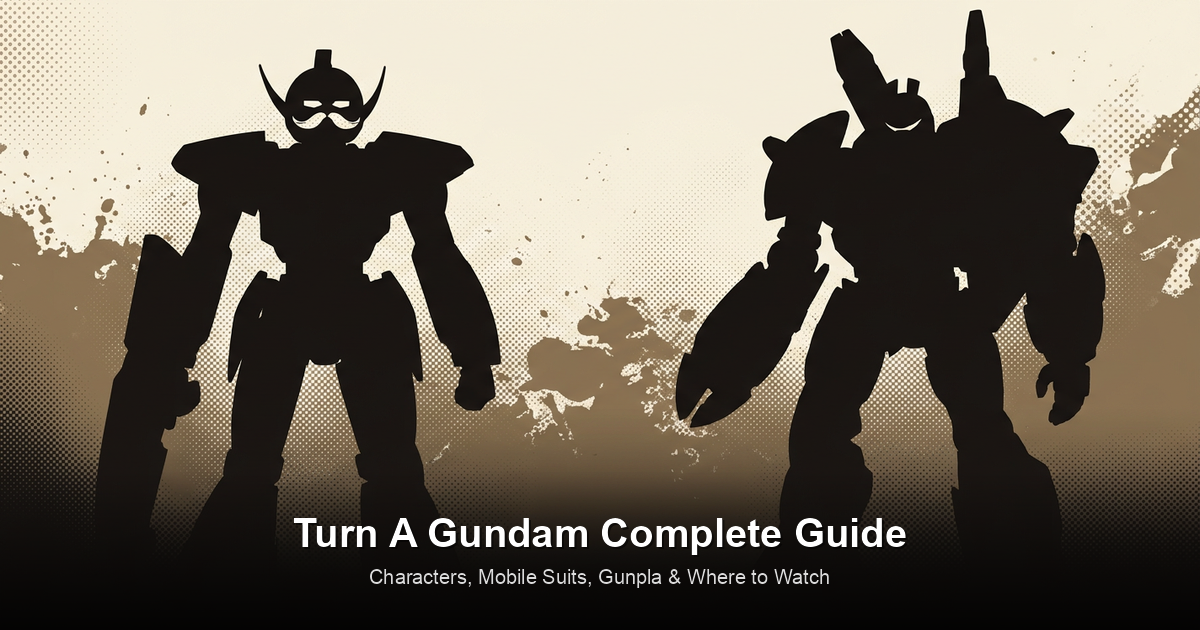
- What Is Turn A Gundam? — The 20th Anniversary Work That Embraces All of Gundam
- The World — Correct Century 2345: A Pastoral Earth and the Return of the Moon’s People
- Story — A Boy Standing Between Earth and Moon
- Part 1: “Return and Collision” (Episodes 1–16) — The Awakening of White Doll
- Part 2: “Negotiation and Betrayal” (Episodes 17–35) — The Switch Between Dianna and Kihel
- Part 3: “Dark History and Final Battle” (Episodes 36–50) — Moonlight Butterfly and Reconciliation
- The Compilation Films — “Earth Light” and “Moonlight Butterfly”
- Characters — Those Who Stand Between Earth and Moon
- Loran Cehack — The Boy They Called “Laura”
- Dianna Soreil — The Moon Queen Bearing a Millennium of Solitude
- Kihel Heim — The Miner’s Daughter Who Wore a Queen’s Crown
- Sochie Heim — Anger, Tears, and Growth
- Guin Sard Lineford — Between Ambition and Idealism
- Gym Ghingham — The Warrior Starving for Battle
- Other Key Characters
- Mobile Suits — Syd Mead’s “Archaeology of the Future”
- The Two Great Concepts — “Dark History” and “Moonlight Butterfly”
- Why Turn A Is Called “Tomino’s Masterpiece” — Critical Reception
- Music — Yoko Kanno’s Ode to Moon and Earth
- Staff and Production — How the Heretical Gundam Was Born
- Turn A and the Wider Gundam Franchise — Where Does the Correct Century Sit?
- Viewing Guide — Getting the Most Out of Turn A Gundam
- FAQ — Frequently Asked Questions About Turn A Gundam
- Q1. Can I enjoy Turn A Gundam without having seen other Gundam series?
- Q2. Did the term “Dark History” originate from this series?
- Q3. Is the ∀ Gundam the strongest mobile suit in the franchise?
- Q4. Is Loran male?
- Q5. Should I watch the TV series or the compilation films first?
- Q6. Is the “Borjanon” actually a Zaku?
- Q7. Are Gundam series made after Turn A also part of the “Dark History”?
- Conclusion — What Turn A Gundam Left Behind
What Is Turn A Gundam? — The 20th Anniversary Work That Embraces All of Gundam
Turn A Gundam (∀ Gundam) is a 50-episode television anime that aired from 1999 to 2000. Conceived as the commemorative project for the Gundam franchise’s 20th anniversary, it marked the return of series creator Yoshiyuki Tomino to the director’s chair for his first TV series since Victory Gundam (1993) — a gap of six years.
This series is unlike any Gundam that came before it. The setting is neither the Universal Century nor the After Colony era, but a distant future measured in a unique calendar system called the “Correct Century” (正暦, Seireki). Earth’s civilization has regressed to roughly the level of the Industrial Revolution — biplanes take to the skies, steam engines churn, and most people have never heard of space travel. The mobile suit designs were handled not by a Japanese animator but by American industrial designer Syd Mead, famous for his work on Blade Runner. The music was composed by Yoko Kanno of Cowboy Bebop fame. Turn A shatters nearly every convention of the Gundam franchise while holding fast to its core truth — and therein lies its genius.
Most remarkably, the series possesses a breathtaking metafictional ambition. Within its narrative, Turn A Gundam subsumes every prior Gundam timeline — Universal Century, After Colony, Future Century, and more — under the umbrella of the “Dark History” (黒歴史, Kuro Rekishi), effectively declaring: “All Gundam stories lead here.” For Gundam’s 20th anniversary, Tomino chose not merely to celebrate, but to affirm every war, every tragedy, every story the franchise had ever told — and then ask: what comes after?
The Meaning of “∀” — Why “Turn A”?
The symbol “∀” is the universal quantifier from mathematical logic. It means “for all” — as in “∀x” (“for every x”). Tomino deliberately chose this symbol for the title, encoding the message: “This is for all Gundam.”
Visually, ∀ is simply the letter “A” turned upside down — hence “Turn A.” This carries a second meaning: to overturn, to invert, to subvert everything that Gundam had been. The title thus contains a double declaration: universal inclusion (“for all”) and radical subversion (“turn upside down”). These twin principles define the entire work.
Series Overview
| Official Title | ∀ Gundam (Turn A Gundam) |
|---|---|
| Format | Television Anime |
| Episodes | 50 |
| Original Run | April 9, 1999 – April 14, 2000 |
| Network | Fuji TV (Japan) |
| Director | Yoshiyuki Tomino |
| Original Character Design | Akira Yasuda (Akiman) |
| Mechanical Design | Syd Mead, Kunio Okawara, Atsushi Shigeta, Takumi Sakura |
| Music | Yoko Kanno |
| Opening Theme | “Turn A Turn” by Hideki Saijo |
| Ending Themes | “AURA” by Shinji Tanimura (1st ED) / “Tsuki no Mayu” (Moon’s Cocoon) by Aki Okui (2nd ED) |
| Production | Sunrise |
| Timeline | Correct Century 2345 |
| Compilation Films | ∀ Gundam I: Earth Light / ∀ Gundam II: Moonlight Butterfly (2002) |
Tomino’s Return — From V Gundam’s Darkness to ∀’s Light
Understanding Turn A requires understanding what came before it. During the production of Victory Gundam (1993), Tomino experienced a severe personal crisis. The grueling production, the story’s relentless depiction of children dying in war, and years of accumulated fatigue from the franchise took a devastating toll. In the years following Victory, Tomino openly discussed his battle with depression. He stepped away from directing TV anime, while other directors helmed Gundam Wing and Gundam X in his absence.
After six years, Tomino returned — and the Gundam he chose to make was one about reconciliation, not war. Where Victory Gundam was bleak and punishing, Turn A would be pastoral, warm, and humane. It would acknowledge human folly and conflict while insisting on the possibility of coexistence. Turn A Gundam is, in many ways, the story of Tomino’s own renewal.
In interviews around the time of broadcast, Tomino stated: “After 20 years of making Gundam, I’ve done nothing but tell stories about war. But I realized that what I ultimately needed to tell was a story about reconciliation.”
The World — Correct Century 2345: A Pastoral Earth and the Return of the Moon’s People
Turn A Gundam is set in Correct Century (C.C.) 2345. The simplest way to describe this world: imagine early 20th-century America — then add visitors from outer space.
Earth’s Civilization — Why Has It Regressed to the Industrial Age?
In C.C. 2345, automobiles have only just been invented. Biplanes barely manage to fly. Telephones are not yet widespread. People mine coal, travel by horse-drawn carriage, and live under something resembling a feudal lordship system. At first glance, it looks like late 19th-century America.
But this world holds mysteries. In regions called “Mountain Cycles,” ancient technology of unknown origin lies buried within the earth. The people revere these sites as sacred. A stone idol called the “White Doll” is worshipped as a deity. Most Earth inhabitants have no idea that humanity once traveled to the stars.
Why has civilization regressed so drastically? The answer lies at the very heart of the story — in the concepts of the “Dark History” and the “Moonlight Butterfly.” Long ago, an advanced civilization flourished and then perished. Its memory was erased, and Earth spent thousands of years slowly rebuilding from nothing.
The Moonrace — A People Awakened from a Thousand-Year Sleep
Meanwhile, on the Moon, an advanced civilization has survived. The “Moonrace” (ムーンレィス) maintained their society in lunar cities long after Earth’s fall, using cryogenic hibernation (cold sleep) technology to endure across the millennia.
But the Moon’s environment is reaching its limits. Queen Dianna Soreil of the Moonrace plans a mass return to Earth — humanity’s original homeland. Whether that return can be achieved peacefully or will devolve into armed conflict becomes the central tension of the story.
Moonrace society carries its own distortions. A deep gulf separates the ruling class, who cycle through cold sleep across centuries, and ordinary citizens who cannot access the same privilege. The Moon’s society appears refined on the surface, but simmers with resentment beneath. This internal tension complicates Dianna’s plans for Earth return.
The “Dianna Counter” — The Moon’s Military and the Descent to Earth
The military force tasked with the Earth return operation is the “Dianna Counter,” named for Queen Dianna Soreil. Though it operates under her authority, its actions increasingly diverge from her wishes.
Officers like Phil Ackman and Poe Aijee view Earth’s people as primitives and see military subjugation as a natural right. On the other side, Earth’s inhabitants are terrified by the sudden appearance of “people from the Moon” and form militia units to resist.
Between Dianna’s ideal of peaceful return, her military’s escalation, and Earth’s defensive hostility, the story spirals into ever-deepening complexity.
Story — A Boy Standing Between Earth and Moon
Turn A Gundam’s 50 episodes unfold in three broad phases: the outbreak of war and discovery of the “White Doll,” a web of negotiations and betrayals, and the revelation of the Dark History leading to the final battle.
Part 1: “Return and Collision” (Episodes 1–16) — The Awakening of White Doll
The story begins with Loran Cehack, a boy of the Moonrace, already living on Earth. Two years prior, Loran and two companions were sent ahead as advance scouts for the Earth return operation. He settled in Vicinity, a mining town on the continent of Ameria (modeled on North America), and worked as a driver for the Heim family — living a quiet, happy life.
On the night of the summer solstice in C.C. 2345, that peace shatters. The Dianna Counter begins a large-scale descent to Earth. Mobile suits called “Flats” attack the town. In the chaos, Loran tumbles to the foot of a sacred stone statue — the White Doll. The stone cracks open, revealing a white mobile suit entombed within.
This is the ∀ Gundam — built during the Dark History era, asleep for thousands of years, carrying the power to end all things. Loran stumbles into its cockpit and, fighting alongside Earth’s self-defense force (the “Militia”), finds himself at war against his own people.
A Moonrace boy fighting to protect Earth against the Moonrace — this contradiction defines Turn A Gundam’s narrative core. Loran is neither purely enemy nor purely ally. He stands as “a bridge between two worlds,” refusing to choose one over the other.
Part 2: “Negotiation and Betrayal” (Episodes 17–35) — The Switch Between Dianna and Kihel
The most dramatic development of the middle act is the identity swap between Dianna Soreil and Kihel Heim.
Queen Dianna and Kihel, eldest daughter of the Heim mining family, are virtually identical in appearance and voice (the reason is given as coincidence). On a whim, the two trade clothing and adopt each other’s roles — but the escalation of hostilities prevents them from switching back. Kihel must act as the Moon’s queen while Dianna experiences life as an ordinary Earth civilian.
The dramatic power of this swap is immense. Kihel grows under the weight of queenship — forced to navigate diplomacy, military command, and political intrigue. Dianna, stripped of her royal status, witnesses firsthand the realities of life for both Earthlings and Moonrace commoners. Their parallel experiences converge on a single conclusion: peace must be achieved, whatever the cost.
Meanwhile, political undercurrents accelerate. Earth’s ambitious nobleman Guin Sard Lineford seeks to acquire lunar technology to jump-start an industrial revolution — and his own power. On the Moon’s side, Dianna Counter officers exploit the queen’s absence to push toward military escalation.
Crucially, ancient mobile suits begin emerging from Mountain Cycles: machines that look startlingly like Zakus, Capules, and other familiar designs from prior Gundam series. The realization grows that this world exists after something.
Part 3: “Dark History and Final Battle” (Episodes 36–50) — Moonlight Butterfly and Reconciliation
In the final arc, the full scope of the “Dark History” is revealed — and it is staggering.
Vast historical archives preserved on the Moon contain footage of the Universal Century’s mobile suit wars, colony drops, Newtype conflicts, and the many wars that followed. The One Year War, the Gryps Conflict, the worlds of Gundam Wing and G Gundam — all of it is revealed as past history, layered in the geological strata of this world.
And the force that sealed away the Dark History was the ∀ Gundam’s ultimate weapon: the “Moonlight Butterfly.” A nanomachine system that decomposes all artificial objects, reducing civilization itself to sand. It was the Moonlight Butterfly that destroyed Earth’s civilization in the distant past, turning history “dark.”
The final adversary is Gym Ghingham, a militaristic Moonrace nobleman consumed by bloodlust, piloting the Turn X — the ∀ Gundam’s “sibling unit.” The climactic battle between Loran’s ∀ Gundam and Ghingham’s Turn X sees both machines activate the Moonlight Butterfly in an apocalyptic confrontation.
But the story’s ending is not one of destruction. After the Moonlight Butterfly’s light fades, Loran chooses to live on Earth, and Dianna quietly prepares to end her long life in peace. The final episode, “Golden Autumn,” depicts the gentle aftermath of war — people hanging laundry, baking bread, putting down roots in the earth.
In the final episode of a Gundam series, the protagonist hangs laundry. This is the essence of Turn A Gundam, and the answer Yoshiyuki Tomino arrived at after 20 years of storytelling.
The Compilation Films — “Earth Light” and “Moonlight Butterfly”
In 2002, two compilation films were released, condensing the 50-episode TV series into two movies.
| Film Title | Content | Approximate TV Coverage |
|---|---|---|
| ∀ Gundam I: Earth Light | From Earth descent to mid-story negotiations | Episodes 1–27 |
| ∀ Gundam II: Moonlight Butterfly | From Dark History revelation to final battle | Episodes 28–50 |
While the films include new footage, compressing 50 episodes into roughly four hours necessarily sacrifices much of the character development and daily-life texture that define the TV series. The nuances of the identity swap, the quiet beauty of Earth’s landscapes, and the gradual deepening of relationships are experiences unique to the full TV run.
The recommended viewing is the full 50-episode TV series. Turn A Gundam’s greatness lies in the accumulation of small moments — conversations over meals, sunsets over grasslands, the gentle rhythms of a world rebuilding itself. The films work best as a revisitation after completing the TV series.
Characters — Those Who Stand Between Earth and Moon
Turn A Gundam’s cast is unlike any in the Gundam franchise. There are no Newtype awakenings, no ace-pilot rivalries steeped in cosmic destiny. Instead, these are people from different worlds, struggling to live on the same soil.
Loran Cehack — The Boy They Called “Laura”
The protagonist of Turn A Gundam. A 17-year-old Moonrace boy with shoulder-length silver hair and green eyes. Sent to Earth two years before the main story as an advance scout, he settled in Vicinity and worked as a driver for the Heim family.
Loran’s defining trait is his identity as a “border-crosser.” A Moonrace citizen who loves Earth, he fights for Earthlings while never abandoning his connection to his lunar homeland. When pressed to declare a side, Loran answers: “I’m on both sides.”
One memorable early episode sees Loran cross-dressing as “Laura” to attend a party. Played for comedy on the surface, the scene also reveals his flexibility, his refusal to be constrained by rigid categories — qualities that make him unique among Gundam protagonists. He is gentle, yet profoundly strong-willed.
Loran is voiced by Romi Park, a woman voicing a male character — a casting choice that reinforces the character’s androgynous appeal and fluidity.
Dianna Soreil — The Moon Queen Bearing a Millennium of Solitude
Queen of the Moonrace. She appears to be a 19-year-old woman, but she was actually born approximately 1,000 years ago. Through repeated cycles of cryogenic sleep and brief periods of wakefulness, she has governed the Moon across centuries — a “thousand-year queen.”
Dianna’s tragedy lies in her near-immortality. Over a millennium, she has awakened again and again, each time watching the people she loved grow old and die as generations turned over without her. Her solitude is unimaginable. Her decision to return to Earth stems not only from political necessity but from a deeply personal wish: “I was born on Earth. I want to die on Earth.”
Through her swap with Kihel, Dianna removes the mask of queenship and, for the first time in centuries, feels the wind on her skin, touches the earth, and speaks with ordinary people. This experience only deepens her resolve.
Dianna is voiced by Rieko Takahashi, who also voices Kihel Heim — a dual performance that anchors the credibility of the identity swap.
Kihel Heim — The Miner’s Daughter Who Wore a Queen’s Crown
The eldest daughter of the Heim mining family in Ameria. At 17, her striking resemblance to Dianna Soreil — nearly identical in face, build, and voice — sets in motion one of Turn A’s most extraordinary plot devices.
Kihel’s character arc is among the most dramatic in the series. She begins as a sheltered, well-meaning young woman with little understanding of the wider world. Thrust into the role of the Moon’s queen, she must navigate diplomatic crises, military decisions, and political maneuvering. Gradually, she transforms into a genuine leader — finding within herself a capacity for governance she never knew she possessed.
Kihel’s ultimate choice is one of Turn A Gundam’s most moving moments. She decides to go to the Moon in Dianna’s place, accepting the role of Moonrace queen permanently. An Earth girl becomes the Moon’s sovereign — a choice that embodies the reconciliation of two worlds in its most beautiful form.
Sochie Heim — Anger, Tears, and Growth
Kihel’s younger sister. At 16, she is fierce, emotional, and headstrong. The Dianna Counter’s initial attack kills her father, and she enlists in the Militia seeking revenge against the Moonrace.
Sochie represents the voice of ordinary human emotion. A girl whose father was killed by invaders from the Moon, whose hometown was ravaged — she rages, weeps, fights, and ultimately learns to forgive. Her emotional journey mirrors the series’ central theme.
Her feelings for Loran, her worry for Kihel, her complicated hatred of the Moonrace — Sochie’s inner world is a perpetual storm. The tears she sheds in the final episode carry the weight of all 50 episodes behind them.
Guin Sard Lineford — Between Ambition and Idealism
A powerful Amerian aristocrat and politician who serves as the de facto leader of the Militia. Outwardly a refined gentleman, Guin harbors ferocious ambition.
Initially, Guin appears to be a trustworthy leader defending Earth’s sovereignty. But as the story progresses, his true aim becomes clear: to acquire lunar technology, spearhead an industrial revolution, and position himself as the ruler of Ameria — and potentially all of Earth.
Guin is no simple villain. His drive to advance Earth’s civilization is not inherently wrong. But his willingness to use anyone — including Loran, toward whom he shows an almost obsessive interest — as a pawn makes him dangerous. His moral complexity adds a unique tension to the series.
Gym Ghingham — The Warrior Starving for Battle
Head of the Moonrace’s most powerful military house and Turn A Gundam’s final antagonist. Known by the title “The Commander,” Ghingham is a man consumed by the desire for combat.
Despite commanding the Moon’s most formidable military force, Ghingham has had no war to fight during centuries of peace. The Earth return operation is, for him, a long-awaited opportunity for battle — peace negotiations hold no interest. He pilots the Turn X, the ∀ Gundam’s sibling unit, seeking to conquer through pure force.
Ghingham is depicted as a man for whom war is the only reason to live — yet he also embodies the sadness of a warrior rendered purposeless by millennia of peace. The madness and melancholy of a soldier kept too long in a gilded cage — that is Gym Ghingham.
Other Key Characters
| Character | Affiliation | Role & Traits |
|---|---|---|
| Harry Ord | Moonrace (Dianna’s Royal Guard) | Dianna’s loyal bodyguard. Recognizable by his red sunglasses. Cool-headed and steadfast, his loyalty to Dianna never wavers. |
| Fran Doll | Moonrace | Loran’s childhood friend. Descended to Earth as a fellow advance scout. Works as a nurse. |
| Miran Rex | Moonrace | Dianna’s chief advisor. Loyal to the queen’s vision while exercising independent political judgment. |
| Phil Ackman | Dianna Counter | Commanding officer of the Dianna Counter. Looks down on Earth’s people and favors military subjugation. |
| Poe Aijee | Dianna Counter | A female Dianna Counter officer. Aggressive and prone to rash action, though fundamentally earnest. |
| Corin Nander | Moonrace | A Moonrace soldier suffering from memory loss who harbors a deep, obsessive hatred of the ∀ Gundam. A character who is simultaneously comic and tragic. |
| Lily Borjarno | Luzianna Territory | A princess of Luzianna with a blend of political shrewdness and youthful charm. |
Mobile Suits — Syd Mead’s “Archaeology of the Future”
The mechanical design of Turn A Gundam sent shockwaves through the Gundam fandom. For the first time in the franchise’s history, the iconic mobile suits were designed not by a Japanese mecha designer but by an American industrial designer: Syd Mead.
Who Was Syd Mead? — The Work of a “Visual Futurist”
Syd Mead (1933–2019) was one of America’s foremost industrial designers and concept artists. Self-described as a “Visual Futurist,” he began his career designing automobiles for Ford before moving into Hollywood, where he created the visual worlds of Blade Runner, TRON, and Aliens.
Tomino’s reason for hiring Mead was straightforward: after 20 years of Japanese mecha designers copying and iterating on established Gundam aesthetics, Tomino wanted to inject fundamentally alien blood into the franchise. It was a deliberate challenge to Japan’s domestic design community. He entrusted the task of asking “What is a Gundam, really?” to a designer who had never seen one.
Mead’s design philosophy was grounded in “70% functional ideas, 30% fantasy and humor.” Rather than toy-like ornamentation, he pursued forms dictated by the logic of industrial design — shapes that existed because they had to, not because they looked cool. This is why Turn A’s mobile suits look nothing like previous Gundam designs: the starting point was fundamentally different.
The ∀ Gundam (System-∀99) — What the “Mustache” Really Means
When the ∀ Gundam’s design was first revealed, the fan community erupted. The white face with a “mustache” defied every expectation. No V-fin antenna, no tricolor scheme, no heroic posture — this was unlike any Gundam that had ever existed.
But to Mead, that “mustache” was never a mustache. It was a “cheek guard” — the traditional V-shaped antenna repositioned from the crown of the head to the lower face, using the conceptual language of a helmet’s chin guard. Form follows function: this is industrial design thinking applied to mecha, where every shape has structural purpose rather than decorative intent.
| Unit Name | ∀ Gundam (System-∀99) |
|---|---|
| Designer | Syd Mead |
| Height | 20.0m |
| Base Weight | 28.6t |
| Power Source | DHGCP (Micro Black Hole Engine) |
| Primary Armaments | Beam Rifle, Beam Saber, Gundam Hammer, Shield, Moonlight Butterfly |
| Pilot | Loran Cehack |
| Special Ability | Moonlight Butterfly (nanomachine-based decomposition of artificial objects), Self-repair function |
In terms of lore, the ∀ Gundam’s capabilities are off the charts. Powered by a degeneracy reactor (essentially a micro black hole), equipped with self-repair capability, and armed with the civilization-destroying Moonlight Butterfly, it is arguably the most powerful mobile suit in the entire Gundam franchise.
And yet, within the story, the ∀ Gundam is also used to carry cows, hang laundry, and build bridges. The most devastating weapon in Gundam history, repurposed as a tool for everyday life — this paradox perfectly encapsulates the spirit of the series.
Turn X — The ∀ Gundam’s Sibling and Nemesis
Piloted by Gym Ghingham, the Turn X is said to possess power equal to the ∀ Gundam’s. Its origins remain shrouded in mystery. The unit features a unique split-body construction, allowing its segments to separate and attack independently, including a devastating attack called the “Shining Finger.”
| Unit Name | Turn X (CONCEPT-X 6-1-2) |
|---|---|
| Designer | Syd Mead |
| Height | 20.5m |
| Base Weight | 30.2t |
| Primary Armaments | Dissolution Cutter Manipulator, Beam Rifle, Triple Beam Projection System, Moonlight Butterfly |
| Pilot | Gym Ghingham |
The Turn X can also deploy the Moonlight Butterfly. The final battle between the ∀ Gundam and Turn X, with both machines unleashing their Moonlight Butterflies simultaneously, produces an apocalyptic spectacle unlike anything else in the franchise.
Other Major Mobile Suits
| Unit Name | Designer | Affiliation | Notable Features |
|---|---|---|---|
| Flat | Syd Mead | Dianna Counter | Standard Moonrace MS. Distinctive disc-shaped head. |
| WoDom | Syd Mead | Dianna Counter | Massive MS standing over 40m tall. Overwhelming firepower. |
| SUMO (Gold & Silver) | Syd Mead | Moonrace | Royal Guard unit. Gold variant is Harry Ord’s personal machine. Sumo wrestler-inspired silhouette. |
| Kapool | (Excavated MS) | Militia | Excavated from a Mountain Cycle. Piloted by Sochie. Nearly identical to the Capule from Gundam ZZ. |
| Borjanon | (Excavated MS) | Militia | Excavated from a Mountain Cycle. Its appearance is unmistakably that of a Zaku II. |
| Bandit | Syd Mead | Ghingham Fleet | Mass-production MS of Ghingham’s forces. |
| Mahiroo | Syd Mead | Ghingham Fleet | Aerial combat MS of Ghingham’s forces. |
The excavated mobile suits are particularly significant. The Borjanon is visually identical to the Universal Century’s Zaku II, and the Kapool is virtually the same as the ZZ-era Capule. In-universe, these are relics of the Dark History — mobile suits from prior Gundam series, unearthed thousands of years later. It is an astonishing narrative device that ties the entire franchise together through archaeology.
The Two Great Concepts — “Dark History” and “Moonlight Butterfly”
Turn A Gundam introduced two concepts that transcend the series itself — impacting the Gundam franchise as a whole, and in one case, even the Japanese language. These are the “Dark History” and the “Moonlight Butterfly.”
Dark History — The Geological Strata Where All Gundam Worlds Sleep
Within Turn A Gundam, the “Dark History” (黒歴史, Kuro Rekishi) refers to the entirety of human history before the Correct Century. The vast archives stored on the Moon contain records of the Universal Century’s wars, colony drops, the rise of Newtypes, and the countless conflicts that followed across multiple eras.
In episode 42, titled “Dark History,” the archive footage shown includes clips from Mobile Suit Gundam, Zeta Gundam, Gundam ZZ, Char’s Counterattack, Victory Gundam, G Gundam, Gundam Wing, and Gundam X. In other words, the world of Turn A Gundam sits at the end of all these histories — every Gundam story ultimately leads to ∀.
The revolutionary implication of this concept is that it resolves the “parallel world problem” in a single stroke. Are the Universal Century, After Colony, and Future Century separate universes? Turn A’s answer is definitive: they are all different eras within a single timeline, separated by recurring cycles of civilizational rise and fall, each era born, destroyed, and eventually forgotten.
Beyond the franchise, the term “Dark History” (黒歴史) entered everyday Japanese as slang for “an embarrassing past one wants to erase.” The fact that an anime coinage became common enough to appear in dictionaries is a testament to Turn A Gundam’s cultural impact.
Moonlight Butterfly — The Wings That End Civilization
The Moonlight Butterfly is the ultimate weapon system carried by both the ∀ Gundam and the Turn X. When activated, luminous nanomachines spread from the unit’s back like butterfly wings. These nanomachines decompose artificial objects at the molecular level, reducing them to sand.
The Moonlight Butterfly’s true horror lies in its selectivity. It does not affect natural objects — only human-made ones. Buildings, machines, weapons: all are broken down. Nature is left untouched. If the Moonlight Butterfly activates at full power, humans survive but civilization vanishes. Mountains, rivers, and forests remain, but every trace of human construction turns to dust.
According to the series’ lore, a past activation of the Moonlight Butterfly at full capacity decomposed every artificial object on Earth, completely resetting civilization. This is the direct cause of the Dark History. After the Moonlight Butterfly subsided, the nanomachines converted into dark particles that aided environmental recovery — making the system simultaneously a destroyer and a healer.
What These Two Concepts Reveal — The Cycle of Forgetting and Rebirth
Dark History and the Moonlight Butterfly are two sides of the same thematic coin.
Humanity fights. Humanity builds advanced civilization. Humanity uses that civilization’s power to destroy itself. The Moonlight Butterfly erases civilization; history turns “dark.” Survivors start over, eventually rebuild, and inevitably begin fighting again. This cycle of forgetting and rebirth is the fundamental human condition that Turn A Gundam depicts.
But Turn A does not merely present this cycle as tragedy. Through Loran — a boy who bridges two worlds — it offers the possibility that “this time, the Moonlight Butterfly need not be used.” To know the Dark History, to remember it, and yet choose not to repeat it — this is Turn A Gundam’s vision of hope.
Tomino spent his career depicting war through Gundam. But in Turn A, he arrived at something different: how to end the story of war itself. Acknowledge every battle that has been fought. Remember it. And then declare: “No more.” The Dark History and the Moonlight Butterfly are the narrative devices that make this declaration possible.
Why Turn A Is Called “Tomino’s Masterpiece” — Critical Reception
Turn A Gundam is a rare work whose reputation has changed dramatically between its original broadcast and the present day. That shift itself speaks to the series’ singular nature.
Reception at Broadcast — “This Isn’t Gundam”
When Turn A premiered in 1999, fan reaction was deeply divided. The primary flashpoint was, inevitably, the “mustache Gundam.” Syd Mead’s design for the ∀ Gundam shattered every expectation of what a Gundam should look like. No V-fin. That “mustache” cheek guard. Proportions completely alien to the franchise tradition.
“This isn’t Gundam” — that sentiment was widespread even before the first episode aired. The pastoral, 19th-century-style setting further alienated fans expecting explosive space battles. Ratings were modest by Gundam standards, and commercial performance was underwhelming.
A Reputation Transformed Over Time — “Just Watch It”
After broadcast ended, however, Turn A’s reputation began a steady, unbroken ascent. Fans who had dismissed it sight-unseen gradually watched it and discovered the extraordinary depth of its narrative, the richness of its characters, the beauty of its visuals, and the brilliance of its music.
By the 2010s, the sentiment that Turn A is “Yoshiyuki Tomino’s greatest work” had become widespread. In fan polls, it consistently ranks alongside the original Mobile Suit Gundam and Char’s Counterattack among the franchise’s pinnacles. What was once “heresy” has, with the passage of time, become “canon.”
Five Reasons It’s Called a Masterpiece
1. Thematic Maturity: Over the 20 years from the original Gundam to Turn A, Tomino evolved from “depicting war” to “ending war.” Turn A contains an answer forged over a long career. It moves beyond simple anti-war messaging to confront a universal question: How do different peoples coexist?
2. Character Depth: Loran’s gentle strength, Dianna’s millennial solitude, Kihel’s transformation, Sochie’s rage and growth, Ghingham’s madness — every character is written as a full human being. There are no simple heroes or villains. Everyone has reasons; everyone has feelings.
3. Visual Beauty: Turn A was among the last Gundam series produced with traditional cel animation. The warmth and subtle gradations of hand-drawn cels, combined with the pastoral landscape design, create visual poetry unmatched in the franchise. Sunsets over grasslands, mobile suits silhouetted by moonlight — the imagery is distinctly, hauntingly beautiful.
4. The Invention of “Dark History”: The concept of subsuming all Gundam timelines into a single history is a breathtaking metafictional stroke. It positions Turn A as both a standalone work and as a punctuation mark for the entire franchise.
5. The Final Episode, “Golden Autumn”: One of the greatest finales in Gundam history. War ends. People return to their daily lives. Dianna makes her quiet decision. Loran makes his choice. Sochie weeps. A conclusion that is both triumphant and aching — it earns every emotion through 50 episodes of careful storytelling.
Points of Contention — Why It Doesn’t Work for Everyone
In fairness, Turn A is not universally beloved, and the reasons are worth acknowledging.
Pacing: Across 50 episodes, spectacular combat is relatively rare. The series favors daily-life scenes and political drama, which can feel slow for viewers seeking the visceral thrill of robot action.
Mecha Design: Syd Mead’s designs remain divisive even 25+ years later. Fans deeply attached to traditional Gundam aesthetics sometimes find them impossible to accept.
A Slow Start: The first several episodes focus on worldbuilding, and the story takes time to build momentum. Some viewers disengage before the narrative catches fire.
Yet the refrain among Turn A’s champions is near-universal: “Watch it to the end. Everything pays off.”
Music — Yoko Kanno’s Ode to Moon and Earth
Yoko Kanno, the composer behind Macross Plus, Cowboy Bebop, and Ghost in the Shell: Stand Alone Complex, is one of Japan’s most acclaimed musicians. Her work on Turn A Gundam is widely regarded as among her finest.
“Tsuki no Mayu” (Moon’s Cocoon) — The Song That Defines Turn A
The second ending theme, “Tsuki no Mayu” (月の繭, “Moon’s Cocoon”), is inseparable from Turn A Gundam’s identity. The lyrics were written by Rin Iogi (Yoshiyuki Tomino’s pen name), with composition and arrangement by Yoko Kanno and vocals by Aki Okui.
Its crystalline melody and lyrics — evoking the sorrow suspended between Moon and Earth — harmonize perfectly with the story’s themes. When it plays as an insert song in the final episode, the effect is devastating. Fifty episodes of accumulated emotion crest as this song quietly fills the screen.
A variant version, “MOON,” exists as well. Sung by Kanno herself under the alias “Gabriela Robin” in an invented language, “MOON” strips away the specificity of Japanese lyrics and becomes pure sound — transcending meaning to strike directly at the heart.
“Turn A Turn” — Hideki Saijo’s Opening Theme
The opening theme, “Turn A Turn,” was performed by Hideki Saijo, a legendary figure in Japanese popular music. Hiring a pop icon to sing an anime opening was highly unusual, and Saijo’s powerful yet melancholic vocals capture the series’ grandeur perfectly. Lyrics are by Rin Iogi (Tomino), with music by Asei Kobayashi.
Uplifting yet tinged with sadness — the song mirrors Turn A Gundam itself. Following Saijo’s death in 2018, the song has taken on an even deeper poignancy for fans.
“AURA” — Shinji Tanimura’s First Ending Theme
The first ending theme, “AURA,” was performed by Shinji Tanimura, another major name in Japanese music. A sweeping ballad, it envelops the viewer in the loneliness of Dianna and the journey of Loran.
The Brilliance of the Background Score
Beyond the theme songs, Kanno’s incidental music is extraordinary. She freely crosses Celtic music, classical orchestration, folk traditions, and jazz, creating a sonic landscape that captures both the 19th-century pastoral world and the Moon’s ethereal mystique.
The contrast is especially effective: gentle orchestral passages for Earth’s idyllic scenes versus ethereal choral works for the Moon. Kanno paints “two worlds” entirely through sound.
Three soundtrack albums were released, and they remain cherished as some of the finest anime soundtracks ever produced.
Staff and Production — How the Heretical Gundam Was Born
Turn A Gundam’s production was as unconventional as its content.
Akira Yasuda (Akiman) — Character Design Origins
The original character designs were created by Akira Yasuda, a game designer from Capcom known for creating Chun-Li and Guile for Street Fighter II. Working under his nickname “Akiman,” his character designs brought a distinctive warmth and lived-in quality rare in the Gundam franchise.
Yasuda’s approach favors naturalistic human forms over anime-style exaggeration. Loran’s gentle expressions, Dianna’s quiet elegance, Sochie’s spirited energy — each character feels like a real person. That sense of genuine humanity owes much to Yasuda’s sensibility.
The Last Cel-Animated Gundam
Turn A Gundam holds the historical distinction of being the last Gundam TV series produced with traditional cel animation. The next TV entry, Gundam SEED (2002), was the first to adopt fully digital production.
The warmth of hand-painted cels, with their subtle color gradations and organic textures, proved ideally suited to Turn A’s pastoral aesthetic. The depiction of sunsets and moonlight, in particular, benefits immensely from cel animation’s inherent qualities. Turn A’s visual beauty is special not only because of its artistic vision but because it represents the pinnacle of an entire production methodology.
Location Scouting and Realism
The production team conducted location research in the American South and European countryside. The pastoral landscapes seen throughout the series — sprawling grasslands, brick-lined towns, mining country — are grounded in real-world observation.
This “sense of reality” is a crucial element of Turn A’s worldbuilding. Though the setting is fictional, viewers feel a strange familiarity — a sense of “I’ve seen this place before.” That recognition draws audiences naturally into the story’s emotional world.
Turn A and the Wider Gundam Franchise — Where Does the Correct Century Sit?
Turn A’s claim to “encompass all Gundam” carries enormous implications for the franchise as a whole. Here, we examine the Correct Century’s position within the broader Gundam timeline.
Timeline Position — The Correct Century Comes After Everything
According to Turn A Gundam’s official setting, the Correct Century follows all previous Gundam timelines.
| Calendar System | Representative Works | Relation to ∀ |
|---|---|---|
| Universal Century (U.C.) | Mobile Suit Gundam, Zeta, ZZ, Char’s Counterattack, F91, Victory | Part of the Dark History |
| Future Century (F.C.) | G Gundam | Part of the Dark History |
| After Colony (A.C.) | Gundam Wing | Part of the Dark History |
| After War (A.W.) | Gundam X | Part of the Dark History |
| Correct Century (C.C.) | Turn A Gundam | The end of all histories |
In the world of Turn A Gundam, the Universal Century’s wars, the Gundam Fight, the colonial independence wars — all of it lies buried in deep geological time. The Borjanon (Zaku) and Kapool (Capule) appearing as excavated relics is a direct reflection of this framework.
Relationship to Later Gundam Series — Is There Anything “After” ∀?
The relationship between Turn A and Gundam series produced after it — SEED, 00, Iron-Blooded Orphans, The Witch from Mercury — has never been officially clarified. However, given the universal nature of the ∀ symbol, fans widely interpret that these series could also theoretically be part of the Dark History.
In 2014, Tomino positioned Gundam Reconguista in G as taking place “after the Universal Century but before ∀,” indicating that he still views Turn A as occupying the furthest point on the Gundam timeline.
“∀ Is Both Gundam’s Graveyard and Its Cradle”
Turn A Gundam is simultaneously the endpoint and the starting point of all Gundam. It accepts the past sealed away as Dark History, and builds a new civilization atop what the Moonlight Butterfly destroyed. After destruction comes rebirth; after rebirth, potentially, another destruction — but within that cycle lies the full spectrum of human life.
The “∀” universal quantifier expresses this structure precisely. All Gundam is contained within ∀, and ∀ contains all Gundam. It is a graveyard. It is a cradle. And it is an affirmation of every Gundam that has ever been.
Viewing Guide — Getting the Most Out of Turn A Gundam
For those about to embark on Turn A Gundam for the first time, here is the optimal approach.
Recommended Viewing Order
1. Watch the full 50-episode TV series first. This is the definitive way to experience Turn A Gundam. Fifty episodes is a commitment, but the series’ greatness lies in the accumulation of daily-life moments, quiet conversations, and gradual emotional deepening. The slow early pacing is not a flaw but a deliberate buildup that amplifies the impact of later episodes.
2. Use the compilation films as a revisitation. After completing the TV series, watching Earth Light and Moonlight Butterfly allows you to survey the full story arc from above. New footage supplements the experience, making the films a worthwhile complement rather than a substitute.
3. The novels offer further depth. Written by Tomino himself, the novel adaptation contains divergent plot developments and deeper character introspection. After enjoying the anime, readers will discover new dimensions to the story.
What You Should Know Before Starting
Prior Gundam knowledge is not required. Turn A is a self-contained story that can be fully appreciated on its own merits. That said, familiarity with earlier series amplifies the shock of the “Dark History” revelation and adds emotional weight to the excavated mobile suits. Watching at least the original Mobile Suit Gundam and Zeta Gundam beforehand enriches the experience.
Don’t let the “mustache” scare you away. The ∀ Gundam’s design may feel strange at first. But as the story progresses, that “mustache” grows endearing. The white machine that Loran calls “White Doll” and uses for everything from combat to chores becomes, imperceptibly, the most beloved Gundam of all. This transformation is a shared experience among Turn A viewers — the “∀ Magic.”
Where to Watch
| Format | Details |
|---|---|
| Blu-ray BOX | ∀ Gundam Blu-ray Box (2 volumes) |
| DVD | ∀ Gundam DVD-BOX |
| Streaming | Available on Crunchyroll and other platforms (availability varies by region) |
| Compilation Film Blu-ray | ∀ Gundam I: Earth Light / ∀ Gundam II: Moonlight Butterfly (individual releases) |
Gunpla and Related Merchandise
Turn A Gundam model kits (Gunpla) have maintained a devoted following from the time of broadcast to the present day.
| Kit Name | Grade | Features |
|---|---|---|
| ∀ Gundam | MG 1/100 | Faithful reproduction of Syd Mead’s design. Includes Moonlight Butterfly effect parts. |
| Turn X | MG 1/100 | Separation gimmick faithfully reproduced. Can be displayed alongside the ∀ Gundam. |
| ∀ Gundam | HG 1/144 | An accessible kit showcasing Syd Mead’s design at a smaller scale. |
| SUMO (Gold Type) | HG 1/144 | Harry Ord’s personal unit. Striking gold-colored plastic. |
| Kapool | HG 1/144 | Sochie’s unit. Charming rounded design. |
FAQ — Frequently Asked Questions About Turn A Gundam
Q1. Can I enjoy Turn A Gundam without having seen other Gundam series?
Absolutely. Turn A is a self-contained narrative and requires no prior Gundam knowledge to understand or appreciate. However, familiarity with earlier series makes the Dark History revelation and the excavated mobile suits significantly more impactful. Turn A works perfectly well as a first Gundam experience.
Q2. Did the term “Dark History” originate from this series?
Yes. The Japanese slang term 黒歴史 (kuro rekishi, “dark history”), widely used to mean “an embarrassing past one wants to erase,” originates from Turn A Gundam. Within the show, it refers to sealed records of human history. The term migrated from fandom into internet culture and eventually into mainstream Japanese. It is a rare case of an anime coinage entering common parlance.
Q3. Is the ∀ Gundam the strongest mobile suit in the franchise?
In terms of lore, the Moonlight Butterfly’s ability to annihilate all artificial objects arguably places it at or near the top. However, Turn A Gundam as a work is fundamentally unconcerned with “power level” debates. The series’ themes of reconciliation and coexistence operate on an entirely different axis from “who would win” discussions.
Q4. Is Loran male?
Yes. The question arises due to his female voice actor (Romi Park), his androgynous appearance, and a cross-dressing episode in which he attends a party as “Laura.” Loran’s gender fluidity in presentation is thematically linked to the series’ rejection of rigid categories and fixed identities.
Q5. Should I watch the TV series or the compilation films first?
The TV series. The films compress 50 episodes into approximately four hours, omitting numerous episodes and the gradual character development that gives the story its power. Turn A’s strength lies in its accumulation of small, quiet moments — an experience available only in the full TV run.
Q6. Is the “Borjanon” actually a Zaku?
In-universe, it is a Dark History-era mobile suit excavated thousands of years later, and its design is based on the same specifications as the Universal Century’s Zaku II. The Earth inhabitants who discover it have no knowledge of the name “Zaku” and call it “Borjanon.” This naming gap is itself an elegant narrative device — a tangible expression of historical disconnection.
Q7. Are Gundam series made after Turn A also part of the “Dark History”?
There is no definitive official statement. However, given the universal quantifier nature of the ∀ symbol, the theoretical implication is that they could be. Tomino has positioned Reconguista in G (2014) as occurring “before Turn A,” indicating that ∀ remains the furthest point on the timeline in his view.
Conclusion — What Turn A Gundam Left Behind
Turn A Gundam is both the most “heretical” and the most “universal” work in the Gundam franchise.
A story of reconciliation between Moon and Earth, set in a pastoral world reminiscent of the 19th century. The “mustache Gundam” born from Syd Mead’s industrial design philosophy. Yoko Kanno’s music, weaving together the earth and the moon. The “Dark History” that contains all of Gundam within its strata. The “Moonlight Butterfly” that ends civilization — and then allows it to begin again.
And above all — a protagonist who, after the battle is over, hangs the laundry.
With Turn A, Yoshiyuki Tomino placed a period at the end of 20 years of war stories. That period was not an explosion, not a victory. It was the quiet image of everyday life. What truly ends war is not the power of heroes but the determination of ordinary people to put down roots and live. That is what Turn A Gundam tells us.
More than 25 years after its broadcast, the series’ reputation continues to rise. “Just watch it” — no phrase suits Turn A Gundam better. If you have not yet experienced it, please commit to all 50 episodes. When you reach the final episode, “Golden Autumn,” you will understand in your heart what it means to say: “All Gundam leads here.”
Comments