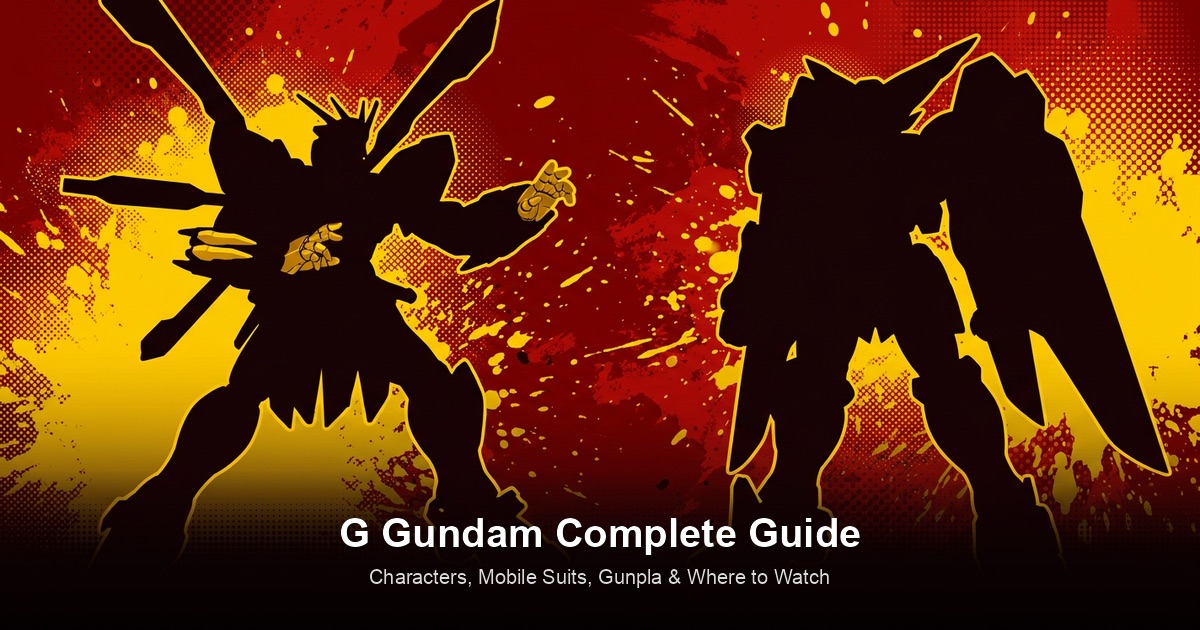
Mobile Fighter G Gundam — Complete Guide— Story, Mobile Suits & Epic Battles
Contents
- 01What Is G Gundam? The "Heresy" That Revolutionized the Gundam Franchise
- 02The Future Century World: Why the Gundam Fight Exists
- 03Complete Story Guide: All 49 Episodes in Four Acts
- Act I: "The Wandering Arc" (Episodes 1-12) -- Domon's Quest and His Rivals
- Act II: "Master and Student Collision" (Episodes 13-24) -- Reunion and Betrayal
- Act III: "The Gundam Fight Finals" (Episodes 25-40) -- Meikyo Shisui and God Gundam
- Act IV: "The Final Battle" (Episodes 41-49) -- Defeating Devil Gundam and Love's Triumph
- 04Character Guide: The Eight Souls That Drive G Gundam
- 05Complete Mobile Fighter Catalog: Combat-Specialized Gundams Like No Others
- 06The Lineage of Signature Techniques: From Sekiha Tenkyoken to Sekiha Love-Love Tenkyoken
- 07Top 10 Iconic Moments and Quotes: Soul-Stirring Scenes
- 08Reception History: How a "Heresy" Became a "Masterpiece"
- 09G Gundam's Legacy: The Wellspring of Alternate Universe Gundam
- 10Viewing Guide: For Those About to Watch G Gundam
- 11Episode List: All 49 Episodes
- 12Gunpla and Merchandise Guide: How to Hold G Gundam in Your Hands
- 13Conclusion: What G Gundam Teaches Us
What Is G Gundam? The "Heresy" That Revolutionized the Gundam Franchise
Mobile Fighter G Gundam was the boldest gamble in Gundam history.
When it premiered on April 22, 1994 on TV Asahi, this series was something no Gundam fan had ever seen before: a Gundam show completely disconnected from the Universal Century timeline that had defined the franchise since the original Mobile Suit Gundam in 1979. Instead of war, there was martial arts. Instead of real robots, there were super robots. Instead of political drama, there was a story about the bond between master and student. Everything that had made Gundam "Gundam" was turned on its head.
The backlash from longtime fans was immediate and fierce. "This is not Gundam" was the prevailing sentiment. Yet over 30 years later, G Gundam stands as the trailblazer that opened the door to the incredible diversity the Gundam franchise enjoys today.
Without G Gundam, there would be no Gundam Wing, no Gundam SEED, no Iron-Blooded Orphans, no The Witch from Mercury -- none of the Alternate Universe Gundam series that have become cornerstones of the franchise. G Gundam proved that the Gundam brand could expand infinitely beyond a single formula.
This article is a thorough dissection of that revolutionary series. From its complete story and unforgettable characters to its Mobile Fighter lineage, signature techniques, and the remarkable journey from rejection to rediscovery -- everything about G Gundam is documented here.
Series Data
| Official Title | Mobile Fighter G Gundam (Kidou Butouden G Gundam) |
|---|---|
| Network | TV Asahi |
| Air Dates | April 22, 1994 -- March 31, 1995 |
| Episodes | 49 |
| Director | Yasuhiro Imagawa |
| Series Composition | Fuyunori Gobu |
| Character Design | Kazuhiko Shimamoto (original), Hiroshi Osaka |
| Mechanical Design | Kunio Okawara, Hajime Katoki, Kimitoshi Yamane |
| Music | Kohei Tanaka |
| Opening Theme | "FLYING IN THE SKY" by Yoshifumi Ushima (1st) / "Trust You Forever" by Yoshifumi Ushima (2nd) |
| Ending Theme | "Umi yori mo Fukaku" by Yoshifumi Ushima (1st) / "Kimi no Naka no Eien" by Takehide Inoue (2nd) |
| Studio | Sunrise |
| Timeline | Future Century (F.C.) 60 |
| Significance | First Alternate Universe Gundam (non-Universal Century) |
The Historical Significance of Being "Alternate Universe No. 1"
G Gundam was born from a crisis of survival within the Gundam franchise.
Victory Gundam, which aired in 1993, was a work plagued by such difficulties that its own director, Yoshiyuki Tomino, famously told fans they did not need to watch it. The Universal Century saga, stretching from the One Year War to UC 153, had been continuously expanding its world -- but that expansion had reached a wall of creative fatigue.
Bandai and Sunrise made a momentous decision: leave the Universal Century behind and create an entirely new Gundam. The director chosen for this mission was Yasuhiro Imagawa, who had demonstrated electrifying directorial vision in Giant Robo: The Animation.
Imagawa's answer was something nobody anticipated. He would make Gundam into a martial arts tournament. National representatives would fight each other in Gundams, and the winning nation would rule the world. It was an absurd premise -- and that very absurdity became G Gundam's greatest weapon.
Director Yasuhiro Imagawa: Destruction and Creation
To understand G Gundam is to understand Yasuhiro Imagawa.
Having established his reputation for grand-scale, high-energy direction with Giant Robo: The Animation -- The Day the Earth Stood Still, Imagawa brought that same sensibility to G Gundam with full force. Hong Kong kung fu cinema, professional wrestling spectacle, shonen manga passion, Shakespearean tragedy, martial arts master-student drama -- he voraciously absorbed the essence of every genre and poured it all into the vessel of "Gundam."
The result was a work that embodied a paradox: "It doesn't feel like Gundam, yet it is unmistakably Gundam." Imagawa destroyed the conventions of robot anime while creating a new form of Gundam through universal human drama. This was his masterwork.
The Future Century World: Why the Gundam Fight Exists
The "Future Century" setting of G Gundam is a world with a history entirely different from the Universal Century. Understanding this world is the first step toward immersion in the story.
A Devastated Earth and the Space Colony Nations
In the Future Century, Earth has been ravaged by environmental pollution and resource depletion. The wealthy and powerful abandoned the planet, constructing space colonies. Each nation formed its own colony state -- Neo Japan, Neo America, Neo China, Neo France, Neo Russia, and many others -- while Earth became "the planet of those left behind."
Rivalry among the colony nations intensified, bringing the threat of large-scale war on multiple occasions. The system devised to avert this crisis was the "Gundam Fight" -- an ingenious, or perhaps insane, institution.
The Gundam Fight: A Once-Every-Four-Years Proxy War
The Gundam Fight is a martial arts tournament in which each colony nation selects a representative Gundam Fighter (pilot) and Mobile Fighter (machine) to battle on Earth's surface as their ring. Held once every four years, the winning nation gains leadership over the world for the next four-year cycle.
This system -- a fusion of the Olympics and professional combat sports -- appears rational on the surface. It replaces full-scale war with proxy combat. But the flip side is a cruel reality: the battlefield is Earth. The wealthy in their space colonies remain safe while the people left on Earth have their living spaces destroyed.
This structural injustice is a critical theme running beneath the entire story. It ultimately becomes the motivation for Master Asia's desire to destroy humanity: the Gundam Fight's fundamental contradiction.
| Gundam Fight Rule | Description |
|---|---|
| Article 1 | A Gundam whose head is destroyed loses the match |
| Article 2 | A match is decided when a fighter surrenders |
| Article 3 | Combat outside the tournament period is prohibited |
| Article 4 | Attacks on space colonies are prohibited |
| Article 5 | A fighter has the duty to protect their own Gundam |
| Article 6 | National representatives must fight on Earth's surface |
| Article 7 | The finals are held in Neo Hong Kong |
The 13th Gundam Fight: The Stage for Our Story
G Gundam's story revolves around the 13th Gundam Fight, held in Future Century 60.
The previous tournament was won by Neo Hong Kong's representative. This time, every nation has sent their strongest fighters and most advanced Mobile Fighters. Preliminary rounds rage across the globe, building toward the final league in Neo Hong Kong -- that is the surface narrative.
But beneath it all, the Devil Gundam -- a threat to humanity's very existence -- lurks in the shadows. Conspiracy intertwines with the bonds between master and student, propelling the story in directions no one could predict.
Complete Story Guide: All 49 Episodes in Four Acts
G Gundam's narrative divides naturally into four acts. Here is a thorough dissection of the epic 49-episode journey where fighting anime clarity meets deep human drama.
Act I: "The Wandering Arc" (Episodes 1-12) -- Domon's Quest and His Rivals
The story begins with Domon Kasshu, Neo Japan's Gundam Fighter, wandering the globe with his Shining Gundam. Domon has a secret mission that matters more to him than winning the Gundam Fight.
Domon's older brother, Kyoji Kasshu, stole the "Ultimate Gundam" developed by their father and fled to Earth. In the aftermath, Dr. Kasshu was convicted of treason and sentenced to cryogenic imprisonment. Domon's mission: capture Kyoji and recover the Ultimate Gundam. In exchange, his father will be freed.
Accompanied by his childhood friend and mechanic Rain Mikamura, Domon travels the world fighting Gundam Fight preliminaries. Along the way, he clashes with the fighters who will become his comrades of destiny.
Chibodee Crocket of Neo America, Sai Saici of Neo China, George de Sand of Neo France, and Argo Gulskii of Neo Russia. Through combat with each of them, Domon evolves from a "warrior driven by anger toward his brother" into "a fighter who can speak through his fists with comrades."
Act II: "Master and Student Collision" (Episodes 13-24) -- Reunion and Betrayal
The atmosphere of the story transforms completely with the arrival of Master Asia, the Undefeated of the East.
Domon's master, the founder of the "School of the Undefeated of the East," the previous tournament champion, Neo Hong Kong's representative -- the strongest man alive, preceded only by the word "supreme" before every title. When Domon reunites with his long-missing master amid the ruins of Shinjuku, he trembles with joy. The two fight Devil Gundam remnants together, seemingly reaffirming their bond.
But Master Asia has sided with the Devil Gundam.
"Humanity is nothing but vermin polluting the Earth!" -- the words from his master's mouth strike Domon like a thunderbolt. Master Asia loves the Earth so deeply that he would destroy humanity to save it. Condemning his student's naivety, the master becomes his enemy. Behind the Gundam Fight, an epic conflict between master and student begins.
This struggle elevates G Gundam from a simple fighting anime into something far deeper. "Surpassing your master" is a classic theme in martial arts storytelling, but Imagawa set that classic framework against the survival of the human race.
Act III: "The Gundam Fight Finals" (Episodes 25-40) -- Meikyo Shisui and God Gundam
The stage shifts to Neo Hong Kong as the Gundam Fight finals begin.
During his battles against Master Asia, Domon lost the Shining Gundam and received a new machine: the God Gundam. But unlocking God Gundam's true power requires not anger or hatred, but "Meikyo Shisui" (Clear Mirror, Still Water) -- a mental state as calm and unclouded as a still lake's surface.
For Domon, who had always fought fueled by rage, this was not a technical challenge but a spiritual trial. His feelings for Rain, his complicated emotions toward his master, his anger and grief over his brother -- by accepting and transcending everything, Domon finally achieves the state of Meikyo Shisui.
The moment God Gundam blazes golden in "Hyper Mode", the story enters a new phase. The finals bring fierce battles against the world's strongest fighters, while Master Asia and the Devil Gundam's conspiracy advances behind the scenes.
The crown jewel of this act is the final showdown between Domon and Master Asia. Their master-student battle, fought with every ounce of their souls, is among G Gundam's most celebrated scenes. The truth behind Master Asia's motives -- that even as DG Cells consumed his body, he wanted above all to witness his student's growth -- moved countless viewers to tears.
Act IV: "The Final Battle" (Episodes 41-49) -- Defeating Devil Gundam and Love's Triumph
After defeating Master Asia, the true threat remained. The Devil Gundam evolved into its ultimate form, initiating the final phase of its plan to exterminate humanity.
The living core chosen for the Devil Gundam's "life unit" was Rain Mikamura. The woman who had stood by Domon's side throughout the entire story became the heart of the final enemy. Domon faces the ultimate battle to rescue her.
The Shuffle Alliance -- Chibodee, Sai Saici, George, and Argo -- arrive to fight alongside Domon. The five combine their power against the Devil Gundam, but its self-evolution, self-regeneration, and self-multiplication abilities are overwhelming.
What decides everything is Domon's love for Rain.
"Rain! Listen to me!!"
Not anger. Not hatred. Love -- the purest of emotions -- gives birth to the most powerful technique. Domon and Rain together unleash the "Sekiha Love-Love Tenkyoken" (Stone-Shattering Love-Love Heaven-Shocking Fist), which annihilates the Devil Gundam completely. The story reaches its triumphant conclusion.
A fighting anime ending as a love story -- this landing is extraordinarily unusual within the Gundam franchise. But for anyone who watched all 49 episodes, it felt like the only possible ending.
Character Guide: The Eight Souls That Drive G Gundam
The greatest reason G Gundam has been loved for over 30 years is the overwhelming charisma of its characters. Here is an in-depth look at the people at the story's core.
Domon Kasshu: A "Story of the Fist" from Anger to Love
Neo Japan's Gundam Fighter. His Shuffle Alliance title is "King of Heart." Voiced by Tomokazu Seki.
Domon's defining characteristic is being intensely passionate yet endearingly awkward. In the first half, he fights fueled by anger over his family's tragedy. In the second half, through bonds with his comrades and Rain, he reaches the state of Meikyo Shisui. This transformation is carefully developed across all 49 episodes.
Domon is never "the strongest hero from the start." He cannot match his master. He relies on his comrades. At times he is crushed by his own weakness. But his unbreakable spirit elevates him to what many consider "the strongest protagonist in Gundam history."
"This hand of mine glows with an awesome power! Its burning grip tells me to defeat you! Shining Finger!" -- this battle cry is etched into Gundam history. Passionate yet theatrical, it is the essence of Imagawa's directorial style.
Master Asia, the Undefeated of the East: The Ultimate "Master" Character
Neo Hong Kong's Gundam Fighter. Winner of the previous (12th) Gundam Fight. Founder of the "School of the Undefeated of the East" and the strongest martial artist alive. Voiced by Yosuke Akimoto.
Master Asia is the soul of G Gundam itself. Master and student. Enemy and ally. Love and hatred. These contradictions coexist within a single man, making him one of the greatest "mentor characters" in anime history.
His overwhelming martial prowess, capable of destroying Mobile Suits with his bare hands. His tragic philosophy of denying humanity out of love for the Earth. His determination to stand as his student's enemy while wanting nothing more than to see that student grow. All of it paints the ultimate portrait of what a "master" can be.
His final words to his student -- "Domon... training with you was fun" -- consistently rank among the top quotes in all of Gundam. While hiding that DG Cells had left him with only days to live, the master fought his student to the very end. The entirety of his true feelings is condensed into that single sentence.
Rain Mikamura: The Other Protagonist
Domon's childhood friend and partner (crew member). Daughter of Dr. Mikamura, she supports Domon as both mechanic and physician. Voiced by Yuri Amano.
Rain is far more than a "heroine." She is an all-rounder who can pilot, repair, and provide medical care. In the story's final phase, she fights in her own Rising Gundam and ultimately becomes the core of the Devil Gundam. Without her, Domon could not even fight.
The relationship between Domon and Rain evolves gradually across the series. What begins as an awkward reunion between childhood friends, through fighting together, drifting apart, and separation, culminates in a confession of love in the final episode. A Gundam series with such a clear, unambiguous happy ending is extraordinarily rare.
The Shuffle Alliance: Five Bonds That Transcend Borders
The Shuffle Alliance is a group of five warriors who have watched over humanity from the shadows throughout history. Inheriting the will of the previous generation, Domon and his four comrades form the new Shuffle Alliance.
| Title | Name | Nation | Gundam | Fighting Style |
|---|---|---|---|---|
| King of Heart | Domon Kasshu | Neo Japan | Shining Gundam / God Gundam | School of the Undefeated of the East (Chinese martial arts) |
| Queen the Spade | Chibodee Crocket | Neo America | Gundam Maxter | Boxing |
| Club Ace | Sai Saici | Neo China | Dragon Gundam | Shaolin Kung Fu |
| Jack in Diamond | George de Sand | Neo France | Gundam Rose | Fencing |
| Black Joker | Argo Gulskii | Neo Russia | Bolt Gundam | Wrestling / Grappling |
The bond between these five is one of the story's greatest highlights. Having earned each other's respect through combat with Domon, the four put their lives on the line to support him in the final battle. "Country and ideology don't matter. We're comrades who spoke through our fists." This simple, powerful message runs through G Gundam's core.
Chibodee is a self-made boxer from the slums of New York. Sai Saici is a young martial artist trained at a Shaolin temple. George is a noble swordsman who embodies chivalry. Argo is a taciturn giant, a national prisoner fighting for his homeland. Each has a different background, yet they are united by a single principle: "speaking through combat."
Kyoji Kasshu and Schwarz Bruder: The Brother's Truth
Domon's brother Kyoji is portrayed throughout the story as "the traitor who stole the Devil Gundam." He is the target of Domon's rage and hatred, and "defeating his brother" is one of Domon's primary motivations.
But the truth is different. Kyoji was a victim consumed by the Devil Gundam. And his shadow self is Schwarz Bruder, Neo Germany's representative -- a copy of Kyoji created by DG Cells, yet possessing independent will, who quietly guided Domon throughout the story.
"Grow stronger, brother." Every one of Schwarz's actions is driven by this single wish. Hiding his true identity while watching over his brother's growth, he represents another kind of "bond" distinct from the master-student relationship with Master Asia.
Complete Mobile Fighter Catalog: Combat-Specialized Gundams Like No Others
The mobile suits of G Gundam are called "Mobile Fighters." Unlike conventional mobile suits designed as weapons, Mobile Fighters are "extensions of the fighter's own body." The unique "Mobile Trace System" translates the pilot's physical movements directly to the machine.
Domon's Machines: Shining Gundam and God Gundam
| Specification | Shining Gundam | God Gundam |
|---|---|---|
| Model Number | GF13-017NJ | GF13-017NJII |
| Allegiance | Neo Japan | Neo Japan |
| Episodes | 1-23 | 24-49 |
| Signature Moves | Shining Finger, Shining Finger Sword | God Finger, Sekiha Tenkyoken, Sekiha Tenkyoken God Finger, Sekiha Love-Love Tenkyoken |
| Special Mode | Super Mode (activated by rage) | Hyper Mode (activated by Meikyo Shisui) |
| Development | Dr. Mikamura's development team | Successor to Shining Gundam |
The Shining Gundam is Domon's first machine. Through the Mobile Trace System, Domon's martial arts become the machine's movements. Its signature technique, "Shining Finger," concentrates energy in the right hand to crush the enemy's head. When the pilot's rage explodes, "Super Mode" activates, turning the machine golden and dramatically increasing combat power.
The God Gundam is the successor machine developed from the Shining Gundam. It overcomes the instability of Super Mode's rage-based activation, featuring Hyper Mode that activates through the mental state of Meikyo Shisui. Beyond "God Finger," it wields the master-inherited "Sekiha Tenkyoken" and the ultimate "Sekiha Love-Love Tenkyoken" from the final episode.
The transition from Shining to God is not merely a power upgrade. It symbolizes the growth from "a boy who fights with anger" to "a man who fights with love" -- a narrative device perfectly integrated with the story's structure.
National Representative Mobile Fighters: A Mirror of World Diversity
One of G Gundam's most distinctive features is its Mobile Fighters reflecting each nation's culture. The designs boldly incorporate stereotypes of real countries -- a choice that was and remains controversial, yet whose audacity is inseparable from G Gundam's charm.
| Nation | Gundam Name | Motif | Fighter |
|---|---|---|---|
| Neo Japan | Shining Gundam / God Gundam | Martial artist | Domon Kasshu |
| Neo America | Gundam Maxter | Boxer / Football player | Chibodee Crocket |
| Neo China | Dragon Gundam | Dragon | Sai Saici |
| Neo France | Gundam Rose | Knight | George de Sand |
| Neo Russia | Bolt Gundam | Russian bear / Cossack | Argo Gulskii |
| Neo Hong Kong | Master Gundam | Martial arts master | Master Asia |
| Neo Germany | Gundam Spiegel | Ninja | Schwarz Bruder |
| Neo Egypt | Pharaoh Gundam IV | Pharaoh / Mummy | Dahal Muhammad |
| Neo Mexico | Tequila Gundam | Cactus / Sombrero | Chico Rodriguez |
| Neo Holland | Nether Gundam | Windmill | Hans Holger |
| Neo Sweden | Nobel Gundam | Sailor-suited girl | Allenby Beardsley |
| Neo Greece | Zeus Gundam | Zeus | Marcelot Cronos |
| Neo England | John Bull Gundam | Gentleman / Union Jack | Gentle Chapman |
| Neo Canada | Lumber Gundam | Lumberjack | Andrew Graham |
| Neo Denmark | Mermaid Gundam | Mermaid | Hans |
| Neo Kenya | Ashura Gundam | Asura | Unknown |
| Neo Nepal | Mandala Gundam | Mandala | Kyral Mekirel |
Neo Holland's representative is a windmill. Neo Mexico's is a cactus. Neo Sweden's is a sailor-suited girl. "How is this Gundam?!" is an understandable reaction. But these wild designs give the story a unique lightness and humor that is undeniably part of G Gundam's appeal.
The Nobel Gundam became particularly iconic, its magical-girl-style design generating enormous buzz. Combined with pilot Allenby Beardsley's popularity, it became one of G Gundam's most representative machines.
The Devil Gundam: A Self-Evolving Ultimate Weapon
Originally called the "Ultimate Gundam," it was a mobile armor developed to restore Earth's environment. Equipped with "DG Cells" -- nanomachines embodying the three great theories of self-regeneration, self-multiplication, and self-evolution -- it was created by Dr. Kasshu (Domon's father) to heal the devastated Earth.
But the Ultimate Gundam went berserk during its descent to Earth. Through self-evolution, it reached the conclusion that "restoring Earth's environment requires the elimination of humanity" and transformed into the Devil Gundam.
The terror of DG Cells lies in their ability to parasitize and control living beings. Those infected by DG Cells become violent, eventually losing consciousness and becoming extensions of the Devil Gundam. Master Asia himself was infected by DG Cells, fighting on with only days left to live.
In the final battle, the completed Devil Gundam merges with Neo Japan's colony, becoming a threat on a cosmic scale. To rescue Rain, who was absorbed as its core, Domon and his allies fight a battle that literally determines humanity's fate.
The Lineage of Signature Techniques: From Sekiha Tenkyoken to Sekiha Love-Love Tenkyoken
What distinguishes G Gundam's combat scenes is the existence of "signature techniques" that transcend the robot anime framework. Borrowing from the grammar of fighting manga and super robot anime, these techniques are intimately connected to the story's dramatic weight.
Shining Finger / God Finger: The "Glowing Palm" Legacy
Shining Finger is the Shining Gundam's iconic signature technique. Energy is concentrated in the right hand to crush the enemy's head. Domon's battle cry -- "This hand of mine glows with an awesome power! Its burning grip tells me to defeat you! Shining Finger!" -- is one of anime's most recognizable attack callouts.
After switching to God Gundam, this evolves into "God Finger." The ultimate form, "Sekiha Tenkyoken God Finger," activated in Hyper Mode through Meikyo Shisui, layers the power of the Sekiha Tenkyoken onto God Finger's energy.
Sekiha Tenkyoken: Proof of the Master-Student Bond
The Sekiha Tenkyoken (Stone-Shattering Heaven-Shocking Fist) is the ultimate technique of the School of the Undefeated of the East. It compresses ki energy between both hands and releases it as a massive fireball.
This technique's significance extends beyond combat power. The Sekiha Tenkyoken is "a technique passed from master to student" -- proof that Master Asia recognized the bond between himself and Domon. The moment Domon first unleashes this technique against Master Asia in their final battle carries the narrative meaning of "the student has surpassed the master."
Sekiha Love-Love Tenkyoken: The Strongest Technique Born from Love
Used only in the final episode, this is literally an ultimate technique powered by love.
When Domon confesses his feelings to Rain to defeat the Devil Gundam, and their hearts become completely one, the Sekiha Tenkyoken evolves into the "Love-Love Tenkyoken." A heart-shaped energy wave obliterates the Devil Gundam.
The name's impact is staggering -- "They're ending the final battle with THAT technique name?" is a common first reaction. But for anyone who has watched the 49-episode buildup of Domon and Rain's story, no other conclusion could be possible. It is the purest expression of G Gundam's identity as a "story of love."
Meikyo Shisui: The Mind Determines Power
Meikyo Shisui (Clear Mirror, Still Water) is a Japanese four-character idiom meaning "a mind as clear as a spotless mirror and as calm as still water" -- a state free from all worldly thoughts.
In G Gundam, Meikyo Shisui is the mental state required to stably activate God Gundam's Hyper Mode. While Shining Gundam's Super Mode was an unstable power triggered by "rage," God Gundam's Hyper Mode activates through Meikyo Shisui -- the state of accepting all emotions and transcending them.
This is not merely a power-up justification. It fuses the story's overarching theme -- "true strength cannot be found through anger or hatred" -- with the mechanical design. Domon's journey toward Meikyo Shisui IS his journey of personal growth.
Top 10 Iconic Moments and Quotes: Soul-Stirring Scenes
G Gundam is a treasure trove of iconic moments. Here are the scenes that have been celebrated for over three decades.
Numbers 1-3: "Master and Student" and "Love"
#1: Master Asia's Death (Episode 45: "Farewell Master! Master Asia Dies at Dawn")
With DG Cells consuming his body, Master Asia summons his final reserves of strength to fight Domon as an equal or better. After the battle's conclusion, the master passes his final words to his student in Domon's arms.
"Domon... training with you was fun."
Watched over by Fuunsaiki (his beloved horse), he quietly passes away. The devastatingly human end of a man defined by overwhelming "strength." The most tearful scene in all 49 episodes.
#2: Domon's Confession (Episode 49: "G Gundam's Great Triumph! A Hopeful Future -- Ready, Go!!")
Facing Rain, who has been absorbed by the Devil Gundam, Domon screams:
"Rain! Listen! I... you... I love you! I love you, Rain!!"
After 49 episodes, this inarticulate man finally speaks his heart. Declaring love in the middle of battle is unprecedented in Gundam history. But in G Gundam, it was inevitable.
#3: The Shuffle Alliance Is Formed (Episode 13: "Big Trouble! The Enemy Is Five Great Gundams")
The previous Shuffle Alliance members sacrifice their lives to pass their crests to Domon's group of five. Former enemies become sworn allies to protect humanity. Bound not by "duty" but by "trust forged through combat" -- quintessentially G Gundam.
Numbers 4-7: Explosions of Passion
#4: God Gundam's Debut / Hyper Mode Activation (Episode 24)
With Shining Gundam destroyed, the new God Gundam is deployed -- but Domon cannot unlock its true power and struggles. Guided by Rain's voice, Hyper Mode activates not through anger but through stillness. God Gundam blazes golden. "So this is... Meikyo Shisui" -- Domon's whisper heralds a new chapter.
#5: "The East Is Burning Red!" (Episode 24)
Master Asia pilots the Master Gundam, demonstrating overwhelming power. "The School of the Undefeated of the East! The winds of the king! Zenshin! Keiretsu! Tenpa Kyoran! Look -- The East is burning red!" There is no Gundam fan alive who does not know this battle cry. The absolute peak of intensity.
#6: Clash of the Sekiha Tenkyoken (Episode 45)
Domon and Master Asia fire Sekiha Tenkyoken at each other simultaneously. Master's technique fully learned by student; the same technique clashing head-on. Victory is decided not by the technique's power but by the strength of feeling behind it. The greatest "master vs. student" battle in fighting anime history.
#7: Master Asia Destroys a Mobile Suit Barehanded (Episode 10)
Without boarding a Gundam, Master Asia destroys a Mobile Fighter with his bare hands. First-time viewers cannot believe their eyes. But this "impossibility" perfectly communicates Master Asia's superhuman strength.
Numbers 8-10: Unforgettable Scenes
#8: The Windmill Gundam Appears (Episode 12)
Neo Holland's Nether Gundam (a windmill-shaped Gundam) symbolizes G Gundam's "anything goes" spirit. A windmill transforming into a Gundam -- the shocking visual encapsulates G Gundam perfectly, for better or worse.
#9: Rain's "I Believe in You" (Episode 49)
Absorbed by the Devil Gundam and losing consciousness, Rain responds to Domon's cry. Their hearts connect, and the Sekiha Love-Love Tenkyoken activates. "I believe" becomes the most powerful weapon -- the most beautiful moment in all of Gundam.
#10: "Gundam Fight! Ready -- Go!!"
The starting call for every Gundam Fight, delivered by referee Stalker's dramatic voice. This catchphrase, opening each episode's battle with mounting excitement, established G Gundam's identity as a battle anime. An enduring signature of the series.
Reception History: How a "Heresy" Became a "Masterpiece"
G Gundam's history follows the rare trajectory of rejection transforming into rediscovery. Understanding this journey is essential to understanding G Gundam's true nature.
The 1994 Shock: "This Is Not Gundam"
When G Gundam premiered in April 1994, the Gundam fan community was thrown into turmoil.
Every previous Gundam series had adhered to a real-robot aesthetic. Political drama, the horrors of war, the possibility of Newtypes -- from the original Gundam through Victory Gundam, the commitment to "realism" had been consistent despite varying tones.
G Gundam obliterated all of that.
"A martial arts tournament with Gundams? National representatives punching each other? A windmill Gundam? Destroying a mobile suit with bare hands? How is any of this Gundam?"
The rejection from veteran fans was intense. Letters pages in anime magazines overflowed with criticism. Some called it "a disgrace to the Gundam name." For fans who loved the Universal Century's meticulous world-building, G Gundam's absurdity was unacceptable.
The Mid-Series Reversal: A Shift in the Air
But as the story progressed, the atmosphere gradually changed.
From Master Asia's debut (Episode 12 onward), the story accelerated dramatically. The bond and conflict between master and student, the formation of the Shuffle Alliance, the Devil Gundam threat -- beneath the fighting anime surface, serious human drama was unfolding.
Among those who had declared "This is not Gundam," a new voice emerged: "It doesn't matter whether it's Gundam. It's a great anime." Master Asia's character in particular won overwhelming popularity, pulling even detractors into the fold.
When the Sekiha Love-Love Tenkyoken was unleashed in the final episode, many viewers wept. The series that "wasn't Gundam" had become one of the most emotionally powerful entries in the entire franchise.
The 2000s Onward: From "Heresy" to "Pioneer"
G Gundam's true reappraisal began in the 2000s.
In 2001, the anime magazine Animage named G Gundam among the "most impactful and important" anime works. When Gundam SEED became a massive hit in 2002, establishing Alternate Universe Gundam as mainstream, "G Gundam blazed that trail first" became a common refrain.
Appearances in the Super Robot Wars game series were also crucial. God Gundam and Master Asia became fan favorites in every game they appeared in, introducing G Gundam's appeal to generations who had never seen the original series.
In 2024, G Gundam celebrated its 30th anniversary with a refreshed official website and commemorative side stories. A series that was once dismissed as a "black sheep" was, 30 years later, celebrated openly as a symbol of the franchise's diversity. G Gundam's "history of reappraisal" mirrors the maturation of the Gundam franchise itself.
G Gundam's Legacy: The Wellspring of Alternate Universe Gundam
G Gundam's greatest achievement was infinitely expanding the possibilities of the Gundam franchise. Its influence is clearly visible in the series that followed.
The Alternate Universe Lineage: No G Gundam, No Future
After G Gundam, the franchise operated on twin pillars: Universal Century and Alternate Universe.
| Series | Year | Connection to G Gundam |
|---|---|---|
| New Mobile Report Gundam Wing | 1995-1996 | 2nd AU series, immediately after G Gundam. Shifted to bishonen pilot aesthetic |
| After War Gundam X | 1996 | 3rd AU series. Reinterpreted the Newtype concept |
| Turn A Gundam | 1999-2000 | Tomino's work "encompassing all Gundam," including G Gundam |
| Gundam SEED | 2002-2003 | Biggest AU hit. On the path G Gundam opened |
| Gundam 00 | 2007-2009 | Return to realism, but within the AU framework G Gundam established |
| Gundam Build Fighters | 2013-2014 | "A tournament fought with Gundams" -- a direct descendant of G Gundam |
| Iron-Blooded Orphans | 2015-2017 | Outlaw route. Extension of G Gundam's "Gundam can be anything" |
| The Witch from Mercury | 2022-2023 | First female protagonist. In the lineage of G Gundam's "freedom to break rules" |
Had G Gundam failed commercially, Bandai and Sunrise would likely have abandoned the Alternate Universe approach. G Gundam's solid commercial performance and strong Gunpla sales opened the door for every AU series that followed.
Cross-Pollination with Fighting Games
G Gundam's concept was born in the early 1990s, at the height of the fighting game boom. Street Fighter II (1991) had become a cultural phenomenon, popularizing the format of fighters from various nations competing against each other.
G Gundam adeptly incorporated this trend. National representatives fighting with distinct martial arts styles was essentially a fighting game character select screen come to life. The series was subsequently adapted into actual fighting games, carving out a unique position as a fusion of fighting games and Gundam.
Impact Through Super Robot Wars
G Gundam is a regular participant in the Super Robot Wars game series. God Gundam's Sekiha Tenkyoken animations, Master Asia's overwhelming stats, and the master-student interactions -- G Gundam's presence in SRW is immense.
Master Asia in particular is celebrated as a character who is "unstoppable as an ally and terrifying as an enemy." Events recreating his barehanded Mobile Suit destruction never fail to stun players.
Many fans first encountered G Gundam through SRW and then sought out the original series -- a textbook case of crossover media serving as a gateway to the source material.
Viewing Guide: For Those About to Watch G Gundam
Interested in G Gundam but daunted by 49 episodes? Here are viewing approaches for different situations.
Watching All 49 Episodes: Key Advice
The strong recommendation is to watch all 49 episodes.
G Gundam's power lies in accumulation. Individual early episodes may seem like "an absurd fighting anime." But as the story builds, attachment to the characters deepens, the master-student conflict grips your heart, and the final episode brings tears. This experience is available only to those who watch from beginning to end.
The critical advice: do not drop the series early. Episodes 1-10 feature episodic "fight a unique national Gundam" stories. Judging the series as lacking depth here and quitting would be a mistake. Think of Episode 12 -- Master Asia's debut -- as where the real story begins, and keep watching.
Essential Episodes for Those Short on Time
If 49 episodes is truly impossible, these selections will convey G Gundam's essence:
| Episode | Title | Why It Matters |
|---|---|---|
| 1 | "The Gundam Fight Begins! The Gundam That Fell to Earth" | World introduction. Domon and Shining Gundam's debut |
| 12 | "He's the Undefeated of the East! Master Asia Appears" | The master arrives. The story's entire tone shifts |
| 13 | "Big Trouble! The Enemy Is Five Great Gundams" | Shuffle Alliance formation. Friendship theme established |
| 24 | "A New Radiance! God Gundam's Birth" | God Gundam debuts. First Meikyo Shisui activation |
| 36 | "The Truth About the Past! Domon's Fury" | The shocking truth about brother Kyoji |
| 45 | "Farewell Master! Master Asia Dies at Dawn" | The master-student final battle. The series' greatest scene |
| 49 | "G Gundam's Great Triumph! A Hopeful Future -- Ready, Go!!" | Final battle. Sekiha Love-Love Tenkyoken. A moving conclusion |
Where G Gundam Fits in a Gundam Watch Order
G Gundam is completely independent of the Universal Century timeline, so it can be fully enjoyed without having seen any other Gundam series. It is, in fact, an excellent entry point for Gundam newcomers.
That said, watching the original Mobile Suit Gundam first provides deeper appreciation of G Gundam's "heretical" nature. Knowing the "real robot" foundation helps you understand just how daring Imagawa's experiment was.
Following G Gundam with Gundam Wing provides further perspective on AU Gundam's diversity. From the hot-blooded martial arts of G Gundam to Wing's bishonen-driven war drama -- it is remarkable how different two "Alternate Universe" series can be.
Episode List: All 49 Episodes
The complete list of G Gundam's 49 episode titles. Even the subtitles alone convey the story's arc.
Episodes 1-16 (Wandering Arc to Master Reunion)
| Episode | Title |
|---|---|
| 1 | The Gundam Fight Begins! The Gundam That Fell to Earth |
| 2 | Roar! The Dream Grasping Deadly Punch |
| 3 | Defeat the Demon Beast! Grand Gundam |
| 4 | Challenge! Versus the Jet-Black Gundam |
| 5 | Great Escape! A Captured Gundam Fighter |
| 6 | Fight, Domon! Earth Is the Ring |
| 7 | Bring It On! A Desperate Death Match |
| 8 | Avenge! Rise Dragon Gundam |
| 9 | Powerful Enemy! England's Gundam Fighter |
| 10 | Terror! The Phantom Fighter Appears |
| 11 | Reunion in the Rain... Falling Rain |
| 12 | He's the Undefeated of the East! Master Asia Appears |
| 13 | Big Trouble! The Enemy Is Five Great Gundams |
| 14 | Shock! Shining Finger Defeated |
| 15 | Warriors' Titles! Farewell, Shuffle Alliance |
| 16 | The Strongest and Worst! Devil Gundam Appears |
Episodes 17-32 (Shinjuku Battle to Finals First Half)
| Episode | Title |
|---|---|
| 17 | Showdown! The Mysterious Masked Fighter |
| 18 | Steal the Secret Technique! The Beautiful Spies' Mission |
| 19 | Fierce Battle! Domon vs. Dragon Gundam |
| 20 | George, Shatter the Nightmare! |
| 21 | Revive! My Maxter |
| 22 | Warriors' Bond! Domon and Rain's Rift |
| 23 | Destined Battle! Domon vs. Devil Gundam |
| 24 | A New Radiance! God Gundam's Birth |
| 25 | The Finals Begin! All Gundam Fighters Assemble |
| 26 | New Special Move! Erupting Burning God Finger!! |
| 27 | Hang In There, Domon! A Vow Between Friends |
| 28 | Domon Targeted! The Assassin Fighter's Deadly Sword |
| 29 | Match Abandoned!? A Fighter Disqualified |
| 30 | Beautiful Fighter! Allenby Appears |
| 31 | The Clown's Rage! A Fierce Fight in Neo Canada |
| 32 | Dangerous Trap! The Temptation of Neros Gundam |
Episodes 33-49 (Finals Second Half to Final Battle)
| Episode | Title |
|---|---|
| 33 | Emissary from Hell! Chapman's Tenacity |
| 34 | Stand, Domon! The Storm-Calling Tag Match |
| 35 | Day of Decision! Battle Royale Begins |
| 36 | The Truth About the Past! Domon's Fury |
| 37 | Where Is the True Enemy? The Shadow of Brother Kyoji |
| 38 | Domon vs. Argo! Charging Bolt Gundam |
| 39 | Sekiha Tenkyoken! Domon vs. Master Showdown |
| 40 | Merciless Death Match! Schwarz's Final Battle |
| 41 | Battle Royale Begins! Devil Gundam Returns |
| 42 | The Four Heavenly Kings Attack! The Gundam Alliance Struggles!! |
| 43 | The Key to Victory! G Gundam's Great Transformation |
| 44 | Schwarz's Last Stand! Domon's Tearful Deadly Fist |
| 45 | Farewell Master! Master Asia Dies at Dawn |
| 46 | Rain in Danger! Devil Gundam Returns Again |
| 47 | Devil Colony Activated! Great Showdown in Space!! |
| 48 | Earth SOS! Launch, Gundam Alliance!! |
| 49 | G Gundam's Great Triumph! A Hopeful Future -- Ready, Go!! |
Gunpla and Merchandise Guide: How to Hold G Gundam in Your Hands
G Gundam's Mobile Fighters, thanks to their unique designs, enjoy enduring popularity as Gunpla (plastic model kits). Here are the key product lines to know.
Gunpla: Mobile Fighters in HG, MG, and RG
G Gundam Gunpla ranges from the original 1/144 scale kits to the current HGFC (High Grade Future Century) line, with extensive coverage across multiple grades.
| Product | Scale | Features |
|---|---|---|
| HGFC God Gundam | 1/144 | HGFC flagship. Includes Hyper Mode effect parts |
| HGFC Master Gundam & Fuunsaiki | 1/144 | Master Asia's machine. Includes horse companion Fuunsaiki |
| HGFC Shining Gundam | 1/144 | Super Mode reproducible. Shining Finger effect parts included |
| MG God Gundam | 1/100 | Master Grade classic. Precision inner frame and posability |
| MG Master Gundam | 1/100 | Combination gimmick with Fuunsaiki |
| MG Shining Gundam | 1/100 | Transformation gimmick to Super Mode |
| RG God Gundam | 1/144 | Real Grade precision with golden Hyper Mode armor |
Where to Watch G Gundam
G Gundam is available across multiple platforms:
| Platform | Format | Notes |
|---|---|---|
| Crunchyroll | Streaming (subtitled) | Available in select regions |
| Amazon Prime Video | Individual purchase/rental | Per-episode rental available |
| Blu-ray Box Set | Purchase | All 49 episodes. Includes bonus features and booklet |
| GUNDAM.INFO (YouTube) | Limited free streaming | Occasionally available during anniversary events |
Related Books and Publications
Related publications for deeper understanding of G Gundam are widely available. Art books and mook publications sometimes command premium prices on the secondary market, but they are invaluable resources for those wanting to explore G Gundam's world more deeply.
Conclusion: What G Gundam Teaches Us
Across 49 episodes, G Gundam's message was beautifully simple: "Comrades who speak through their fists" and "No wall is too high when you fight with love."
The Value of Being "Heretical"
G Gundam destroyed the "common sense" of the Gundam franchise. Gundam works without the Universal Century. Gundam is entertaining without real robots. Human drama works without depicting war.
Because of this "destruction," the Gundam franchise has been able to produce new works for over 30 years. To be heretical is to be revolutionary. G Gundam embodies that truth.
A "Heat" That Transcends Eras
Yasuhiro Imagawa's direction has not aged. Master Asia's overwhelming presence. Domon's awkward expressions of love. The Shuffle Alliance's cross-border bonds. The catharsis of the Sekiha Tenkyoken.
All of these are supported by a universal truth: "Human emotion transcends logic." That is why a 1994 series continues to win new fans in the 2020s.
Domon's Story Is Your Story
A boy consumed by anger grows through encounters with his master, bonds with his comrades, and feelings for the one he loves, ultimately saving the world with "love."
Domon Kasshu's story is the story of growth that everyone experiences. Beginning with anger, passing through struggle, arriving at love -- when this universal journey was poured into the vessel of Gundam, a singular masterpiece was born.
If you have not yet watched G Gundam, press play on Episode 1 right now. And please keep watching until Master Asia appears. "Gundam Fight! Ready -- Go!!" -- that call to battle will be the beginning of your own "burning story."